
Lace Fit-and-Flare Wedding Dresses: Lace Types, Support, Movement & How to Choose
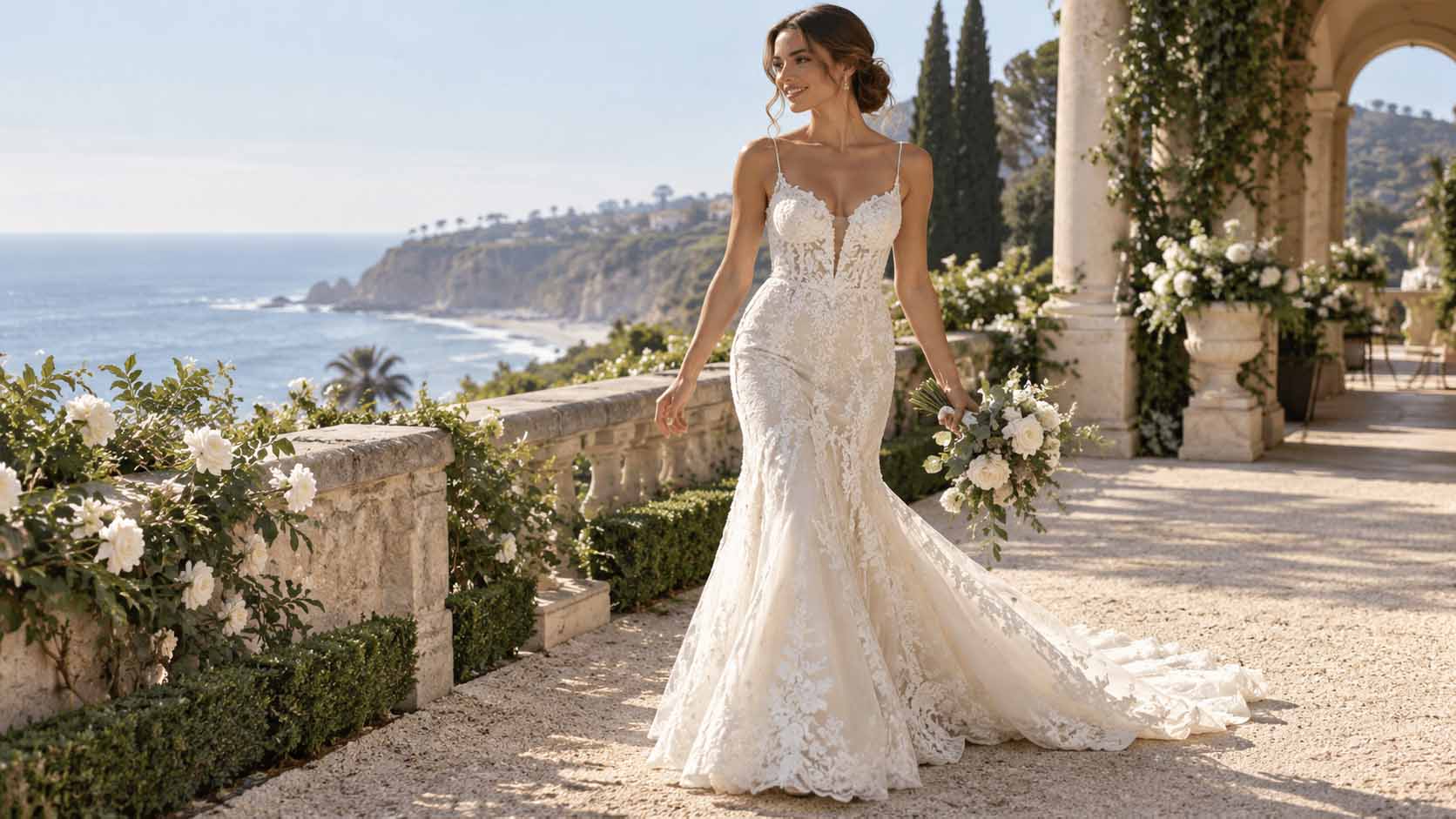
A lace fit-and-flare wedding dress combines two strong bridal design elements: a silhouette that follows the torso and hips before opening into the skirt, and lace that brings pattern, transparency, texture, or dimension to the surface of the gown.
But not all lace fit-and-flare gowns behave the same way.
A soft Chantilly lace gown over stretch lining can feel light and fluid. A heavily appliquéd design over structured corsetry can create a much more sculpted silhouette. Guipure or dimensional lace can change the visual weight of the dress again.
For a bride, the better question is not simply, “Do I want a lace fit-and-flare?”
It is:
What kind of lace, support, flare placement, lining, and construction will give me the look I want while still letting me comfortably walk, sit, hug, and dance?
That is where this guide begins.
What Is a Lace Fit-and-Flare Wedding Dress?
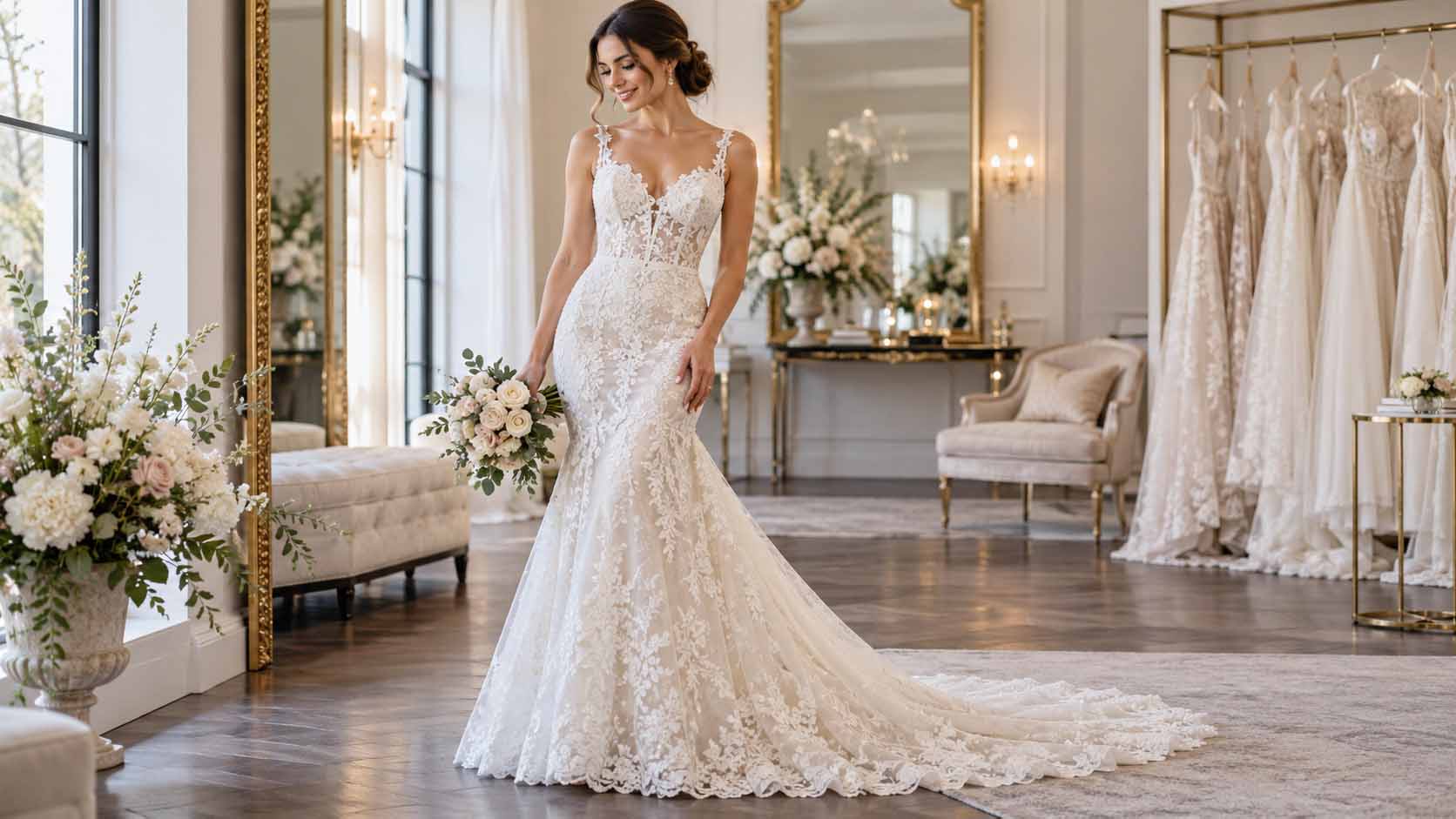
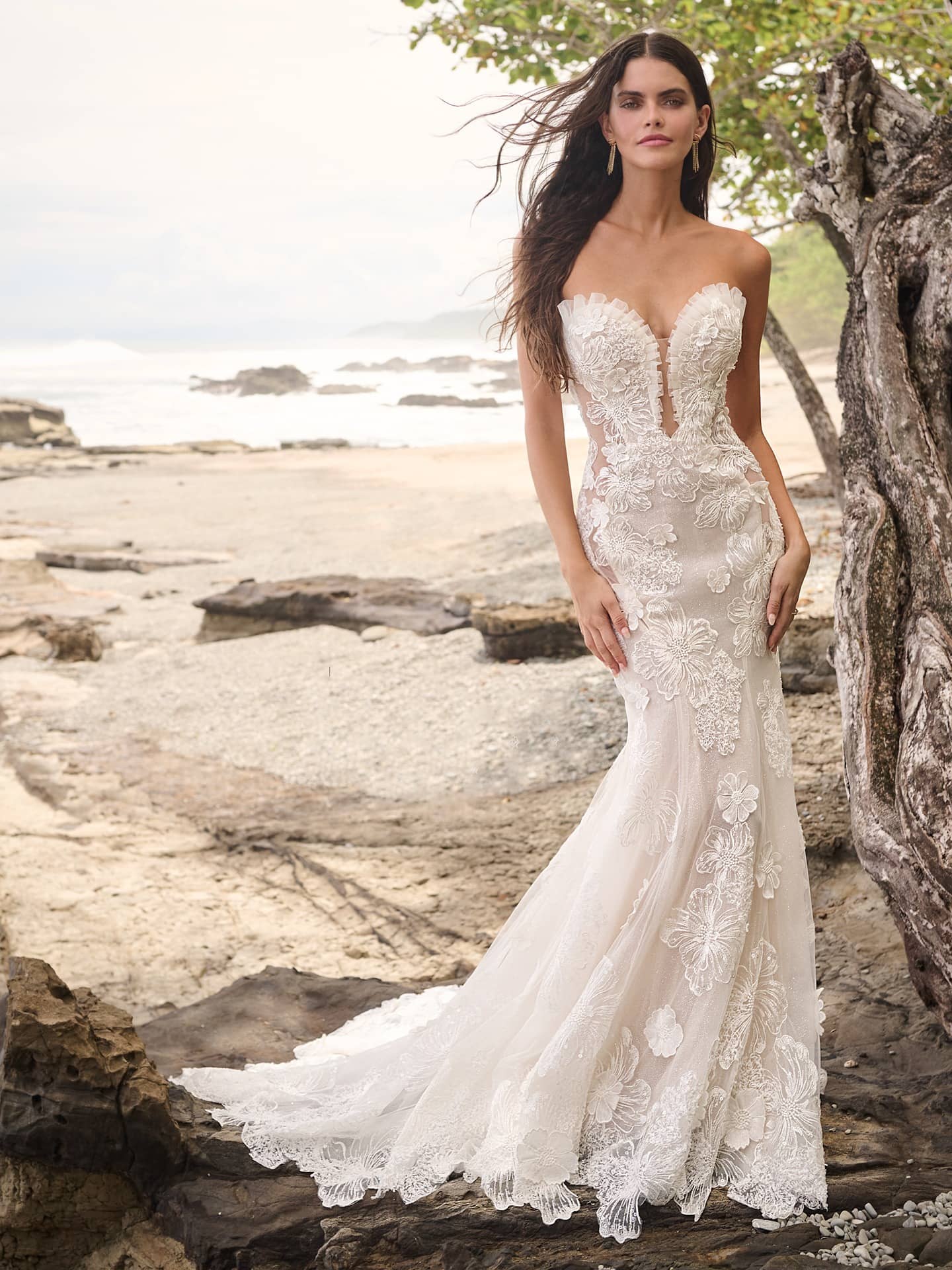
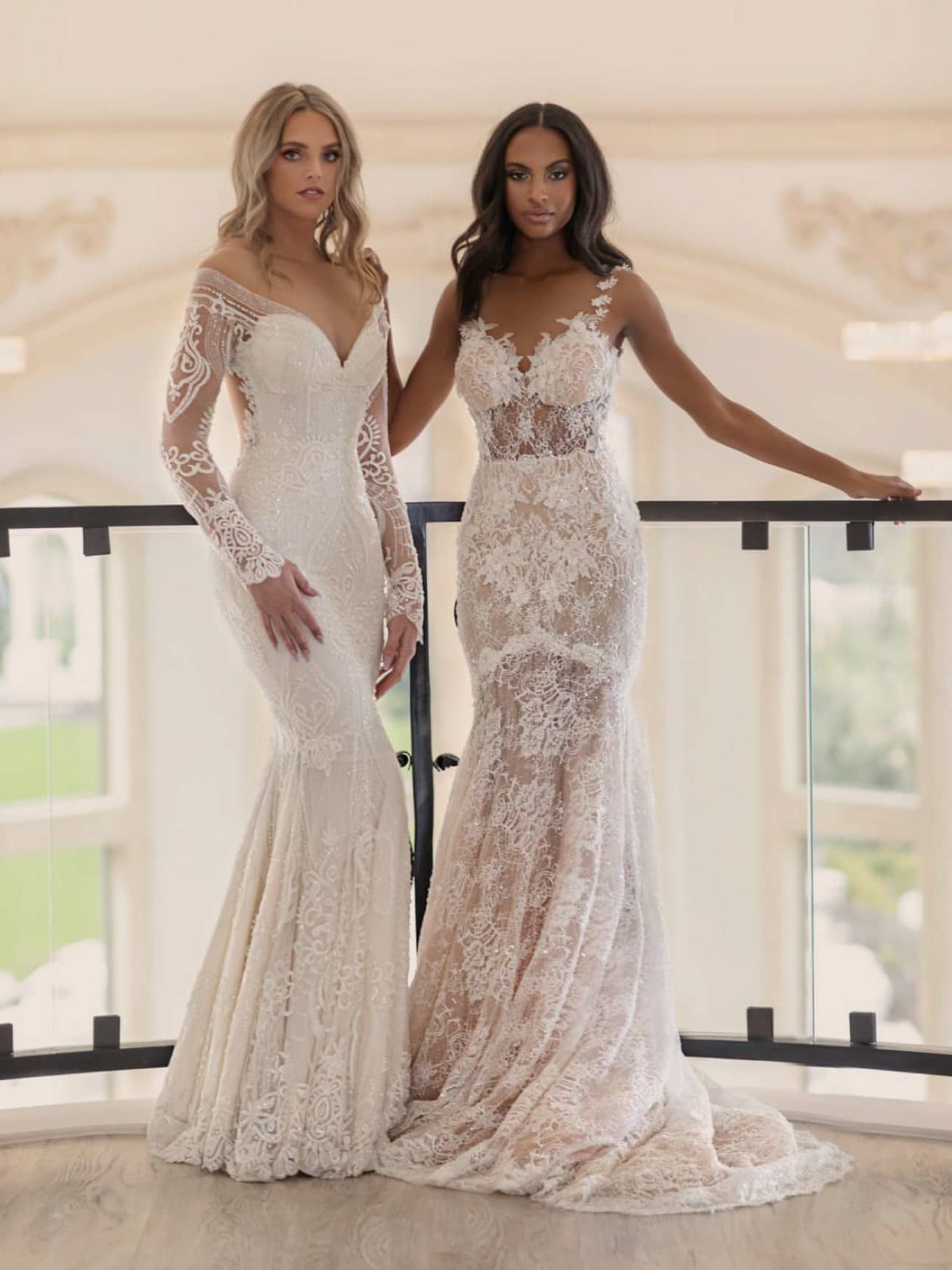
A lace fit-and-flare wedding dress follows the body through the bodice, waist, and hips, then gradually releases into a fuller lower skirt. Lace may cover the entire gown or appear selectively across the bodice, sleeves, back, skirt, or train.
The silhouette generally offers more gradual release and mobility than a strongly sculpted mermaid gown, although exact flare placement varies by designer and pattern. Bridal & Tuxedo Galleria describes fit-and-flare as following the torso and hips before releasing through the lower skirt, while its mermaid silhouettes maintain a closer fit farther down the leg before creating a more pronounced flare.
That distinction matters.
Two dresses can both be labeled “fit-and-flare” while feeling completely different once you walk in them.
Quick Answer: Is a Lace Fit-and-Flare Wedding Dress Comfortable?
It can be. Comfort depends less on the silhouette name and more on where the dress releases, whether the lining stretches, how tightly the hips are fitted, the weight of the lace, and how the bodice is constructed.
A beautiful fitting-room pose tells you very little about how the gown will feel five hours later.
You need to move in it.
Why Lace and Fit-and-Flare Work So Well Together
Lace adds surface interest exactly where a fit-and-flare silhouette creates shape.
Placed thoughtfully, lace motifs can:
- Lead the eye vertically through the torso
- Define the waist without a visible belt
- Continue naturally from bodice to hip
- Soften strong structural seams
- Create dimension across the flare
- Transition into an intricate train
- Add coverage while preserving an illusion effect
- Create contrast between a structured silhouette and a softer textile
This relationship between lace and shape is especially relevant now.
Vogue’s 2026 bridal coverage noted a significant return to lace across New York Bridal Fashion Week, including delicate Chantilly lace, architectural silhouettes, layering, transparency, draping, and unconventional applications. Spring 2027 collections continued that direction.
The result is a useful shift for brides: a lace gown no longer has to mean one particular romantic or vintage aesthetic.
Modern lace can feel restrained, sculptural, sensual, botanical, minimal, textural, or unapologetically couture.
Explore Vogue’s 2026 lace bridal trend report
Start With : Which Lace Type Works Best on a Fit-and-Flare Gown?
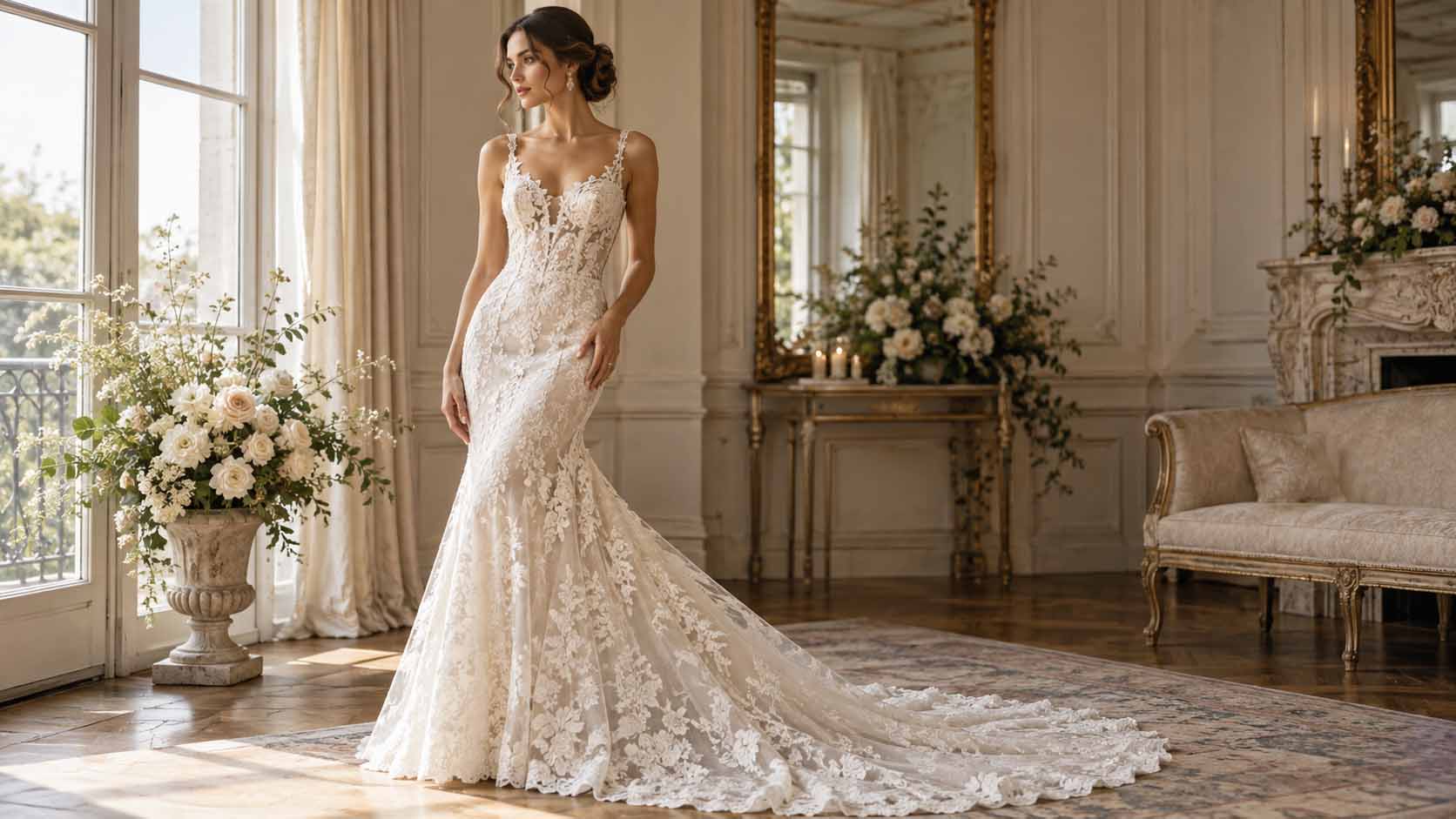
The word lace describes an enormous textile category. Even within bridal fashion, different lace constructions can completely change how a fitted gown looks and moves.
One important note: commercial bridal terminology does not always follow museum-level textile classification precisely. Bridal designers may also combine traditional lace techniques with embroidery, appliqué, machine-made netting, beading, or dimensional motifs.
Chantilly Lace: Soft, Fine and Lightweight
Chantilly lace is one of the most recognizable choices for brides who want delicacy rather than heavy surface texture.
Historically, Chantilly is associated with fine French bobbin lace; examples survive in the textile collection of The Metropolitan Museum of Art.
View historic Chantilly lace at The Metropolitan Museum of Art
In contemporary bridal design, Chantilly-style lace can work beautifully across a fitted silhouette because its fine pattern does not necessarily add substantial visual bulk.
Consider Chantilly lace if you want:
- Fine floral or botanical detail
- A softer surface
- Sheer or illusion elements
- Lace sleeves
- Lightweight layering
- A romantic gown without heavy appliqué
It can be especially effective when the silhouette itself is highly structured: the lace adds softness while the internal construction provides shape.
Alençon-Style Lace: Defined Motifs With More Presence
Alençon-style bridal lace typically creates a stronger pattern than very fine Chantilly lace. Floral or botanical motifs can feel more defined, sometimes with corded outlines that make the design more visible from a distance.
On a fit-and-flare silhouette, placement becomes important.
Large motifs concentrated around the waist and hips create a different proportion from motifs that trail vertically into the skirt.
Best for brides who want: recognizable lace, clear pattern definition, and a balance between traditional bridal texture and structured shape.
Guipure or Venise Lace: Bold, Graphic and Dimensional
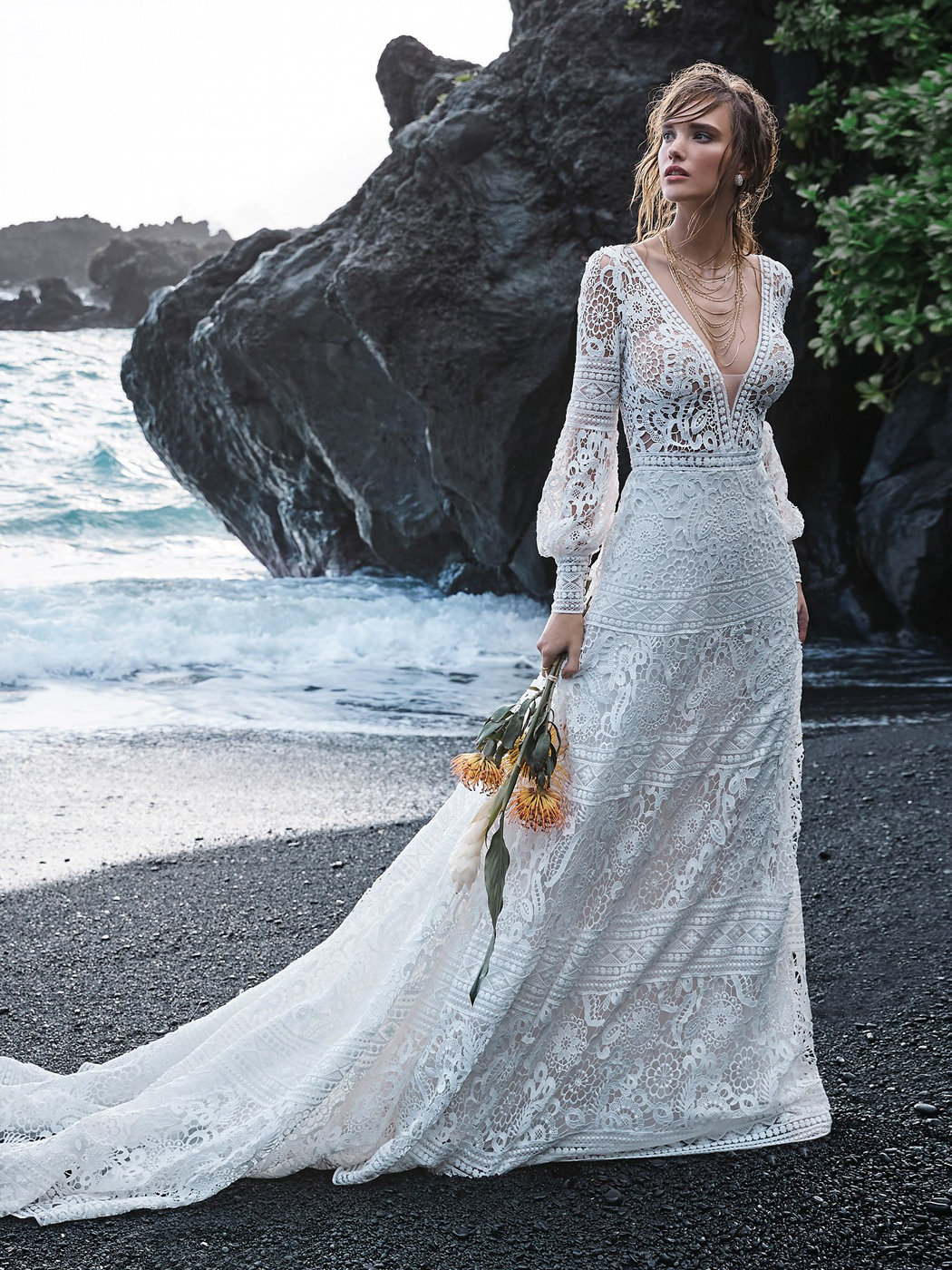
Guipure-style and Venise laces tend to feel denser and more graphic because the motifs themselves create much of the textile’s visual structure.
On a fitted wedding dress, that can produce a striking effect.
The tradeoff is weight.
A dense lace treatment may feel heavier and visually stronger than fine lace over tulle. That does not make it less comfortable automatically, but it makes construction and lining more important.
Consider this direction when you want:
- Strong floral motifs
- Graphic texture
- Defined couture detail
- Less visual transparency
- A gown that photographs with visible surface dimension
Embroidered Tulle: Lace-Like Detail With More Design Freedom
Many gowns brides describe as “lace wedding dresses” actually use embroidery or appliqué placed over tulle.
This gives designers far more control over motif placement.
Flowers can begin densely at the bodice and gradually disappear down the skirt. Leaves can follow princess seams. Embroidery can frame the neckline without covering the entire torso.
For fit-and-flare gowns, this can be particularly effective because the embellishment can be positioned around the architecture of the dress rather than applied as one continuous lace surface.
3D Floral Appliqué: Texture That Changes With Movement
Three-dimensional floral appliqués create a different experience entirely.
Petals and leaves cast small shadows, catch changing light, and move slightly with the body. That makes them particularly effective for photographs and close-up bridal imagery.
But more embellishment also means considering weight, placement, snagging, and how the gown feels when sitting.
A dramatic surface is most successful when it supports the silhouette rather than covering its construction.
Lace Type Comparison for Fit-and-Flare Wedding Dresses
| Lace Direction | Visual Effect | Typical Feel | Movement Consideration | Works Especially Well For |
|---|---|---|---|---|
| Chantilly | Fine, soft, romantic | Light | Usually easier to layer fluidly | Illusion details, sleeves, refined fitted gowns |
| Alençon-style | Defined and traditional | Medium | Depends on backing and appliqué density | Sculpted bodices and visible lace motifs |
| Guipure/Venise | Graphic and dimensional | Medium to heavier | Weight should be evaluated in person | Bold couture texture |
| Embroidered tulle | Customizable and airy | Light to medium | Can transition smoothly into skirt | Strategic motif placement |
| 3D floral appliqué | Dimensional and expressive | Varies | Heavier placement can affect skirt behavior | Editorial and couture-focused gowns |
| Beaded lace | Luminous and detailed | Medium to heavy | Weight matters over several hours | Formal evening and ballroom weddings |
Important: Lace name alone cannot tell you whether a gown will feel light or heavy. The base fabric, lining, boning, beading, appliqué density, train, and number of layers matter just as much.
Does Lace Provide Support in a Fit-and-Flare Wedding Dress?
Usually, the lace itself is not what supports the bride.
Support comes from what is underneath it.
A fitted bridal bodice may rely on some combination of:
- Boning
- Cups
- Structured lining
- Corsetry
- Firm seam placement
- Stable waist construction
- Straps
- Higher back coverage
- Carefully fitted side seams
This is why judging support from a photograph is difficult.
A sheer lace bodice may contain considerable internal engineering. Another gown may look structured but rely primarily on stretch fabric.
How Much Structure Do You Need?
There is no universal answer.
Ask yourself:
How secure do I want my bust to feel?
A bride wanting strong internal support may prefer more boning, a well-fitted cup, or corset-inspired construction.
Do I want a very low back?
A dramatic low back can change the support options available in the bodice.
Is the lace stretchy?
Stretch lace and stretch lining may create easier movement but a different level of compression than firmer construction.
Do I want a sharply defined waist?
More internal architecture may help preserve a sculpted waistline throughout the day.
Is the bodice strapless?
A successful strapless fit depends heavily on the bodice itself rather than simply tightening the top edge.
How heavy is the skirt and train?
A heavy lower gown affects the way the complete dress sits on the body.
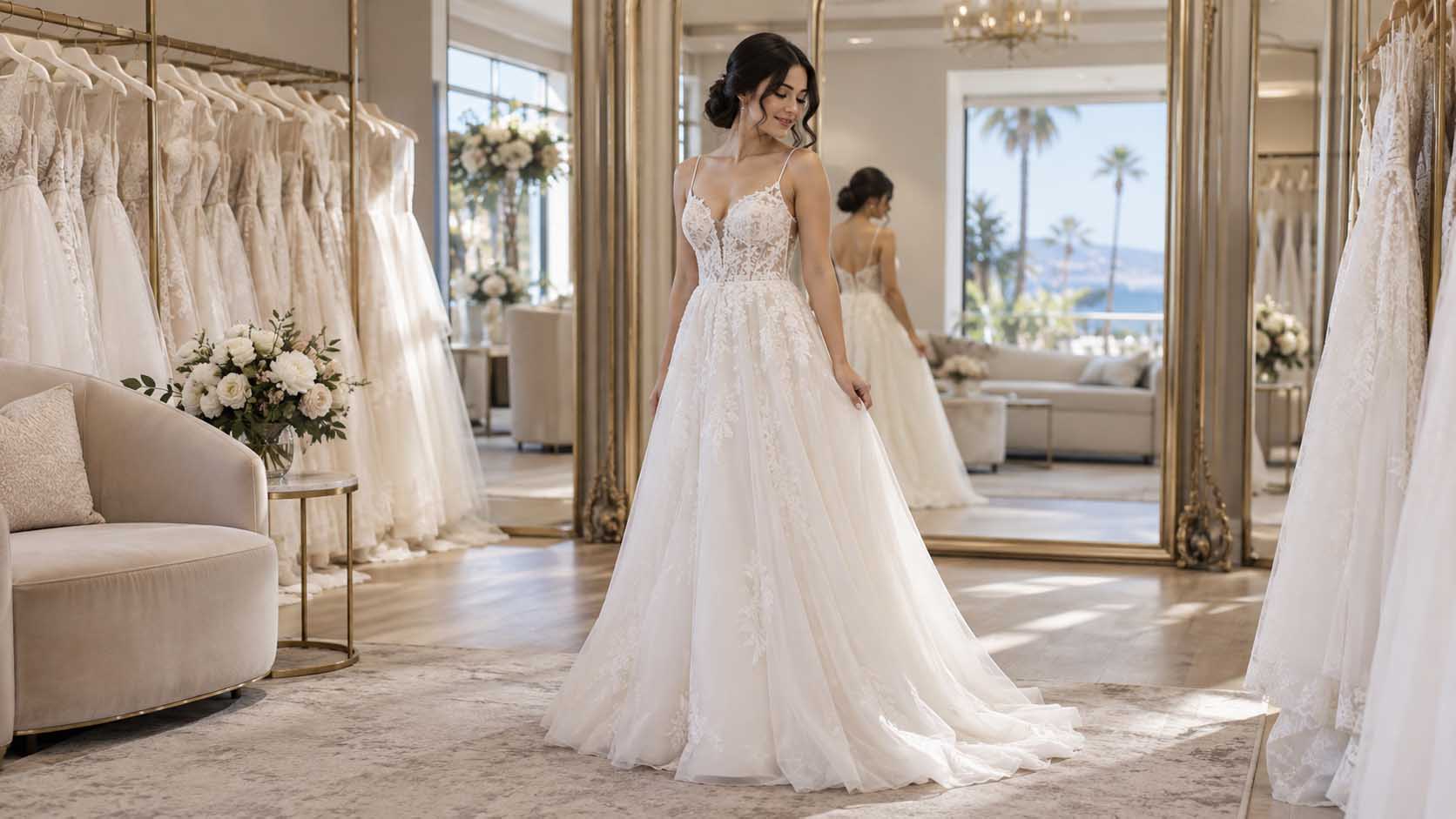
At Bridal & Tuxedo Galleria, brides can evaluate these details during a one-on-one appointment rather than choosing a gown by silhouette name alone. The boutique’s current appointment experience specifically includes comparison of silhouettes, fabrics, necklines, support, movement, designer gowns, couture styles, and the Navid Noor Collection.
Book a private bridal appointment at Bridal & Tuxedo Galleria
How Should a Lace Fit-and-Flare Wedding Dress Fit?
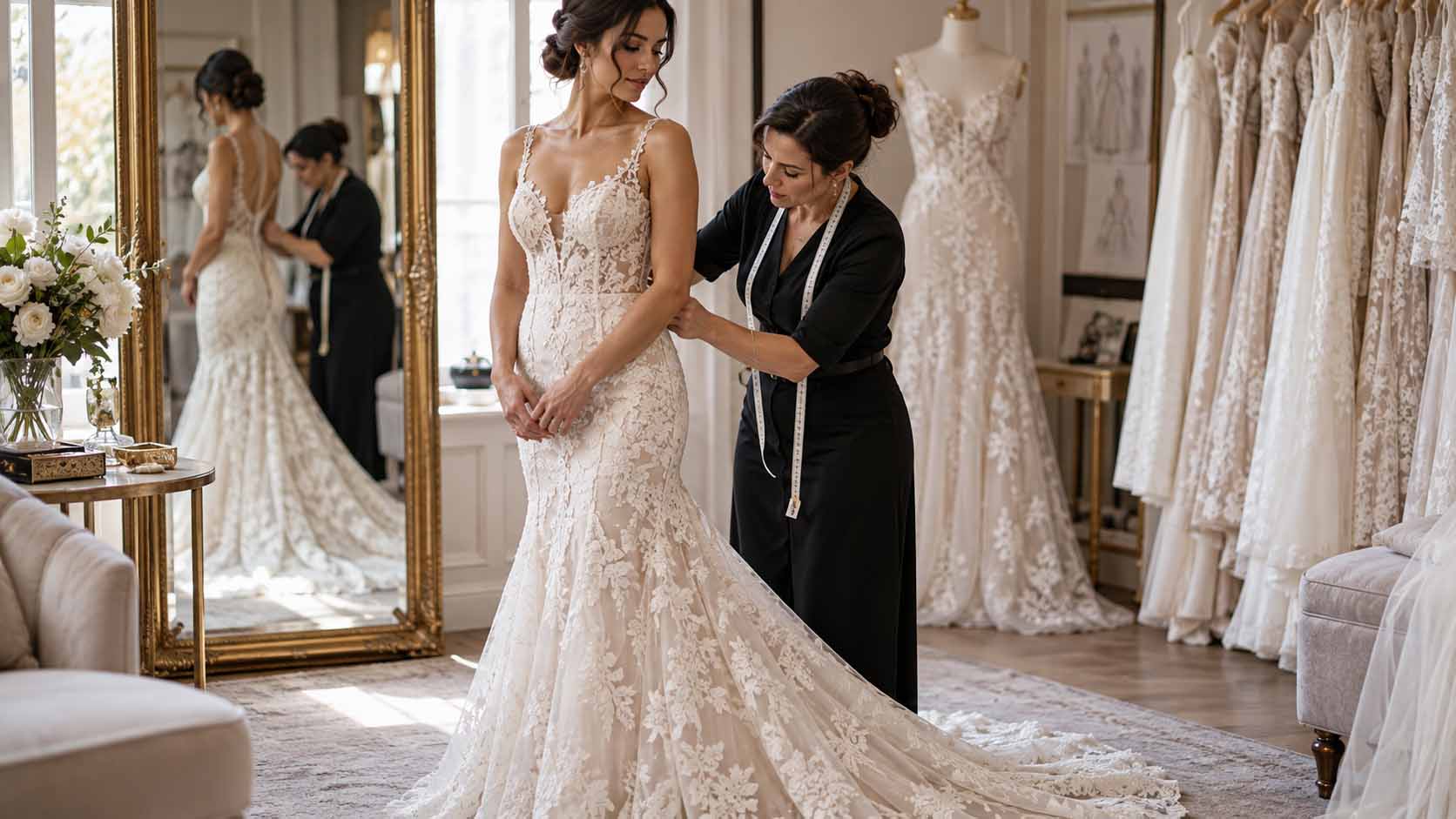
A fit-and-flare gown should follow your shape deliberately without making normal movement feel like a negotiation.
The dress should feel secure through the bodice and intentional through the waist and hips, but the fitting process should also account for breathing, sitting, walking, and dancing.
Watch for four areas.
1. Bust
The bust should sit where the pattern intends it to sit.
Look for:
- Gaping
- Spillage
- Cups positioned too high or low
- A neckline that changes dramatically when you move
- Excessive pressure created only to keep a strapless gown up
2. Waist
The designed waist position should correspond correctly with your proportions.
When a waist seam sits too high or too low, the entire gown can look different even if its circumference is technically correct.
3. Hips
A fitted hip does not need to mean zero movement.
Excessive pulling, horizontal stress lines, or difficulty taking a natural step can signal that the garment needs adjustment.
4. Flare Point
This is one of the most important details in the entire silhouette.
Moving the point where the skirt begins to release can make the dress feel longer, softer, more sculpted, or easier to walk in.
That is why Bridal & Tuxedo Galleria’s fit-and-flare guidance emphasizes proportion and flare placement as part of the overall design rather than treating every fitted gown identically.
Explore fit-and-flare wedding dresses in San Diego and Orange County
Fit-and-Flare vs. Mermaid: Which Gives You More Movement?
The difference is primarily about where and how aggressively the gown releases from the body.
| Fit-and-Flare | Mermaid |
|---|---|
| Typically begins releasing earlier and more gradually | Usually remains fitted farther down the thigh |
| Often creates a softer transition into the skirt | Creates a more dramatic change between fitted body and flare |
| Can provide a wider natural stride | May create a more restricted stride |
| Sculpted but comparatively fluid | Strongly sculpted and dramatic |
The labels are not perfectly standardized across every bridal designer.
Try both.
A soft mermaid may move more easily than an aggressively fitted fit-and-flare from another designer.
The hanger label is less important than what happens when you take ten real steps.
The Bridal Movement Test: Do This Before Saying Yes
A wedding dress is not a photograph.
You will wear it while greeting people, reaching for someone, sitting through dinner, stepping onto a dance floor, and moving through spaces you have never rehearsed in.
When you try on a lace fit-and-flare gown, test it properly.
Walk
Take natural-length steps. Do not automatically shorten your stride to accommodate the dress.
Sit
Sit fully rather than balancing on the edge of a chair.
Notice pressure through the waist and hips.
Raise Your Arms
Imagine hugging someone or dancing.
Watch what happens to the neckline and bodice.
Bend Slightly
You do not need to perform a workout in the fitting room, but you should know whether the bodice remains secure when your torso changes position.
Turn
A heavily embellished train may respond differently from a lightweight lace skirt.
Take a Stair Step
If possible, simulate a step up. This can reveal whether the skirt gives you enough room through the thighs.
Dance
You do not need choreography. Turn, sway, and take several lateral steps.
Your gown should participate in the evening, not prevent you from enjoying it.
BTG’s alterations guidance makes the same broader point: bridal fit is multidimensional, and changes to straps, bodice, waist, hem, or bustle can affect other parts of the dress.
Can a Fitted Lace Wedding Dress Still Feel Soft?
Absolutely.
“Fitted” describes shape. It does not have to describe stiffness.
A lace fit-and-flare dress can combine:
- Stretch lining
- Fine Chantilly lace
- Soft tulle
- Flexible seam construction
- A gradual flare
- Light appliqué
- A fluid train
Or it can combine:
- Firm corsetry
- Dense lace
- Heavy beading
- Multiple layers
- A dramatic train
- Strongly sculpted hips
Both are fit-and-flare gowns.
They simply create different experiences.
That is why fabric and construction should be considered together.
Lined Lace vs. Illusion Lace: Which Should You Choose?
This decision can transform the personality of the same gown.
Fully Lined Lace
Lining creates a more continuous surface and usually reduces visible transparency.
A lining close to the lace color can create a quieter, more unified effect.
A contrasting nude or warm lining can make the lace pattern more visible.
Illusion Lace
Illusion tulle can make appliqué or lace motifs appear to sit directly against the skin.
The quality of the illusion effect depends on:
- Mesh fineness
- Mesh color
- Edge finishing
- Motif placement
- Seam visibility
- Fit
For brides comparing illusion bodices, examine the gown in natural light as well as boutique lighting whenever possible.
A mesh that nearly disappears under one type of lighting may become more visible under another.
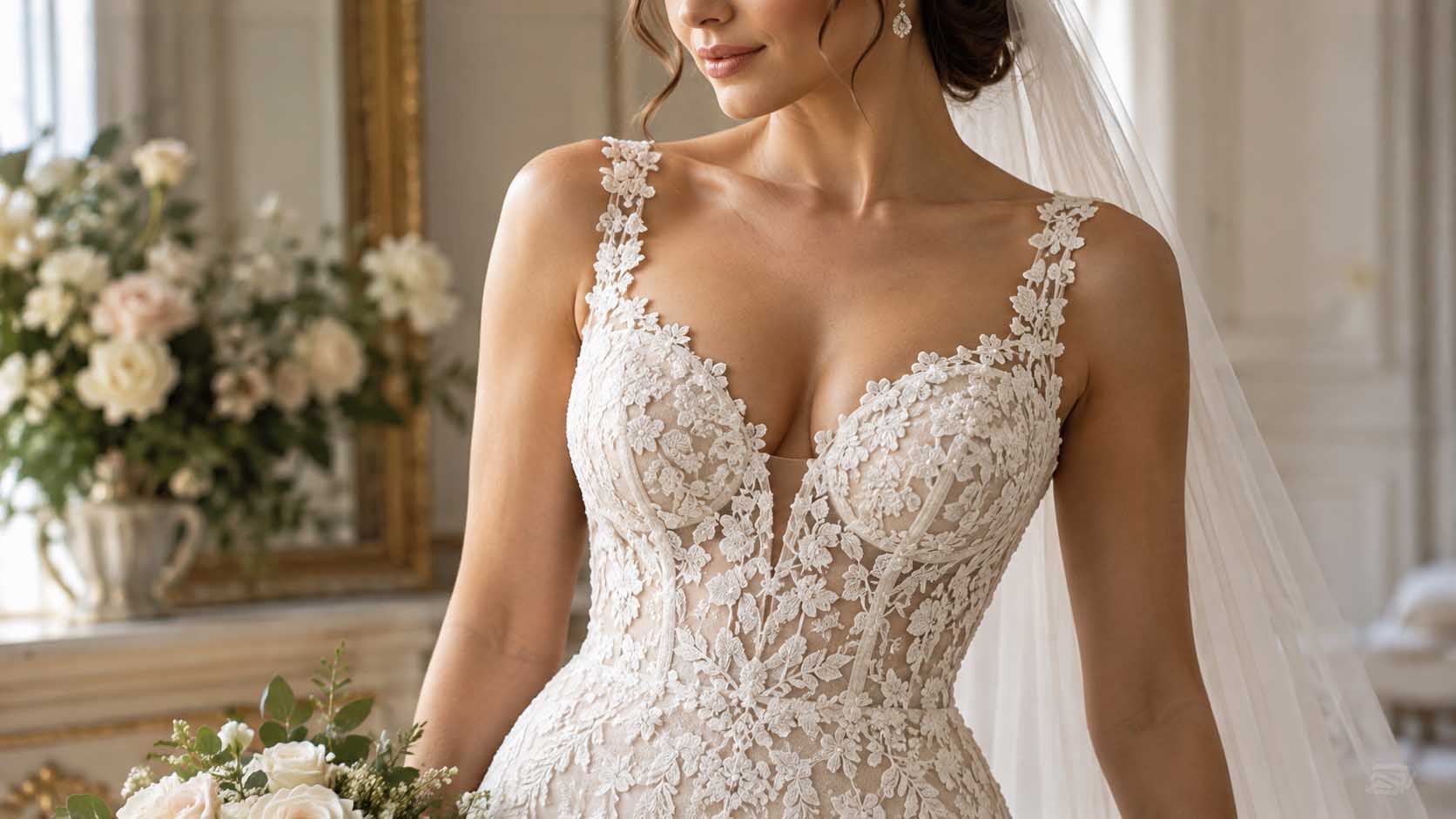
What Necklines Work With Lace Fit-and-Flare Wedding Dresses?
Almost any neckline can work. The decision should relate to the complete gown.
Sweetheart
A sweetheart neckline adds curves at the top of the silhouette and works naturally with corseted lace bodices.
Strapless
A strapless lace fit-and-flare puts more emphasis on the bodice construction and upper edge fit.
V-Neck
A V-neck creates a clear vertical line and gives lace motifs space to frame the neckline.
Square
A square neckline can make romantic lace feel more architectural and contemporary.
Off-the-Shoulder
Lace sleeves or straps can extend the texture of the bodice while creating a broader horizontal neckline.
Illusion
An illusion neckline allows embroidery or appliqué to continue beyond the structural bodice itself.
Do not select a neckline because a body-shape chart declares it “correct.”
Try different widths, depths, straps, and sleeve treatments while looking at the entire silhouette.
What Do You Wear Under a Lace Fit-and-Flare Wedding Dress?
Start with the gown before buying special undergarments.
Many structured wedding dresses already contain cups, boning, lining, or corset-inspired support, and adding an unnecessary bra can alter the intended fit.
Depending on the gown, you may ultimately choose:
- No separate bra
- Sewn-in cups
- Seamless underwear
- Low-profile shapewear
- No shapewear at all
Avoid buying expensive bridal undergarments before your fitting unless your stylist or alteration specialist confirms that they work with the dress.
Bring any undergarment you intend to wear to your alteration appointments so the gown can be fitted with the same foundation you will use on the wedding day.
Can Lace Fit-and-Flare Wedding Dresses Be Altered?
Yes, but lace requires planning.
Bridal & Tuxedo Galleria’s alteration services currently include bodice adjustments, strap changes, neckline reshaping, sleeve additions, corset installation, illusion-mesh resizing, lace appliqué repositioning, structural balancing, hemming, and bustle work.
Explore bridal alterations and in-house tailoring at BTG
Usually more straightforward:
- Refining the bodice fit
- Adjusting straps
- Altering cups
- Hemming
- Resizing certain seams
- Adding or adjusting support
- Repositioning selected appliqués
- Refining illusion mesh
Potentially more complex:
- Moving a major flare point
- Dramatically changing the neckline
- Converting a very low back to substantially higher coverage
- Reshaping a heavily beaded bodice
- Shortening a lace hem with a complex scalloped border
- Reconstructing large sections containing continuous motifs
With lace, the tailor is often doing two jobs: altering the underlying garment and then restoring the visual continuity of the surface decoration.
That is why a technically correct seam is not always enough.
The lace has to look intentional afterward.
Navid Noor’s Design Perspective: Lace Should Follow the Architecture
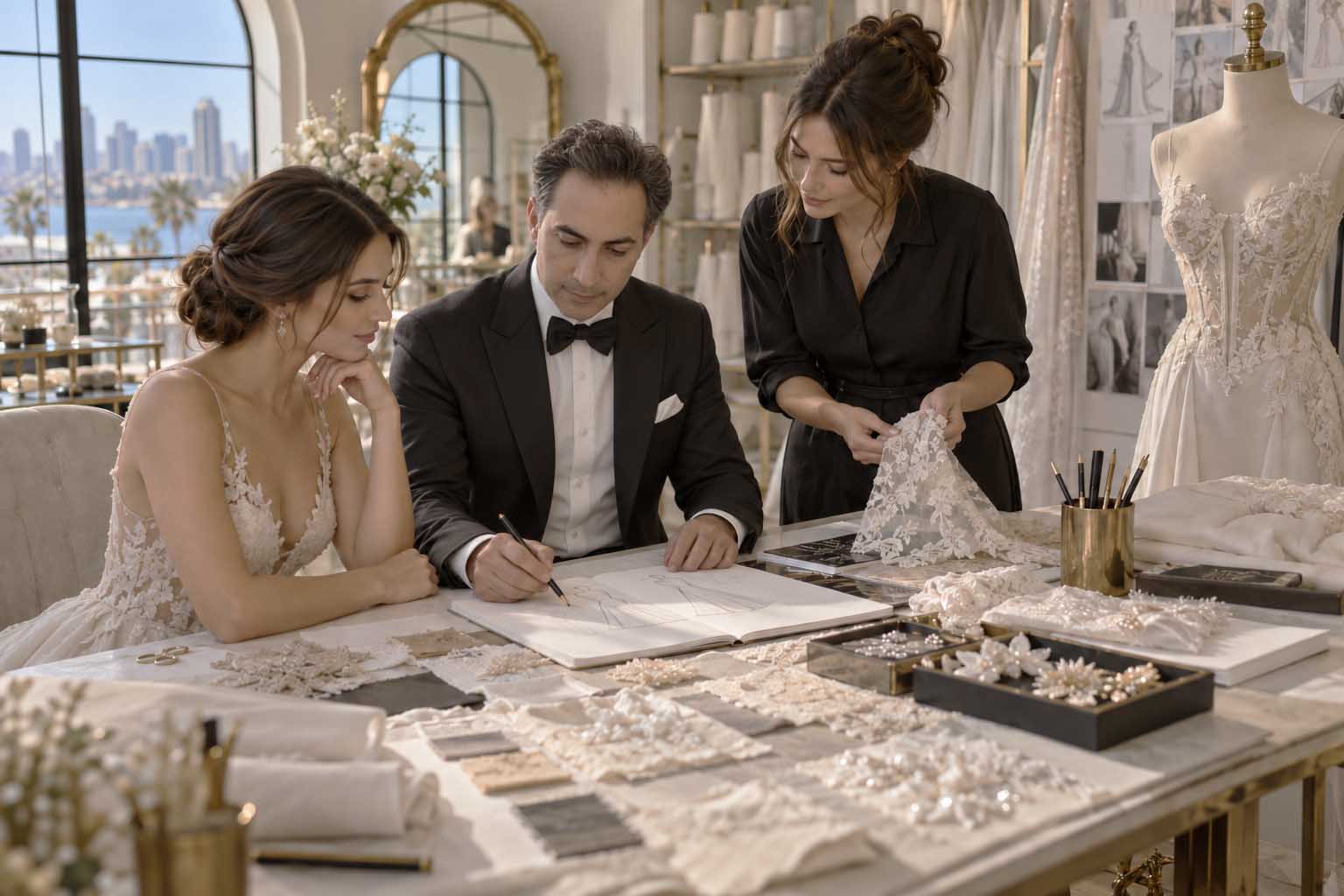
At Bridal & Tuxedo Galleria, Navid Noor, the boutique’s owner and head designer, approaches gowns through proportion, construction, movement, and couture detail. The boutique’s current silhouette and couture materials describe the Navid Noor approach as one in which seam placement, flare placement, bodice structure, fabric, and customization are considered together.
For a lace fit-and-flare gown, that creates an important design principle:
Designer Perspective: Lace should not simply be placed on top of a fitted silhouette. Its scale, direction, density, negative space, lining, and placement should work with the underlying architecture of the gown.
A floral motif running directly across an important seam can interrupt the line.
The same motif carefully repositioned can make the seam nearly disappear.
Dense appliqué at the hips creates a different proportion from a gradual pattern that becomes lighter as it reaches the skirt.
A scalloped edge can finish a neckline beautifully, or make an already detailed area feel crowded.
That is the difference between selecting lace because it looks beautiful on a swatch and designing with lace as part of the gown.
Brides interested in a more individualized version can also explore BTG’s custom wedding-dress process, which includes discussion of necklines, sleeves, bodice construction, waistlines, silhouettes, internal support, fabrics, trains, and embellishment.
Explore custom wedding dresses and Navid Noor couture design
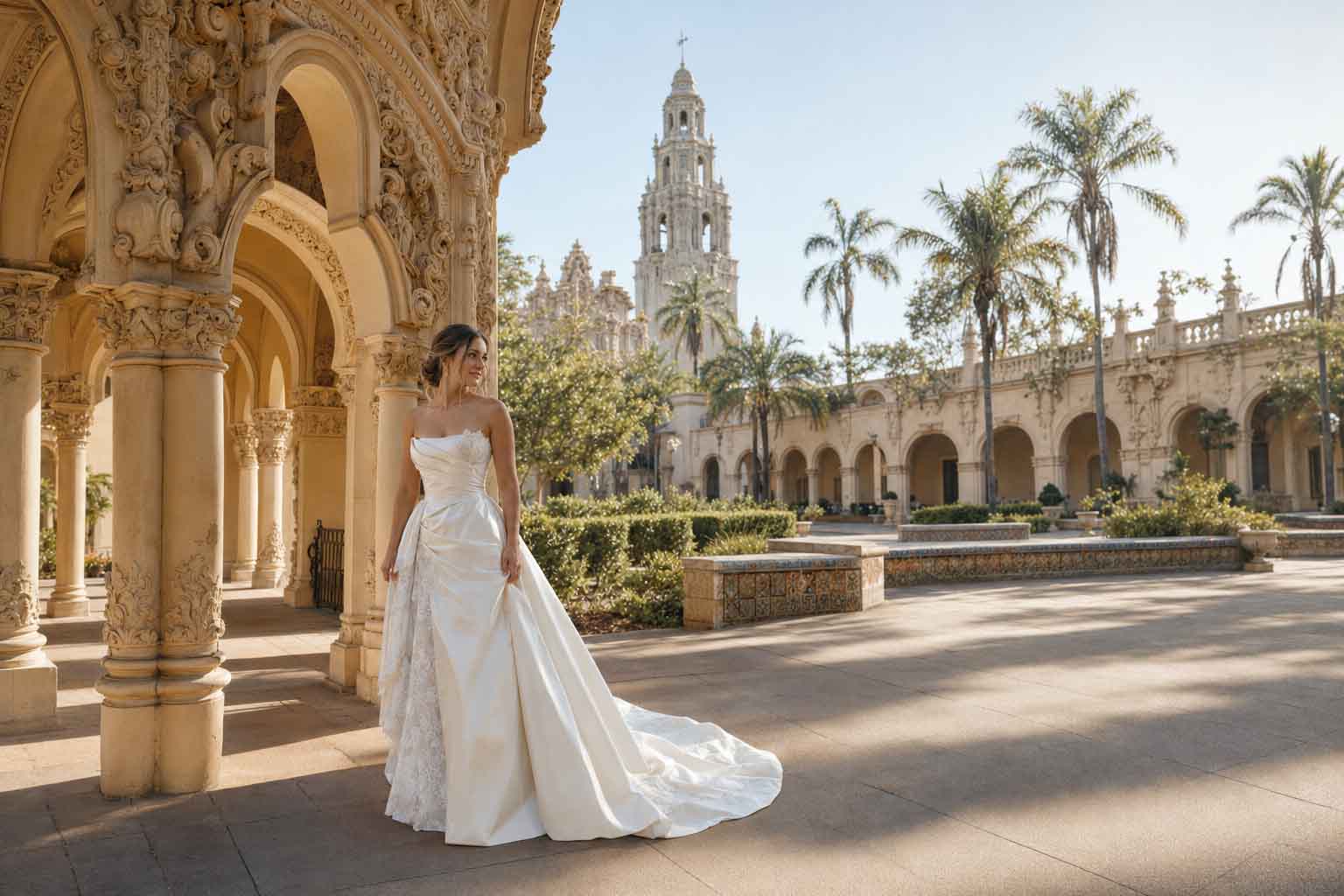
Choosing Lace for a San Diego Wedding
Your venue does not determine your dress, but it can help you evaluate practical details.
Coastal Ceremony
For a La Jolla, Del Mar, Coronado, or other coastal celebration, consider how the skirt behaves outdoors.
A lighter lace-and-tulle construction may move more freely, while a highly embellished train can create greater visual drama but also greater weight.
Garden or Estate Wedding
Botanical lace and dimensional appliqués can echo the setting without requiring the gown to become literal or themed.
Consider how dimensional flowers photograph against landscaped backgrounds.
Formal Ballroom
Dense lace, beading, corsetry, and a longer train can hold their own against a larger interior space and formal evening lighting.
Vineyard or Destination Wedding
Think about transportation, walking surfaces, stairs, heat, and how many hours you expect to remain in the dress.
The most useful question is not, “Is this lace right for my venue?”
It is:
“Will this construction work with the way I will actually spend my wedding day?”
A 60-Second Fit-and-Flare Decision Checklist
Before saying yes, ask:
- Can I walk at my normal pace?
- Can I sit comfortably?
- Does the neckline remain stable when I move?
- Do I like where the flare begins?
- Do I like the lace from both close up and six feet away?
- Does the lining create the level of contrast I want?
- Does the gown feel secure without excessive tightness?
- Can I raise my arms and hug someone?
- Is the train manageable for my venue?
- Will I need different support or coverage?
- Are the alterations I want technically realistic?
- Do I like the side and back views as much as the front?
- Would I still choose this silhouette if social media had never told me it was “flattering”?
That last question matters.
The right gown is not the dress that follows the most rules.
It is the gown whose proportion, construction, movement, and character make sense for you.
Try Lace Fit-and-Flare Wedding Dresses in San Diego
Online photographs can help you identify the lace patterns and silhouettes you like.
They cannot tell you how tightly a dress follows your hips, where the flare hits your body, whether the lining stretches, how secure the bust feels, or whether a dimensional lace train feels light enough to wear all evening.
That information comes from the fitting room.
Established in 1994, Bridal & Tuxedo Galleria has more than 30 years of bridal experience in San Diego and offers designer wedding dresses, exclusive Navid Noor collections, one-on-one bridal styling, custom-design options, and professional in-house alterations.
During a bridal appointment, compare more than dresses.
Compare:
Fine lace vs. dimensional lace.
Stretch vs. structure.
Soft fit-and-flare vs. sculpted fit-and-flare.
Strapless vs. supported necklines.
Earlier vs. lower flare points.
Light trains vs. dramatic trains.
The difference may be obvious the moment you begin moving.
Your Lace Should Be Beautiful. Your Gown Should Also Work.
If you are searching for lace fit-and-flare wedding dresses in San Diego, schedule a private bridal appointment at Bridal & Tuxedo Galleria.
Explore designer gowns, the Navid Noor Collection, custom possibilities, and alteration options with a team that can evaluate the entire dress—from lace placement and corsetry to flare position and movement.
Schedule your Bridal & Tuxedo Galleria appointment
Frequently Asked Questions About Lace Fit-and-Flare Wedding Dresses
What is a lace fit-and-flare wedding dress?
A lace fit-and-flare wedding dress follows the torso, waist, and hips before gradually opening into a fuller lower skirt. Lace may cover the entire gown or appear as appliqué, embroidered tulle, sleeves, illusion panels, or train detailing. Exact flare placement and fit vary by designer, so movement should always be tested in person.
Are lace fit-and-flare wedding dresses comfortable?
They can be very comfortable when the flare placement, hip fit, lining, and bodice construction allow natural movement. A stretch-lined fit-and-flare may feel substantially different from a heavily boned or beaded design. Walk, sit, turn, raise your arms, and take dance steps before judging comfort.
How should a fit-and-flare wedding dress fit?
A fit-and-flare gown should feel secure through the bodice and intentionally shaped through the waist and hips without excessive pulling or restricting a normal stride. The bust should remain properly positioned, and the flare should begin at a point that creates the proportion and mobility you want.
What is the difference between a fit-and-flare and mermaid wedding dress?
A fit-and-flare generally releases from the body more gradually, while a mermaid gown typically remains closely fitted farther down the thigh before creating a stronger flare. Designer terminology varies, so compare actual flare placement and movement instead of choosing based only on the silhouette label.
Which lace is best for a fit-and-flare wedding dress?
There is no single best lace. Fine Chantilly lace can create softness and lightness; Alençon-style motifs provide stronger definition; guipure or Venise lace creates bolder texture; embroidered tulle allows strategic motif placement; and 3D appliqué creates visible dimension. Choose based on the gown’s structure, movement, venue, and desired aesthetic.
Can lace fit-and-flare wedding dresses have sleeves?
Yes. Lace fit-and-flare gowns can work with fitted long sleeves, illusion sleeves, cap sleeves, detachable sleeves, off-the-shoulder treatments, or removable straps. Sleeve construction should be tested for arm mobility, especially if the lace or embroidery has limited stretch.
What should I wear underneath a lace fit-and-flare wedding dress?
First evaluate the gown’s built-in structure. Many bridal gowns already include cups, boning, lining, or corset-inspired support. You may only need seamless underwear or low-profile shapewear. Bring planned undergarments to your alterations fittings so the gown is tailored over the same foundation you will wear on the wedding day.
Can a lace fit-and-flare wedding dress be altered?
Yes. Common alterations include bodice shaping, strap adjustments, cup changes, hemming, neckline refinements, illusion-mesh work, and appliqué repositioning. Major structural changes can be more complicated because lace motifs must often be removed and replaced after the underlying seam is altered.
Is a lace fit-and-flare wedding dress suitable for a beach wedding?
It can be. For a beach or coastal wedding, focus on weight, train length, skirt mobility, lining, and lace density rather than the silhouette alone. A lightweight lace fit-and-flare can work beautifully outdoors, while a heavily beaded or multi-layered version may require more consideration for walking and handling.
Where can I try lace fit-and-flare wedding dresses in San Diego?
Bridal & Tuxedo Galleria in San Diego offers fit-and-flare gowns from established bridal designers alongside exclusive Navid Noor designs, custom options, private styling, and in-house bridal alterations. A bridal appointment allows you to compare lace, structure, flare placement, support, and movement before selecting a gown.
Final Thought: Choose the Lace, Then Test the Architecture
The strongest lace fit-and-flare wedding dresses succeed because texture and structure are working together.
Beautiful lace gets your attention.
But the bodice keeps you secure. The seam placement establishes proportion. The lining changes the lace’s character. The flare controls movement. And tailoring makes all of those pieces work on your body rather than on a mannequin.
That is why the final decision should happen in motion.
Walk in the gown. Sit in it. Turn around. Look closely at the lace. Then step several feet away from the mirror and look at the entire silhouette.
If the lace feels expressive, the structure feels secure, and the dress still feels like you when you begin moving, you are much closer to the answer that matters.
For brides in San Diego, Orange County, and throughout Southern California, Bridal & Tuxedo Galleria offers the opportunity to explore that relationship between lace, construction, fit, and couture design through designer collections, Navid Noor couture, custom options, and professional bridal tailoring.
Explore Bridal & Tuxedo Galleria’s San Diego bridal boutique

Author bio :
Kayla brings more than 10 years of hands-on experience in bridal fashion and boutique styling, specializing in personalized bridal consultations and luxury client experiences. As the manager of the San Diego location of Bridal and Tuxedo Galleria, she is known for her keen eye for detail, deep understanding of couture wedding dress design, and ability to guide brides toward a gown that reflects their unique vision and wedding aesthetic. Her approach blends fashion expertise with genuine care, ensuring every bride feels confident, understood, and unforgettable on her wedding day
Call Now

Your Personalized Wedding Dress Shopping Experience in San Diego With over 30 years of styling expertise, our dedicated team is passionate about helping you find the perfect wedding dress and tuxedo.

Leave a Reply