
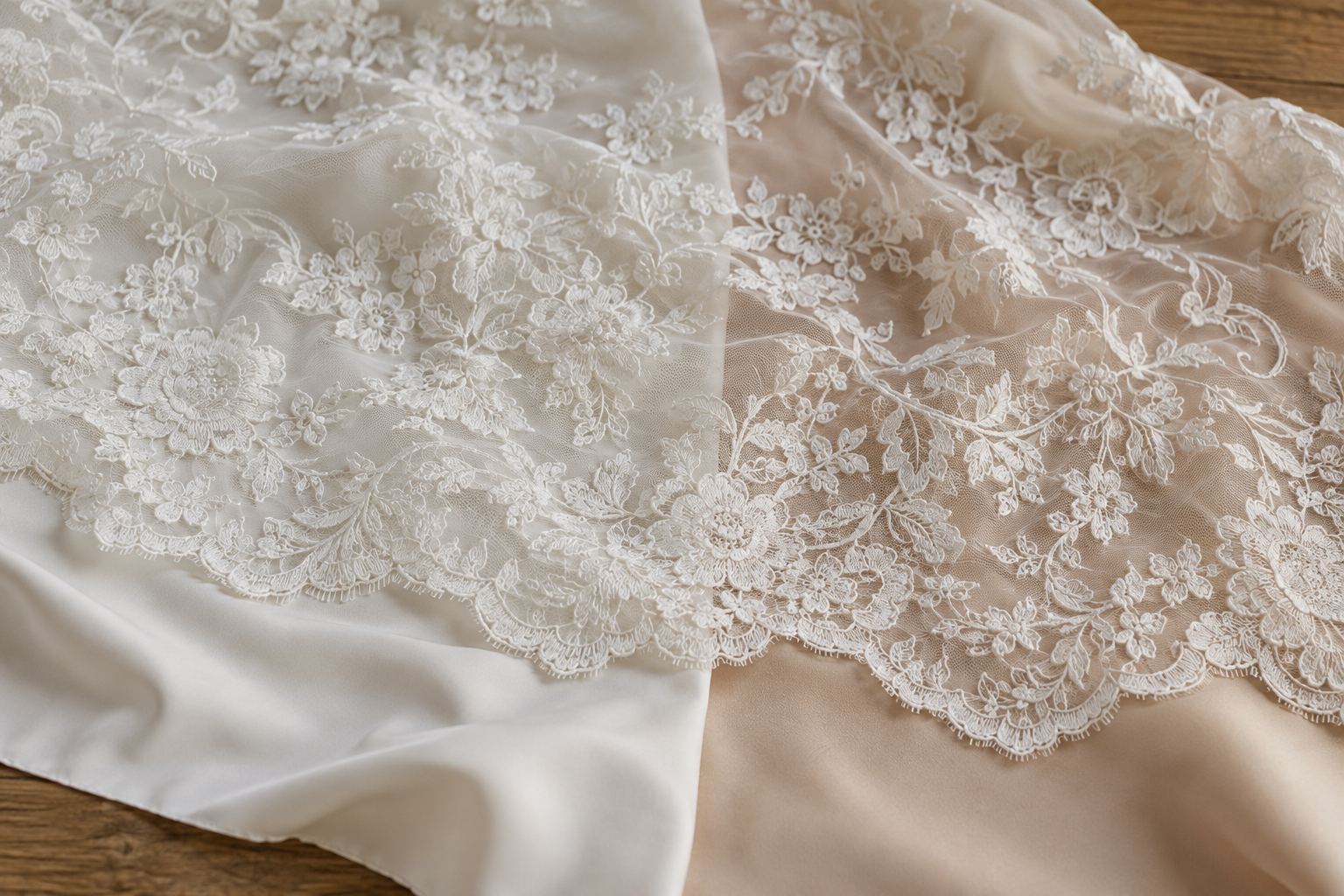
What Type of Lace Is Best for a Wedding Dress? 7 Lace Styles Explained
There is no single best type of lace for a wedding dress. Fine Chantilly offers delicate surface detail, Alençon-style lace gives floral motifs clearer outlines, and guipure creates bolder openwork. Your best choice depends on the appearance you love and the complete gown’s construction. Lining, fabric layers, bead density, and internal structure can change how any lace dress feels, covers, supports, and moves.
What does “type of lace” mean when shopping for a wedding dress?
Bridal shopping vocabulary combines traditional lace names, fabric constructions, and decorative treatments. A dress might have a Chantilly base, applied floral motifs, scattered beads, and dimensional petals. Those descriptions can all refer to the same gown.
Start by separating the surface you see into three parts:
- Base: the underlying material, such as tulle, fine net, or an allover lace fabric.
- Pattern: flowers, leaves, dots, or geometric shapes formed within the lace or embroidered onto a base.
- Added decoration: separate motifs, beads, sequins, or fabric petals attached to the surface.
Lace and embroidered tulle can look similar, but they do not always describe the same textile construction. Embroidery decorates an existing fabric; lace terminology also includes specific openwork structures and techniques. Some embroidered net textiles are classified as lace, while other embroidered fabrics are better described by their base and decoration.
Allover lace creates a continuous patterned surface. Placed appliqué uses individual decorative pieces attached in selected areas. Appliqué describes an application method, and it can sit flat or project from the gown.
As you browse our lace wedding dress collection, save photographs of the details you like. You do not need to identify the textile perfectly before trying it on.
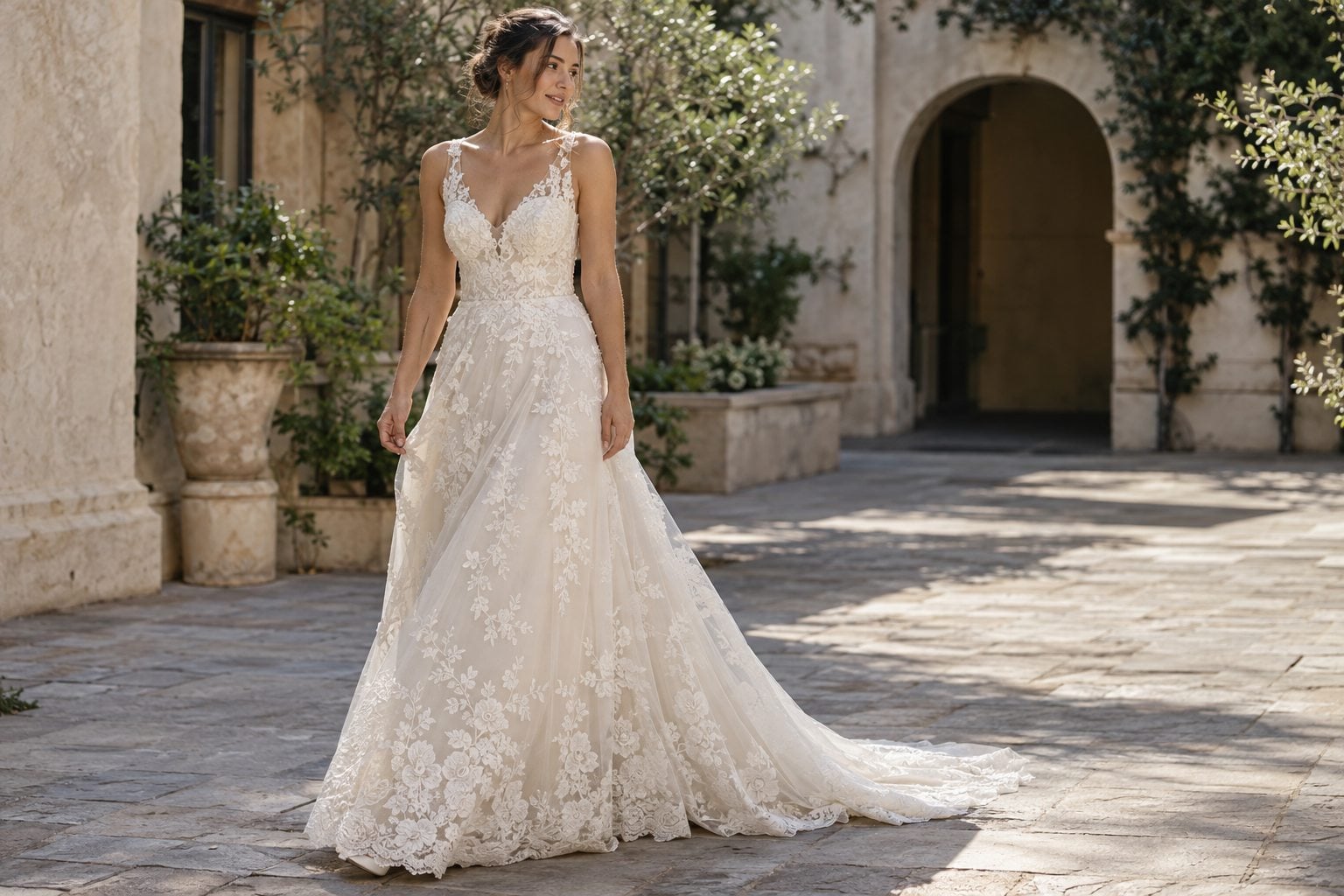
A quick comparison of seven bridal lace styles
| Style or treatment | How to recognize it | Visual effect | What to check when trying it on |
|---|---|---|---|
| Chantilly lace | Fine motifs against a sheer net ground | Delicate pattern with subtle surface relief | Whether layers and lining preserve the detail you like |
| Alençon and Alençon-style lace | Defined motifs, often with raised corded outlines in bridal fabrics | Clear floral shapes and visible edges | Cord placement at seams, neckline, and skin contact points |
| Guipure lace | Motifs connected by bars or bridges, without a continuous net ground | Bold open spaces and distinct shapes | Backing, coverage, and how the openwork behaves when seated |
| Point d’esprit | Small dots spaced across net or tulle | A restrained dotted texture | Dot visibility, overlapping layers, and mesh shade |
| Embroidered tulle | Threadwork stitched onto a visible mesh base | Floating flowers, vines, or geometric designs | Embroidery density, mesh visibility, and sleeve flexibility |
| Beaded lace | Beads, pearls, crystals, or sequins decorating lace | Shimmer, highlights, or a textured finish | Added weight and embellishment touching your arms |
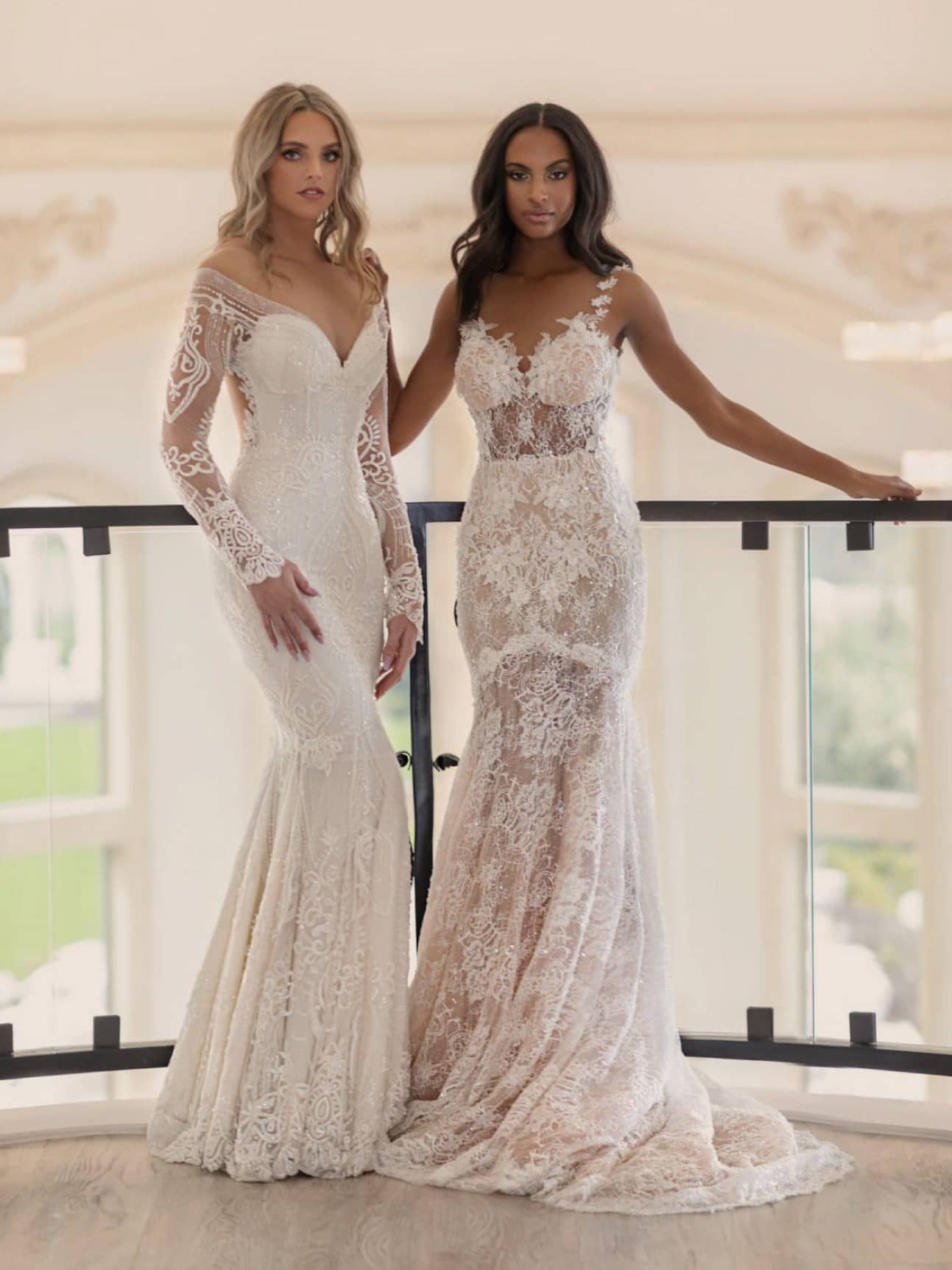
| Three-dimensional floral lace and appliqué | Petals or decorative pieces lifting from the surface | Raised flowers, shadows, and sculptural detail | Contact with your veil, arms, and folded train |
The seven lace styles and treatments explained
1. Chantilly lace
Chantilly is associated with fine floral patterns on a sheer net ground. Its detail often appears like a drawing in thread, with shaded areas and delicate spaces between motifs. Compared with strongly corded bridal lace, its surface typically has less pronounced relief.
It can form an allover overlay, a sleeve, a bodice layer, or a border on a train. Over a similarly colored lining, the pattern can look understated. A contrasting lining may make the flowers easier to distinguish.
That delicate appearance does not tell you how the finished dress will feel. Multiple underskirts, a firm bodice, or added appliqué can substantially change the experience. Examine one layer, then look at the complete gown from a few steps away.
Ask your stylist: “Is the fine lace I’m noticing the main surface, or is it underneath another decorative layer?”
2. Alençon lace and Alençon-style lace
In contemporary bridal descriptions, Alençon-style lace commonly means floral lace with clearly defined, often corded outlines. The raised thread traces the motifs, helping individual flowers and leaves remain visible against the background.
Historical handmade point d’Alençon is a specific needle-lace tradition. A modern gown described as “Alençon lace” does not, by that wording alone, establish handmade production or French origin. Ask for the designer’s fabric description if those details matter to you.
Outlined motifs can frame a neckline, finish sleeves, or continue across a bodice and skirt. Run your attention along the edges: does a cord sit near the underarm, and how does that area feel as you move? Compare the definition close up with its appearance across the room.
A useful question is: “How does the designer describe this lace, and which details create its raised outline?”
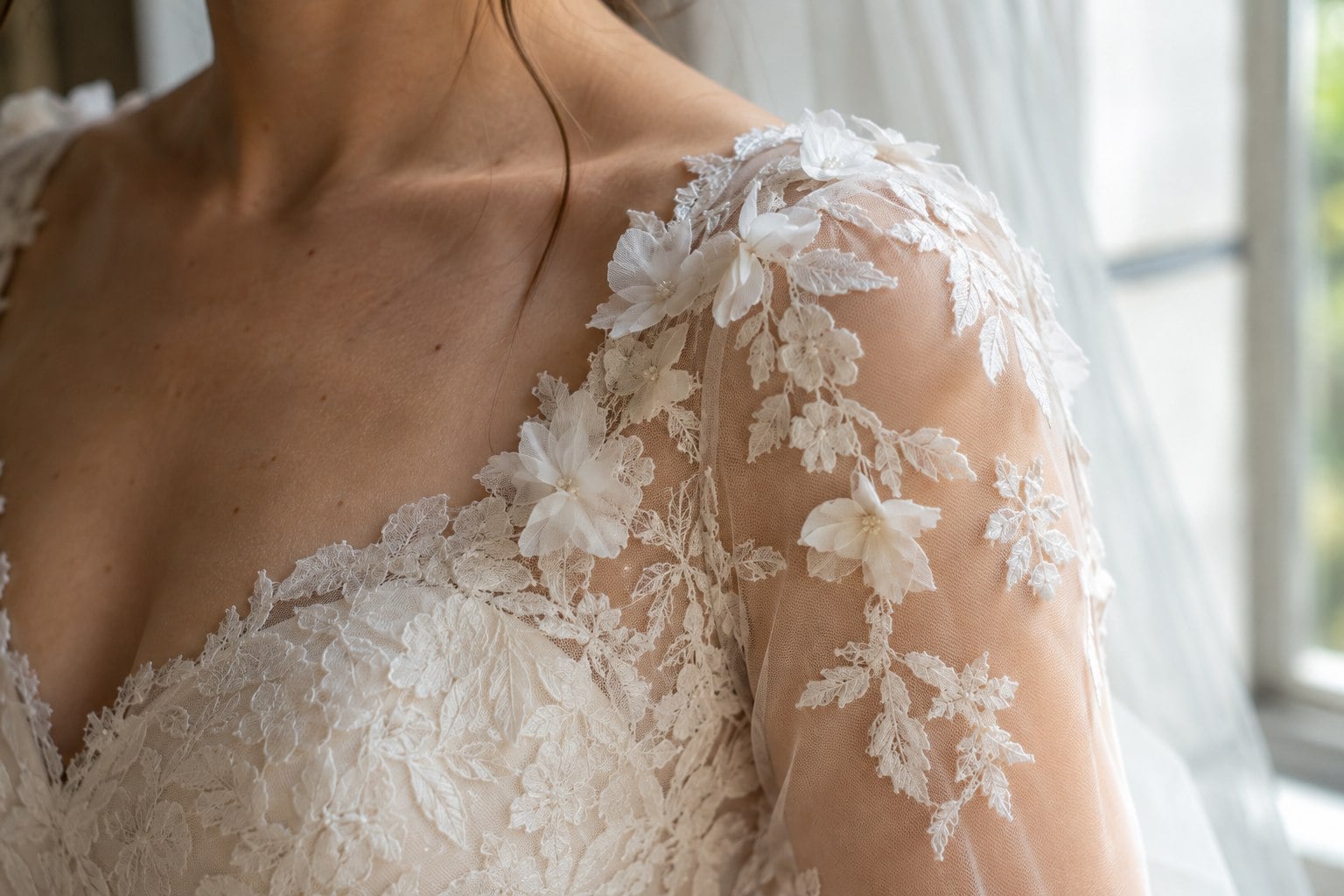
3. Guipure lace, including some fabrics called Venise
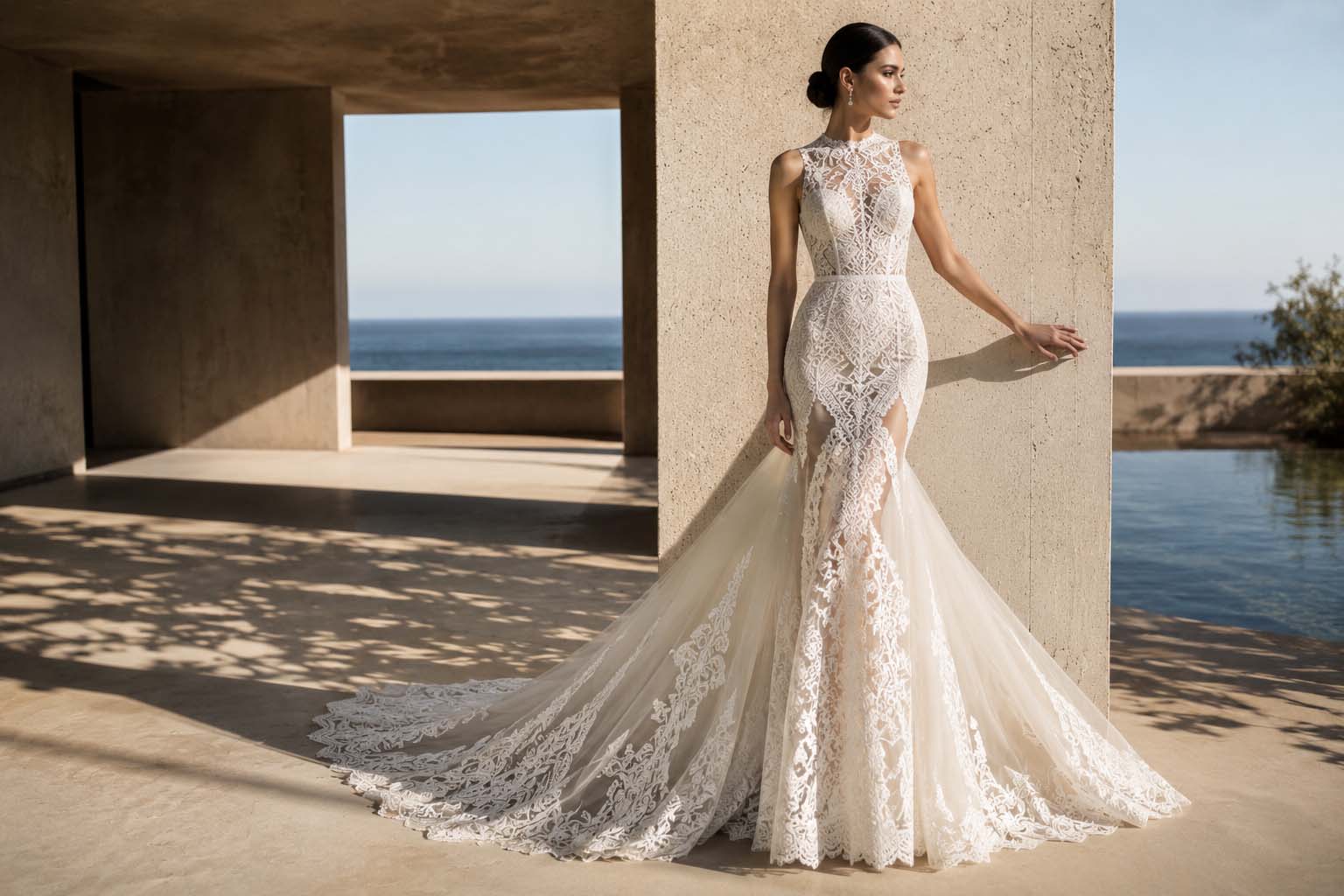
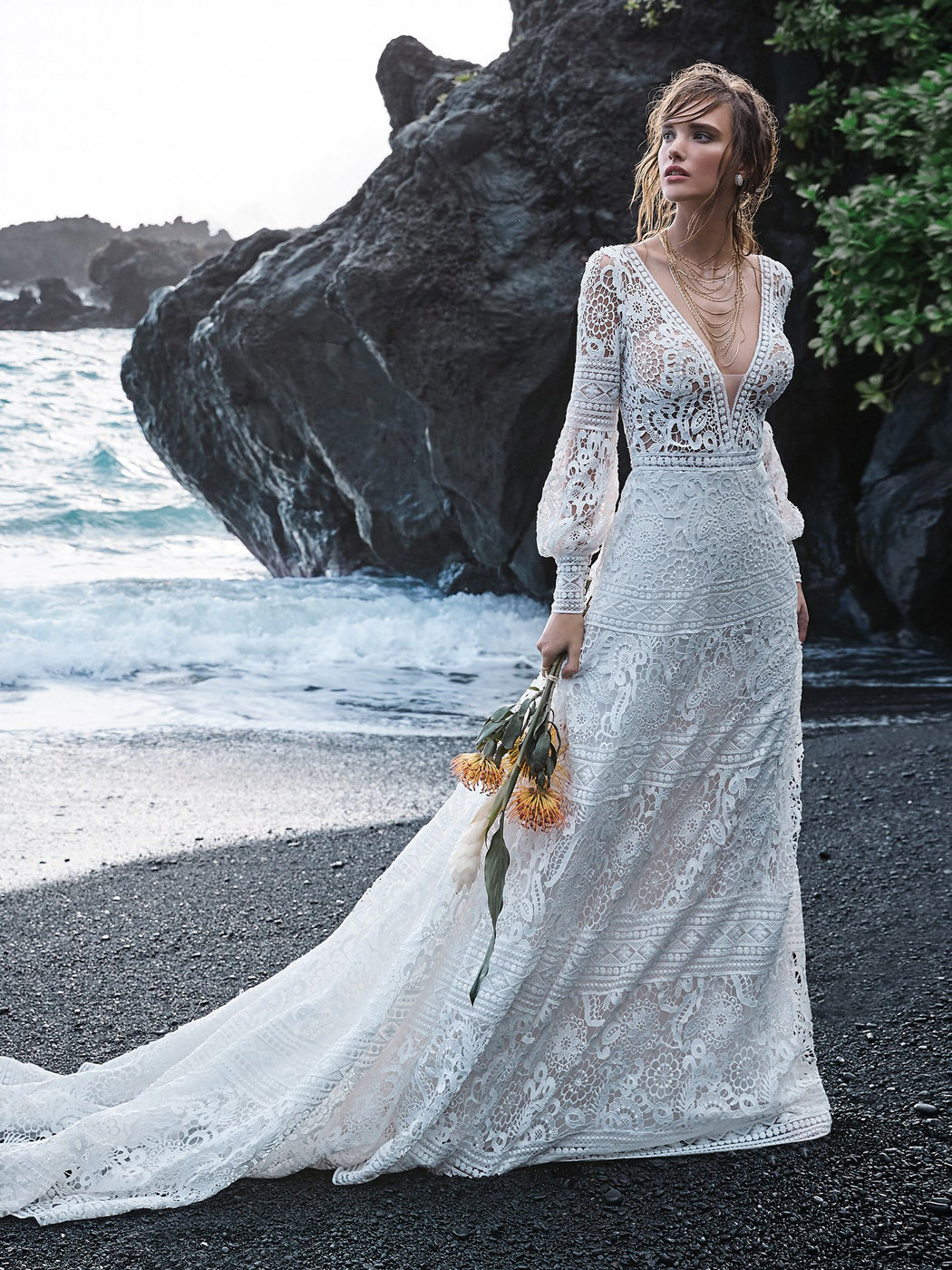
Guipure is recognizable by motifs connected through bars, bridges, or similar links rather than a continuous net background. The open spaces are part of its character. Floral or geometric shapes can read distinctly even when the thread matches the lining.
You may encounter “Venise,” “Venice,” or “Venetian” in descriptions of related bridal openwork. These names overlap in commercial usage, but they do not identify one universal construction. Not every guipure fabric is the same kind of Venise lace, and the label alone does not establish its production method or origin.
Guipure can appear in a bodice, overlay, sleeve, or train. Inspect what lies behind it: a sheer backing, opaque lining, or exposed skin changes the result. Sit down to see how larger openwork sections settle.
Ask: “What supports this openwork, and which areas will remain sheer?”
4. Point d’esprit
Point d’esprit is dotted net or tulle, often grouped with bridal lace. Its distinguishing feature is the small repeated dot, rather than an elaborate floral motif. The effect can be quiet and graphic, particularly when the dots are widely spaced.
It may appear in an overlay, sleeves, an illusion neckline, or a layer beneath larger floral details. Look closely to distinguish actual dots from tiny beads or scattered sequins, since those decorations create different surfaces.
Also examine layered areas. Dots may appear denser where fabric overlaps, while the underlying mesh may become more visible against certain lining or skin shades. The name does not mean the fabric sparkles; any shimmer comes from its particular materials or embellishment.
Ask your stylist: “Can I see this dotted layer on its own and over the lining used in the dress?”
5. Embroidered tulle and embroidered lace looks
Embroidered tulle has decorative stitching worked onto an existing tulle base. The thread may create scattered blossoms, dense leaves, or long branching patterns. Bridal descriptions frequently call these surfaces “embroidered lace,” although not every embroidery on tulle is technically identical to a traditional lace construction.
Look between the motifs. You may see the mesh carrying the threadwork, especially on sleeves, a sheer back, or a train. The pattern can become sparse in one area and dense in another, allowing the decoration to transition across the gown.
Evaluate both components. A fine mesh can still carry substantial embroidery, and a seemingly open sleeve may have dense stitching at the elbow or cuff. Bend your arms and notice where the fabric pulls or touches your skin.
Ask: “Which parts are embroidered directly onto the tulle, and which are separately applied motifs?”
6. Beaded lace
Beaded lace is lace decorated with beads or related embellishments. It is a surface treatment that can accompany several lace styles. A fine floral base might carry a few pearls, while a densely decorated bodice may combine beads, crystals, and sequins.
Their effects differ. Some embellishments catch light sharply; others add a quieter texture. Beading can outline flowers, concentrate around the bodice, or continue into sleeves and the train.
Look at the dress while turning, rather than judging sparkle from one still photograph. Check the inner arms against the bodice and notice any embellished area beneath your underarms. Dense decoration can add weight, but its amount and placement matter more than the label “beaded lace.”
Ask your stylist: “Where is the embellishment concentrated, and can I compare its effect under different available lighting?”
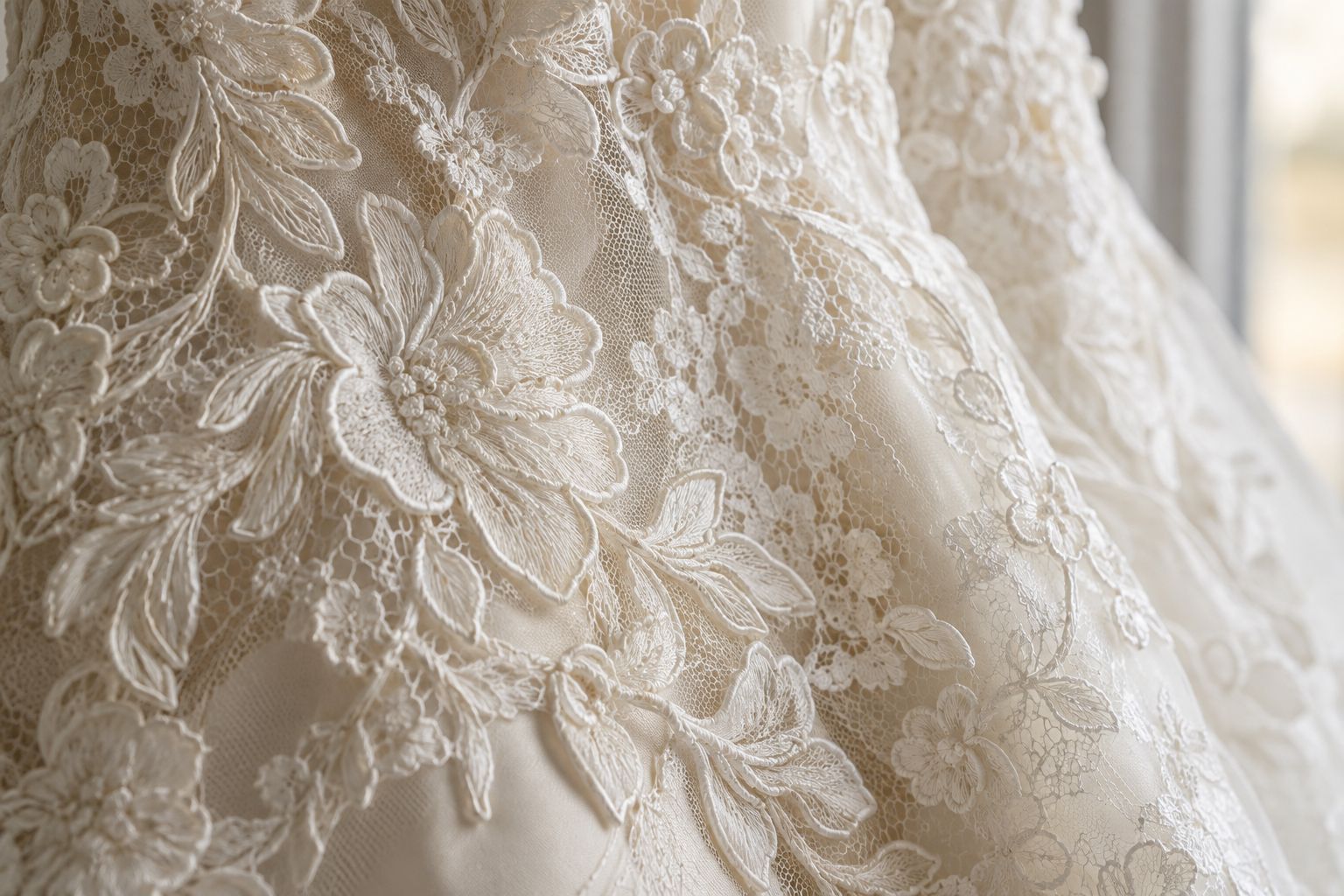
7. Three-dimensional floral lace and appliqué
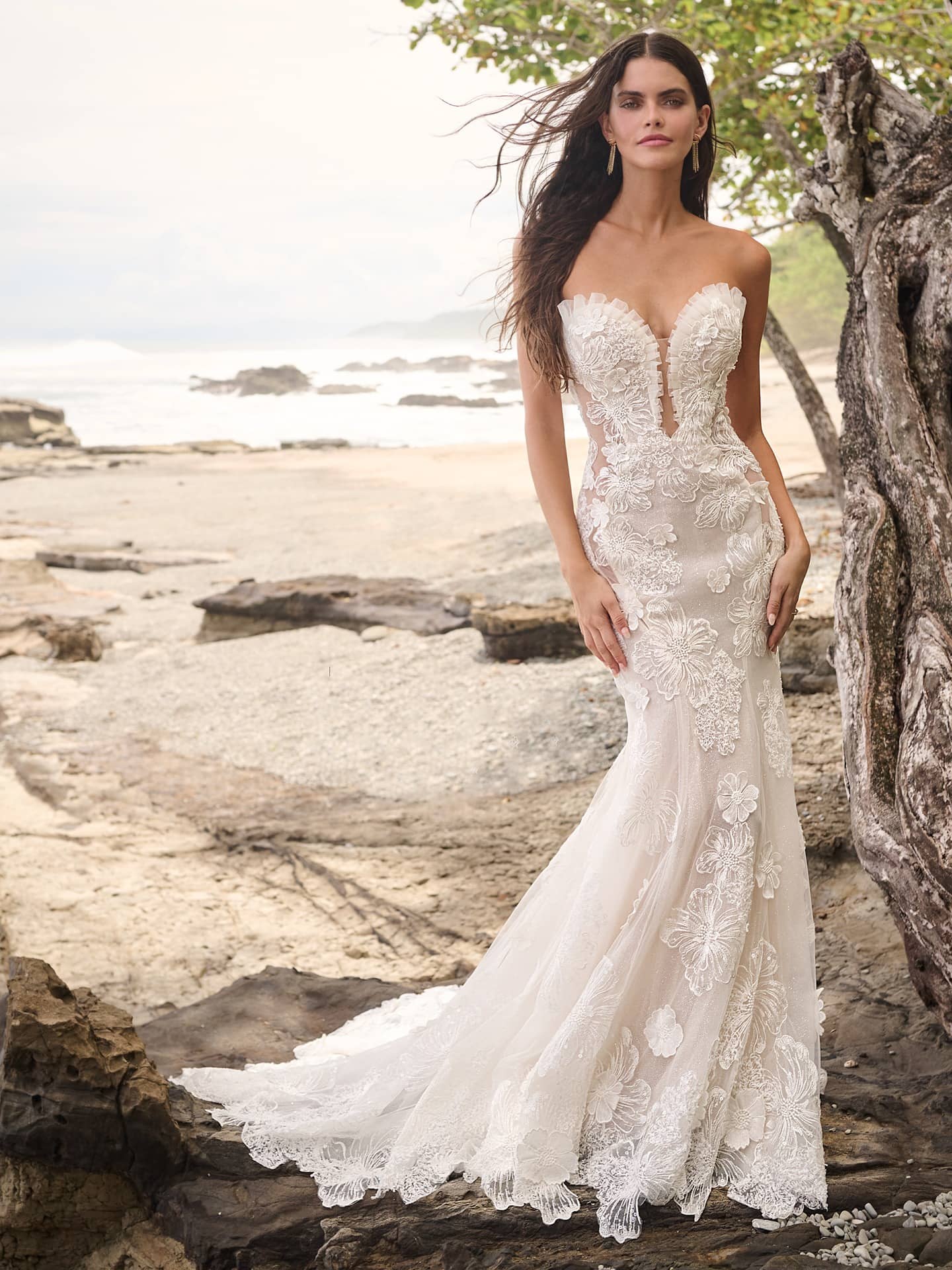
Three-dimensional floral treatments use petals, leaves, or other elements that stand away from the gown. Light catches their edges and creates small shadows beneath them. Some are combined with lace; others use fabric flowers on tulle, satin, or another surface.
Appliqué means attaching decorative pieces to a base. An appliqué can be flat, beaded, or dimensional, so the word alone does not mean raised petals. Likewise, a floral dress is not necessarily made with lace.
Dimensional decoration might cluster at the shoulders, drift down the skirt, or edge a train. Try your veil with it and watch how the two surfaces meet. Check whether petals brush your arms or become compressed when the skirt folds.
Ask: “How should these raised details be handled when the dress is bustled, transported, or worn with my veil?”
How to choose the right type of lace for your wedding dress
Start with the effect you want to see, then test how the dress achieves it. Lace style influences the surface; lining changes contrast and coverage; embellishment adds texture and potentially weight; construction contributes support and movement.
Compare delicate detail with bold motifs
Fine patterns invite a closer look. Larger flowers and openwork can make the design easier to read from farther away. Neither effect belongs to a particular body type or silhouette.
Use the same viewing distance for each dress. If you love a close-up photograph, check whether you also enjoy the quieter pattern in a full-length mirror. If you like bold motifs, examine how they meet at the waist and side seams.
Decide how much texture and sparkle you want
A relatively flat lace surface, a corded outline, and lifted petals create different kinds of dimension. Compare them from the side as well as the front.
Separate texture from shine. Matte embroidery can be highly detailed without sparkling, while a few clear sequins can introduce flashes of light. Ask to compare similar patterns with different finishes. Our wedding dress style guide can help you connect those details with the overall look you prefer.
Choose coverage and lining together
An ivory motif over an ivory lining may appear more blended than the same motif over a deeper shade. Actual contrast depends on both colors and the fabric’s opacity.
Illusion sections also need attention. Check mesh against your skin, the placement of motifs, and where opaque lining ends. An open-looking surface does not reveal how warm the complete gown will feel; consider the season alongside its layers and coverage.
Test your priorities in a wedding-day setting
These three hypothetical scenarios show what to compare:
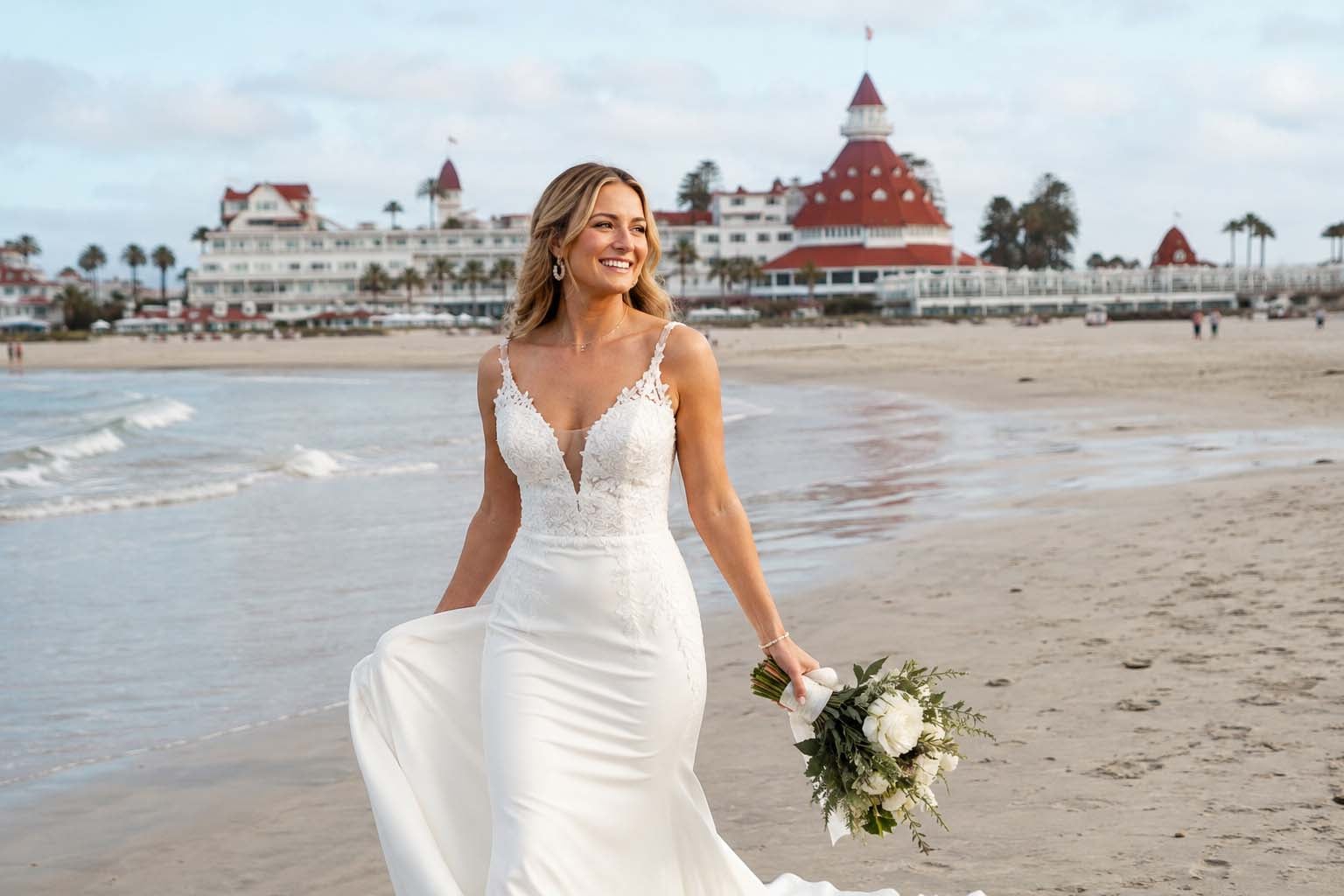
- Outdoor San Diego ceremony: Imagine walking along a garden path before standing outside for the ceremony. Compare the complete gowns’ layers, train handling, and ease of walking. A more open-looking lace can provide the appearance you like, but substantial lining may still feel warm.
- Indoor evening reception: Imagine choosing between lightly embellished lace and dense beading. Turn under the available lights and sit for several minutes. More shimmer may appeal to you, with the tradeoff of added weight or more noticeable contact against your arms.
- Detailed lace with minimal sparkle: Imagine comparing matte Alençon-style outlines, embroidered tulle, and raised fabric petals. View each close up and across the room. A tonal finish may reveal less pattern at a distance, while dimensional petals bring stronger texture and require attention when paired with a veil.
If a fitted silhouette is on your shortlist, our guide to lace fit-and-flare wedding dresses explains its specific support and movement considerations.
Bring two or three contrasting lace references to your bridal appointment. We can use them as a starting point for discussing the texture, coverage, and overall effect you want to compare.
What to check during a bridal appointment
Use the same small set of checks for each dress so your comparisons stay useful:
- Look close up, then step several feet from the mirror. Notice which details remain visible.
- Compare available lining shades and opacity. Ask which options actually belong to the gown you are considering.
- Watch how lining changes motif contrast, especially at the bodice and upper skirt.
- Sit, walk, raise your arms, and turn. Notice the lace and the underlying structure together.
- Check sleeve edges, seams, underarm contact, and raised embellishment. Report any pulling or scratching.
- Examine the hem and train. Ask how shortening could affect scallops, borders, or pattern continuity.
- Discuss possible bustle arrangements and how they might change the visible train decoration.
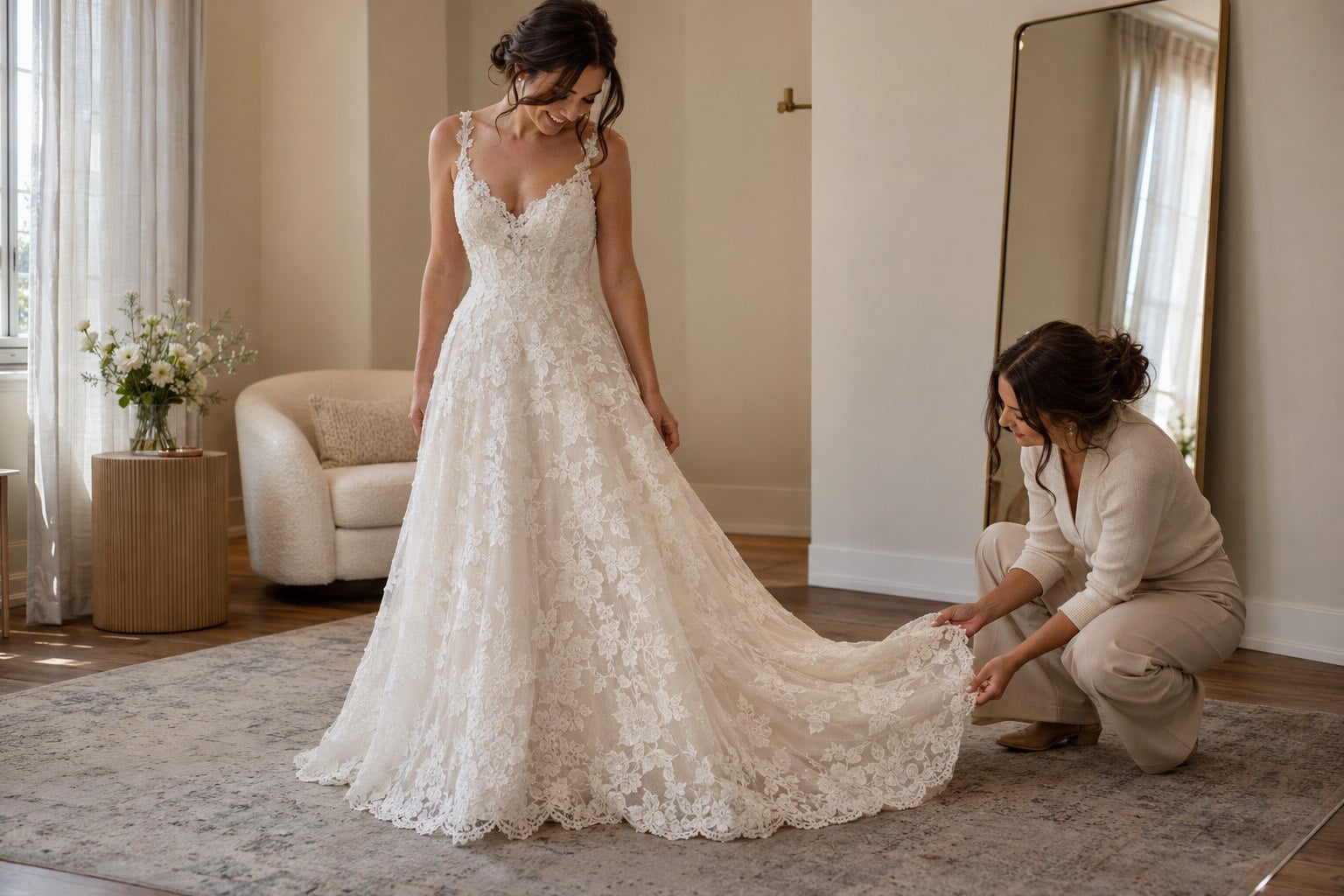
Ask which sample-fit issues can reasonably be addressed and which reflect the design itself. A gown clipped for a fitting cannot demonstrate every aspect of the eventual fit, and every requested alteration needs an individual assessment.
Does the type of lace affect price and alterations?
The lace name alone does not determine a gown’s price or alteration cost. Manufacturing method, design, lining, embellishment, motif placement, and overall construction all contribute.
An adjustment may involve changing the underlying seam and then restoring the decorative pattern. Beading, a continuous border, or large motifs crossing that seam can affect the work required. Two gowns described with the same lace name may therefore need different alteration approaches.
Ask for an assessment of the actual dress and proposed changes before deciding. Our wedding dress alterations service provides a starting point for discussing fit, hems, appliqué, and bustle options; feasibility depends on the gown.
Frequently asked questions
Does lace automatically stretch?
No. Stretch depends on the fabric’s construction and fiber content, and the finished dress may contain layers that behave differently. A lace overlay with some give does not guarantee stretch through the lining or bodice. Ask about each layer and test normal sitting and walking without pulling on the fabric yourself.
Can two gowns use the same lace style but feel different?
Yes. Two Chantilly-style gowns, for example, may use different linings, numbers of layers, bodice structures, and embellishments. Even similar lace can be arranged differently across a dress. Compare the complete garments and note where you feel weight, support, or restriction, rather than expecting the lace name to predict comfort.
Can a lace dress be hemmed without losing its scalloped edge?
Sometimes a specialist can preserve or reposition a decorative border, but it depends on how the dress is constructed. An integrated pattern, layered hem, or heavy embellishment may complicate the work. Ask how your particular hem would be shortened and whether the proposed method would change the border or motif spacing.
Does ivory lining change how lace looks?
Yes. Ivory lining can blend with similarly colored lace, while a contrasting lining can make the motifs more distinct. The effect depends on the exact shades, opacity, and lighting. Compare actual fabric options where available, and confirm whether a swatch represents the bodice lining, skirt lining, or both.
What should I ask before ordering illusion lace sleeves?
Ask about mesh shade, sleeve lining, closures, seam placement, and movement at the shoulder and elbow. Clarify whether the sleeve shown is part of the original design or a proposed modification. Ask how its fit will be assessed and which adjustments may be possible before committing to a change.
Compare your lace shortlist at Bridal & Tuxedo Galleria
Bring the close-up that caught your attention and a full-length image of the gown. Tell us what you like about each: fine net, outlined flowers, open spaces, a dotted sleeve, or petals that lift from the skirt.
At Bridal & Tuxedo Galleria in San Diego, we can help you explore those preferences in the context of an actual dress. Compare the lining, feel the texture, and see how the gown moves before deciding which details belong on your shortlist.

Author bio :
Kayla brings more than 10 years of hands-on experience in bridal fashion and boutique styling, specializing in personalized bridal consultations and luxury client experiences. As the manager of the San Diego location of Bridal and Tuxedo Galleria, she is known for her keen eye for detail, deep understanding of couture wedding dress design, and ability to guide brides toward a gown that reflects their unique vision and wedding aesthetic. Her approach blends fashion expertise with genuine care, ensuring every bride feels confident, understood, and unforgettable on her wedding day
Call Now

Your Personalized Wedding Dress Shopping Experience in San Diego With over 30 years of styling expertise, our dedicated team is passionate about helping you find the perfect wedding dress and tuxedo.

Leave a Reply