
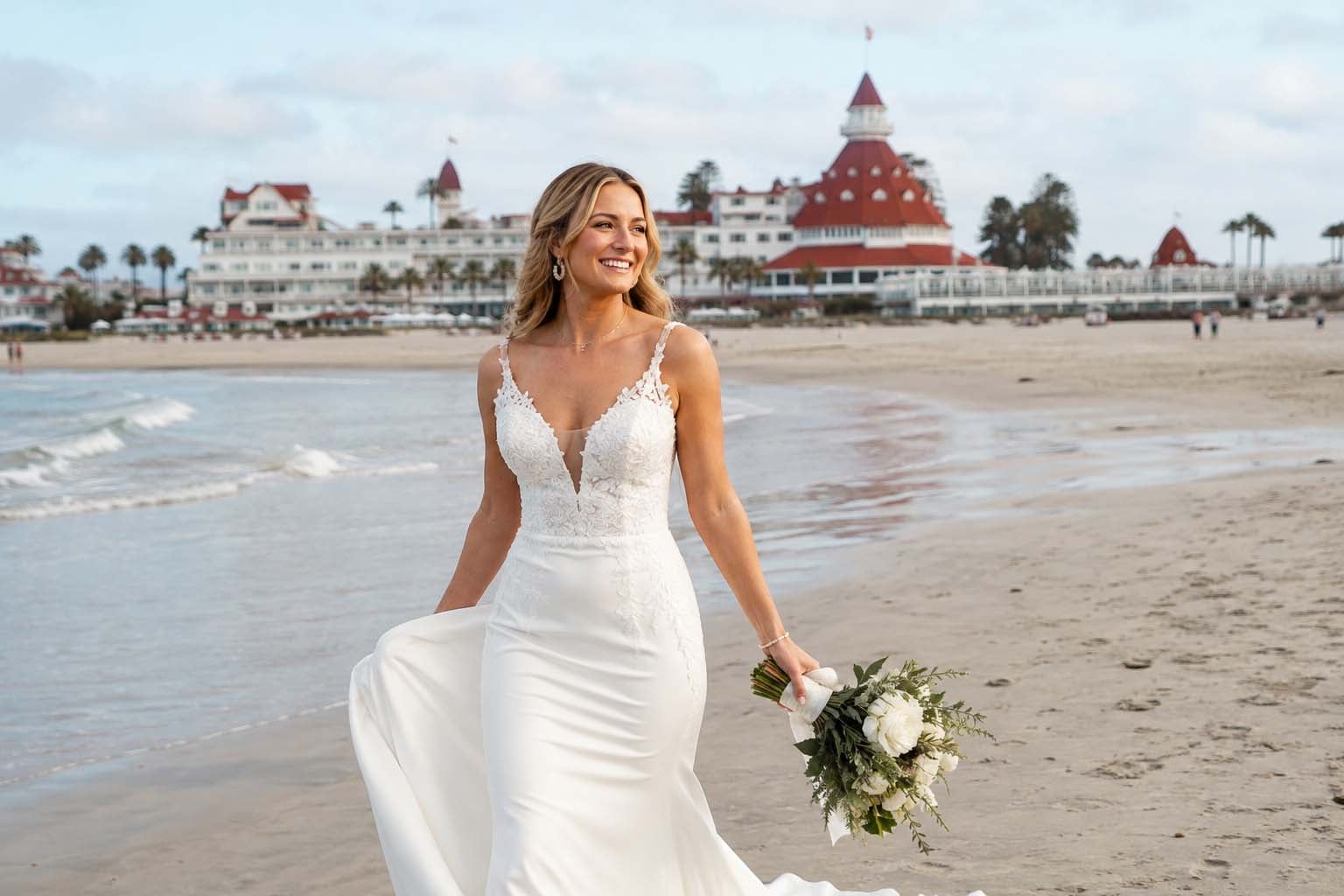
Lace vs. Satin Wedding Dress: Which Fabric Is Right for You?
Choosing between a lace vs. satin wedding dress is rarely just a fabric decision. It is often a choice between two different ways you want your gown to communicate your personal style.
Lace can create visible texture, pattern, softness, dimension, and intricate detail. Satin creates a smoother surface that can place more emphasis on silhouette, draping, waist placement, and the architecture of the gown.
Neither is universally better.
The right wedding dress depends on far more than the material name. Construction, lining, silhouette, bodice support, embellishment, weight, movement, photography, venue, and alterations all influence how the finished gown looks and feels.
For brides shopping in Southern California, the most useful question is not simply, “Do I want lace or satin?” It is:
Which gown gives me the combination of style, support, movement, proportion, and confidence I want for my wedding?
At Bridal & Tuxedo Galleria, we believe the gown should be refined around the bride rather than forcing the bride into a formula. Comparing both fabrics in person is one of the best ways to discover which direction truly feels like you.
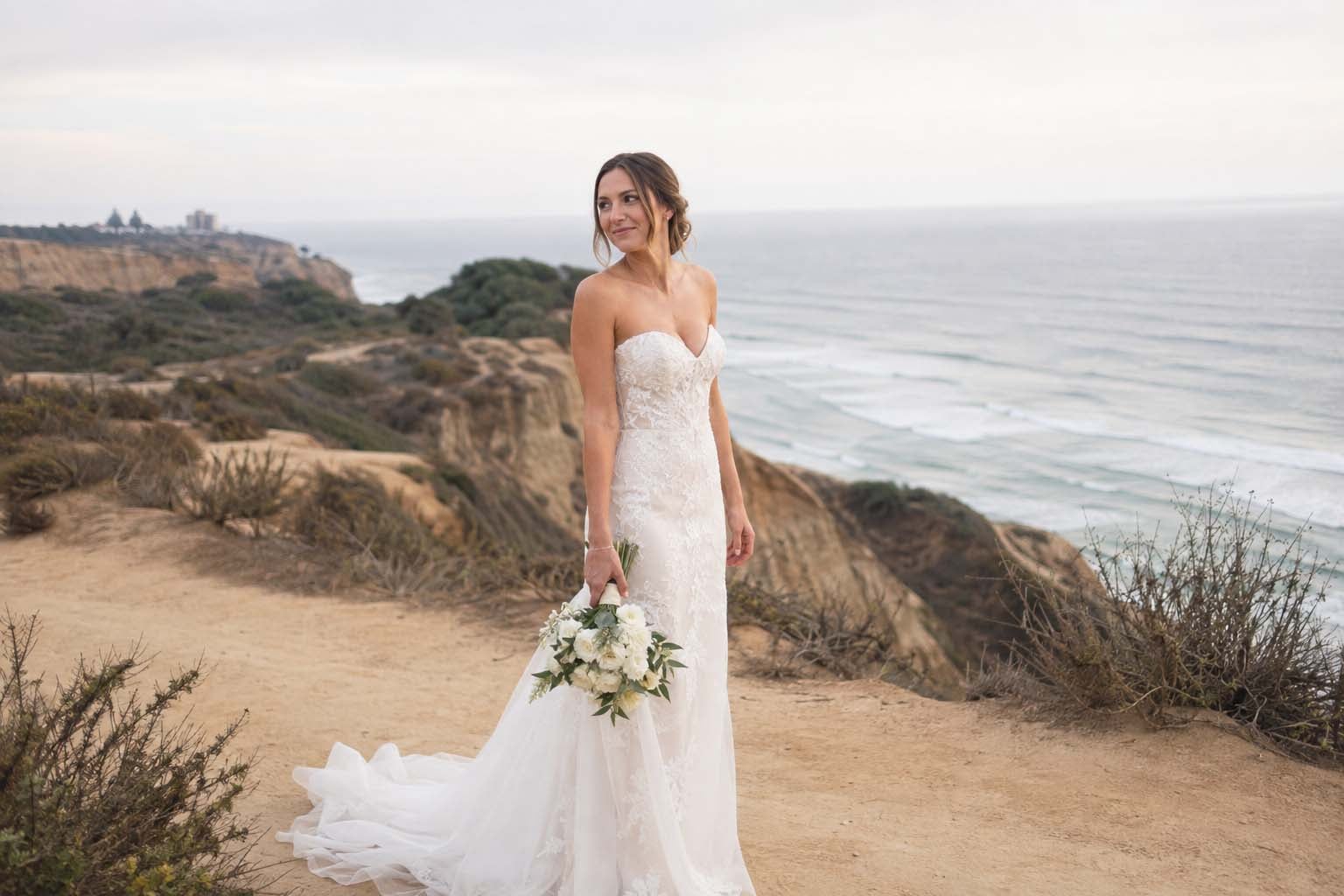
Quick Answer: Is Lace or Satin Better for a Wedding Dress?
Lace often creates a textured, detailed, romantic, or dimensional bridal look, while satin usually creates a smoother, cleaner, and sometimes more sculptural impression. Neither is automatically more flattering, comfortable, formal, or photogenic. The better choice depends on the specific gown’s construction, silhouette, weight, lining, venue, movement, and how you feel wearing it.
Lace vs. Satin Wedding Dress: At-a-Glance Comparison
| Consideration | Lace Wedding Dress | Satin Wedding Dress |
|---|---|---|
| Overall look | Textured, patterned, dimensional | Smooth, polished, clean |
| Visual mood | Romantic, organic, graphic, detailed | Minimal, architectural, classic, dramatic |
| Surface | Openwork, embroidery, appliqué or dimensional motifs | Smooth surface with varying sheen |
| Structure | Depends heavily on base fabric and internal construction | Can range from fluid to highly structured |
| Movement | May feel soft or substantial depending on layers and embellishment | Can drape, skim or hold volume depending on weight |
| Photography | Creates texture, pattern and shadow | Reflects light across folds and clean surfaces |
| Comfort | Depends on lining, layers, appliqué and bodice construction | Depends on weight, lining, weave and internal structure |
| Alterations | Motifs and appliqués may need careful repositioning | Seam tension and alignment may be more visually noticeable |
| Venue compatibility | Works across gardens, coastlines, estates, churches and ballrooms | Works across modern venues, estates, ballrooms, outdoor settings and churches |
| Season | Depends on the complete gown rather than the fabric name | Depends on weight, lining and construction rather than the fabric name |
| Style priority | Texture, pattern and visual detail | Clean lines, drape and visible construction |
If you are still defining your direction, start by exploring wedding dresses at Bridal & Tuxedo Galleria and compare how different fabrics behave across silhouettes.
First, Understand the Difference Between Lace and Satin
Lace and satin are often treated as equivalent fabric categories, but technically they describe different textile characteristics.
What Is Lace?
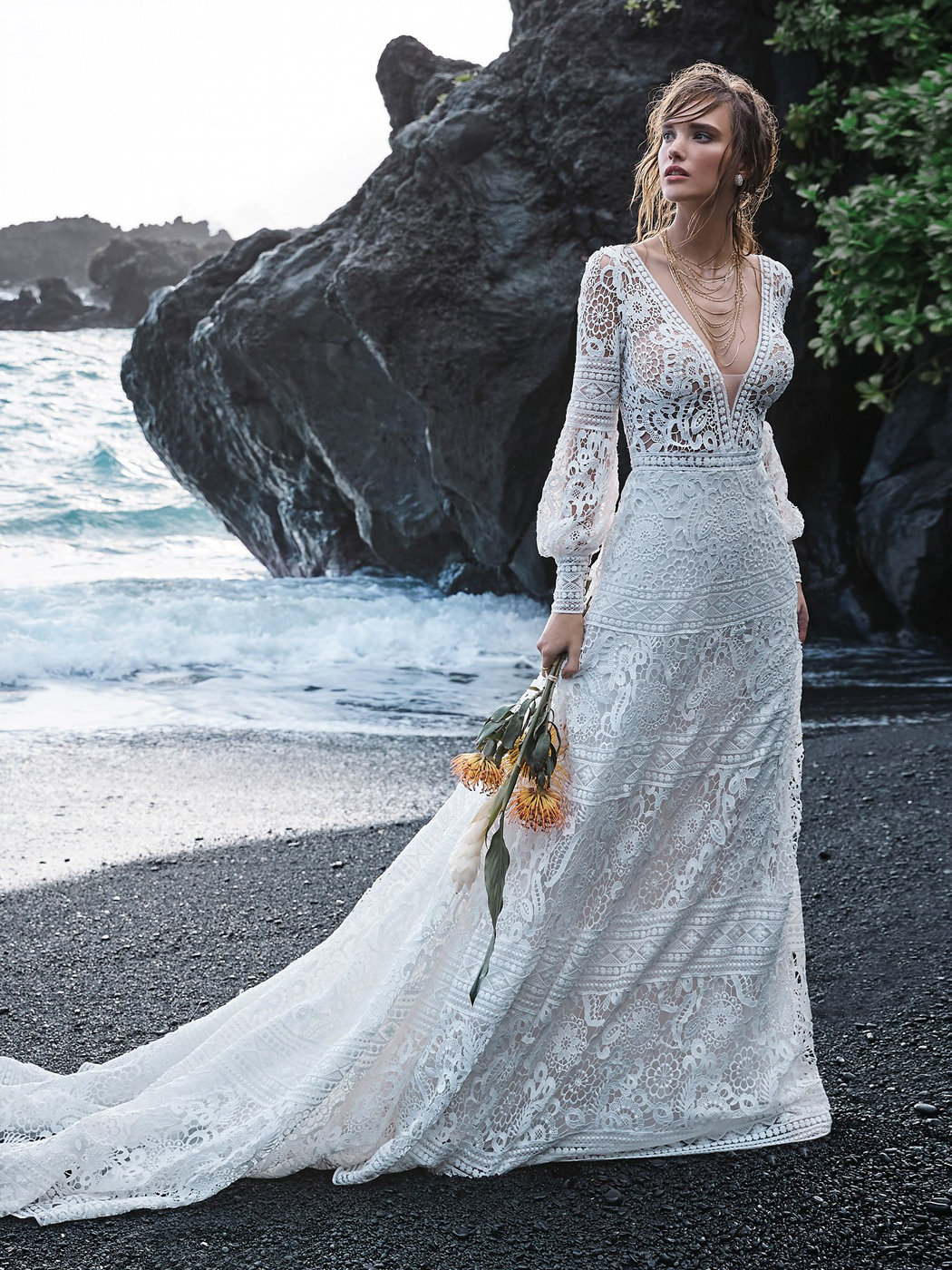
Lace is generally an openwork decorative textile made through techniques that create patterned areas of fabric and open space. Bridal lace can appear delicate and barely there or bold and dimensional.
You may encounter styles such as:
- Chantilly-inspired lace
- Corded or Alençon-style lace
- Guipure lace
- Embroidered lace
- Lace appliqué
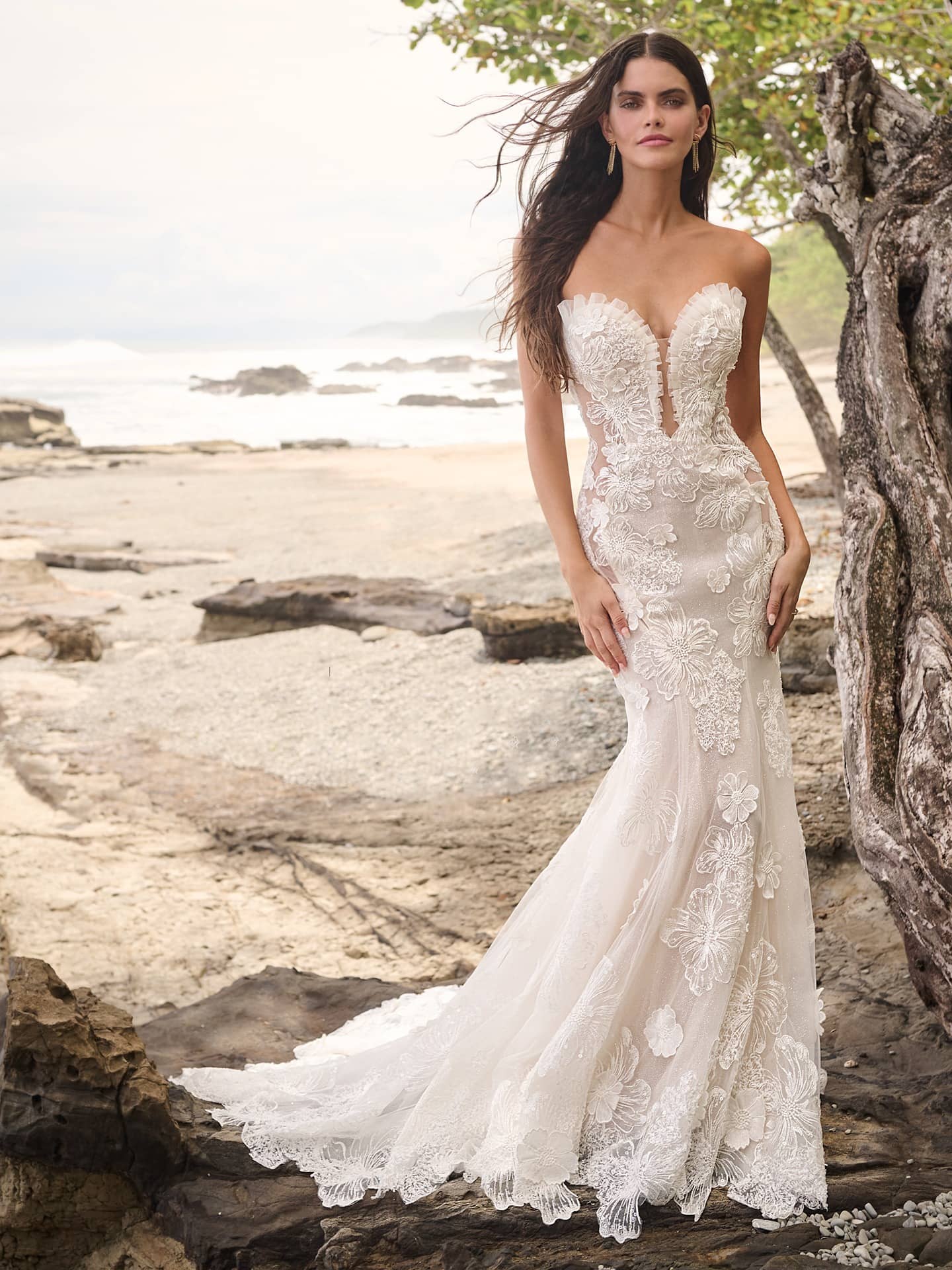
- Three-dimensional floral lace
- Beaded lace
A wedding dress may be covered completely in lace, or lace may appear only on the bodice, sleeves, train, neckline, or specific appliqué placements.
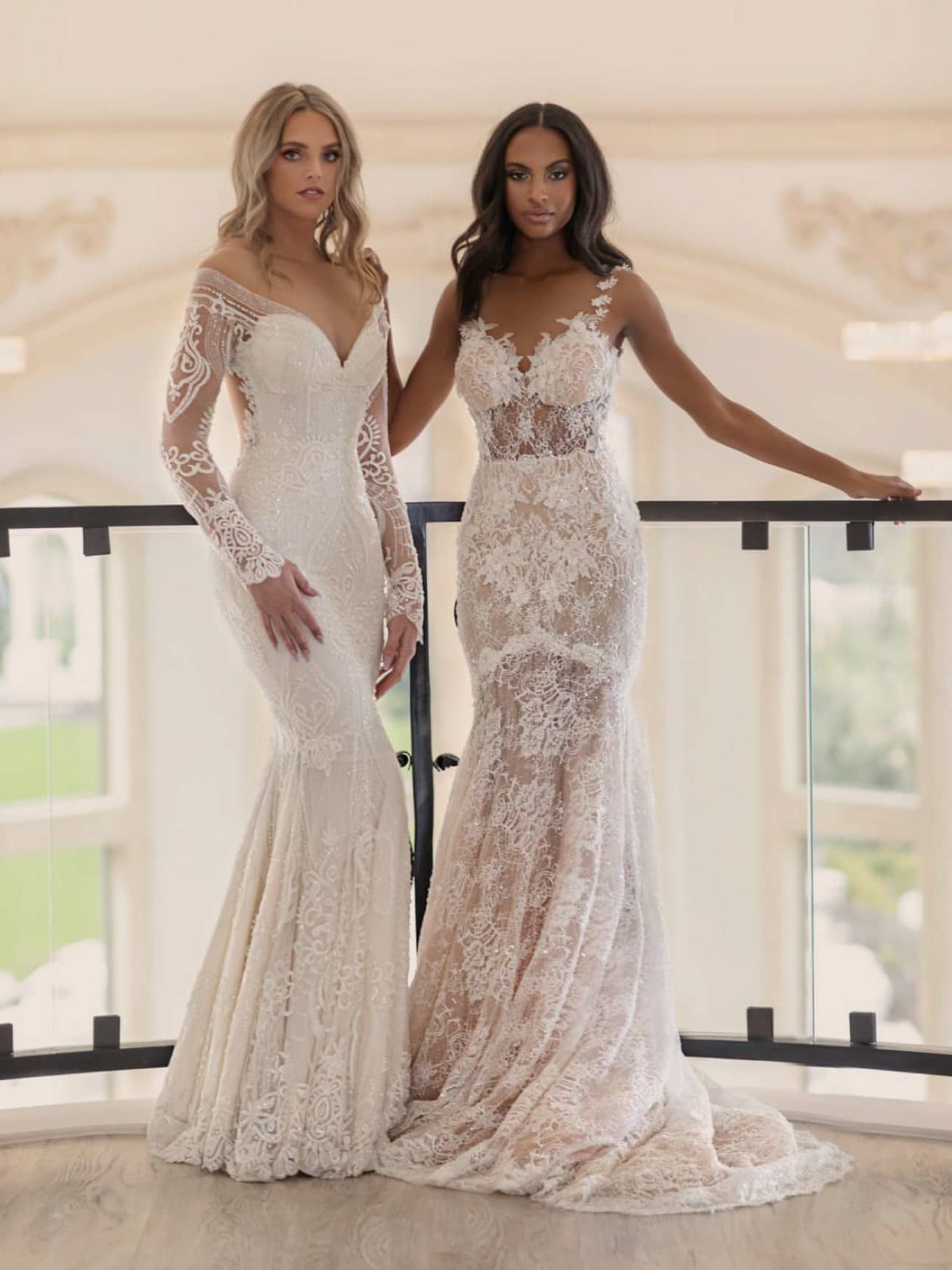
The visual effect can change dramatically depending on what sits beneath it. Lace over nude-tone lining, ivory lining, tulle, satin, or another base can each create a different impression.
What Is Satin?
Satin refers primarily to a type of weave that creates a characteristically smooth surface. Satin can be made using different fibers and produced in different weights.
That distinction matters.
One satin gown might move softly and closely with the body, while another may have enough structure to create a sculptural skirt with substantial volume.
For brides who want to understand bridal textiles in more detail, both The Knot’s wedding gown fabric glossary and Brides’ wedding dress fabric guide provide helpful general references.
The important takeaway is simple: the name of the fabric does not tell you everything about how the dress will behave.
Construction matters just as much.
The Biggest Differences Between Lace and Satin Wedding Dresses
Texture and Visual Personality
Lace gives the eye something to explore.
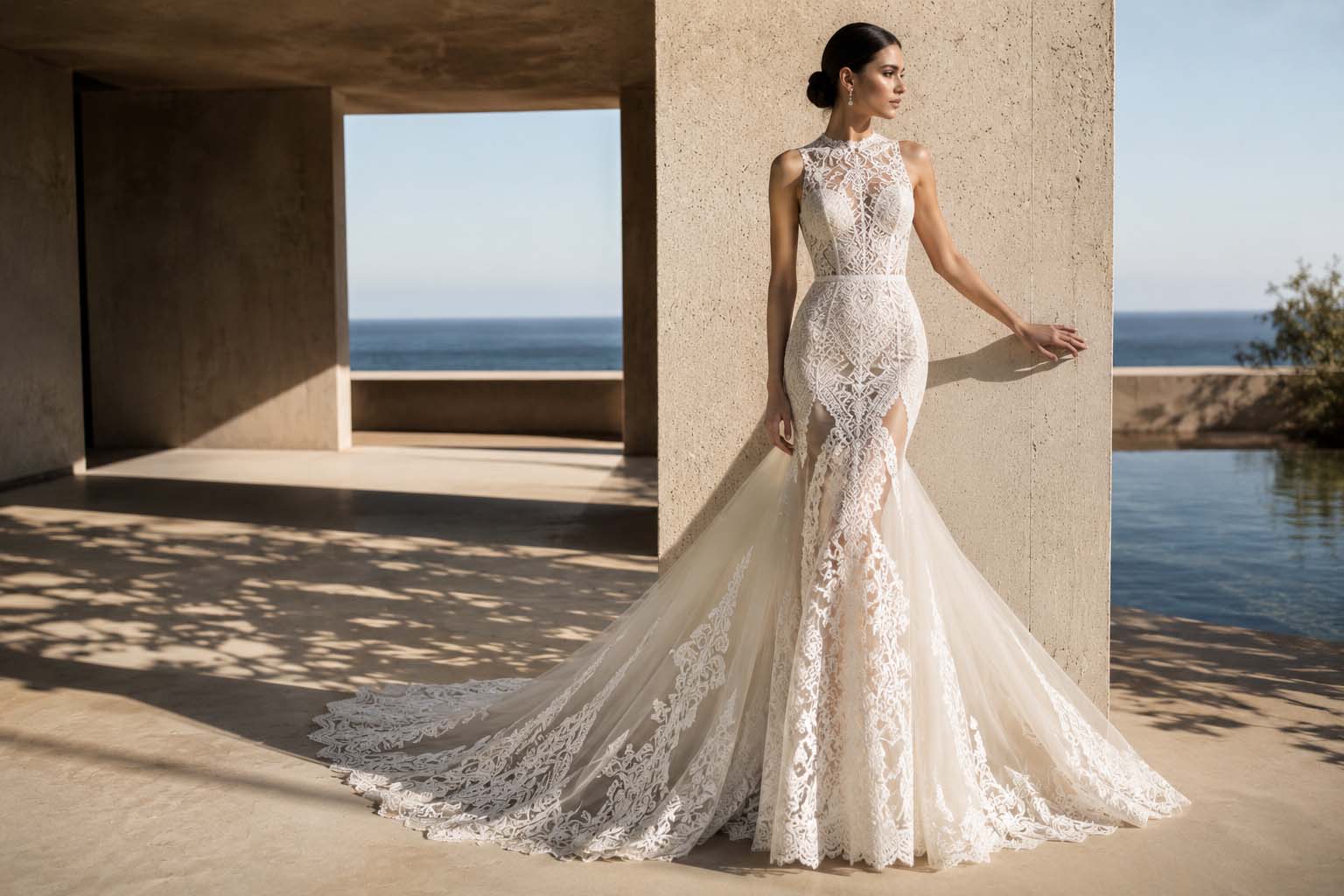
Floral motifs, embroidery, openwork, appliqué, dimensional petals, or beading can create visual depth from several distances. From across a room, you may first notice the silhouette. As someone moves closer, the details become increasingly visible.
That makes lace especially compelling for brides who are drawn to craftsmanship, texture, and surface detail.
Satin communicates differently.
Because the surface is smoother, the eye often notices shape first. Neckline, waist placement, draping, seams, pleating, and skirt volume may become more prominent.
A satin gown can therefore feel highly architectural even when the design itself is simple.
But avoid reducing the choice to “lace is romantic and satin is modern.”
Contemporary lace can feel graphic and directional. Satin can feel deeply romantic. The designer’s construction decisions matter more than a simple fabric stereotype.
You can see how dramatically silhouette changes fabric expression by browsing BTG’s designer wedding dress collection.
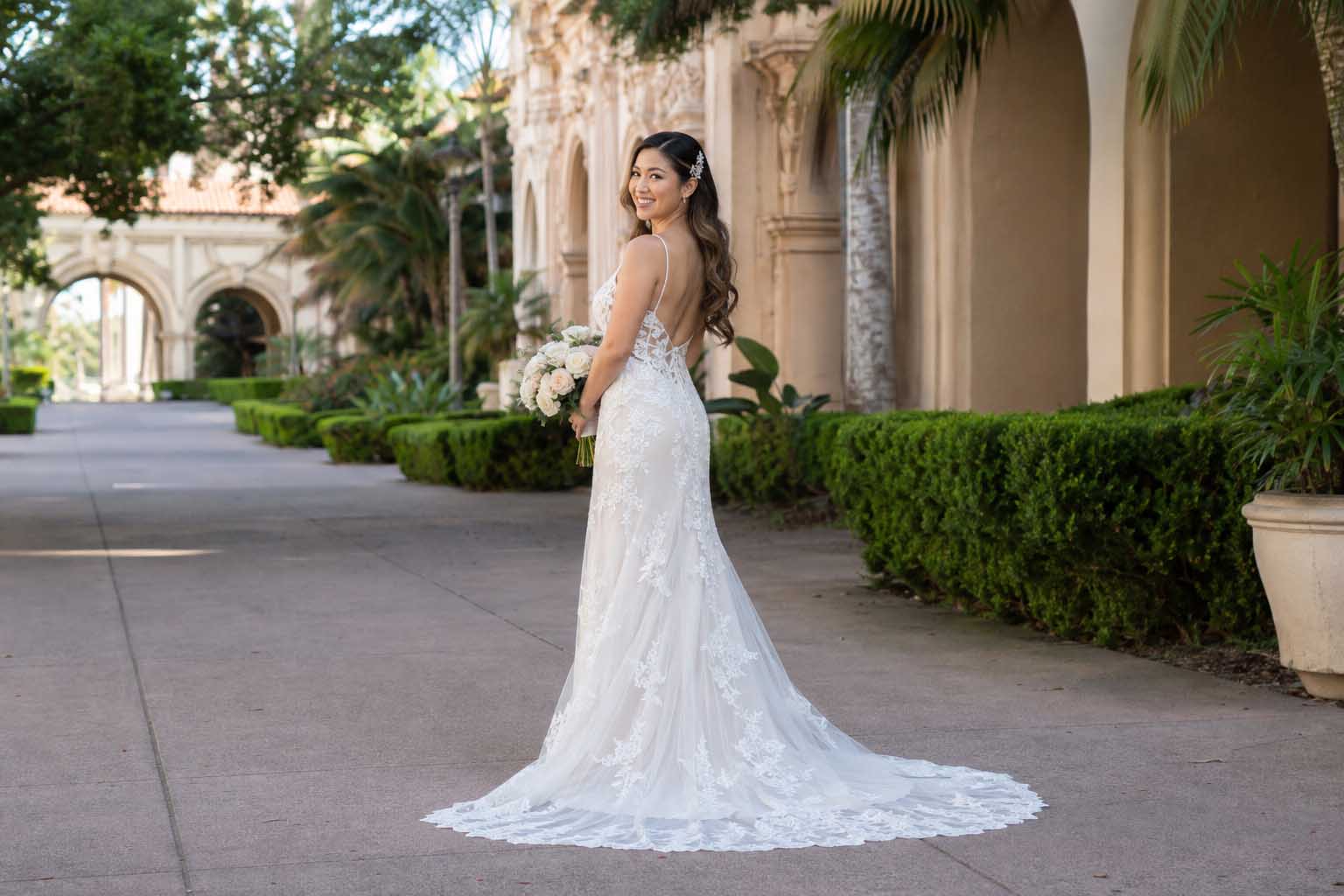
Silhouette and Gown Construction
This is where bridal expertise becomes especially important.
A wedding dress is not simply fabric wrapped around a body. The internal architecture of the gown influences support, balance, waist placement, neckline stability, movement, and overall proportion.
A lace bodice may include:
- Boning
- Corsetry
- Multiple lining layers
- Cups
- Tulle foundations
- Structural seams hidden beneath appliqué
The lace creates the visible surface, but much of the support may come from underneath.
With satin, that construction is often more visible.
Because the surface is smoother, seams, draping, darts, pleating, and waist transitions become part of the design language.
A sculpted satin bodice can look remarkably clean, but achieving that effect requires precise construction and fitting.
The skirt tells a similar story.
A light satin may fall softly and move fluidly. A more substantial satin may hold shape and volume. Lace may float over layers of tulle, follow a fitted silhouette, or become surprisingly substantial when embellished.
That is why two satin gowns can feel completely different, just as two lace gowns can.
Comfort, Weight, and Movement
Brides often ask whether lace or satin is more comfortable.
There is no reliable universal answer.
A lightweight lace fabric may become much heavier after adding lining, beading, appliqué, corsetry, and multiple skirt layers.
Likewise, a satin gown may be lighter than expected depending on its construction.
The best way to evaluate comfort is to test the completed gown rather than judging a fabric swatch.
During a bridal appointment, notice what happens when you:
- Walk normally
- Sit
- Turn
- Raise your arms
- Take several steps
- Move through the skirt
- Imagine dancing
- Allow the train to settle naturally
Pay particular attention to the bodice.
Does it stay balanced when you move?
Does the neckline remain secure?
Do you feel supported without constantly adjusting the gown?
Comfort on a wedding day is not simply softness against the skin. It is the combination of support, movement, weight, balance, and confidence.
How Lace and Satin Photograph
Fabric can change the way a wedding dress interacts with light.
How Lace Photographs
Lace creates small variations of texture, light, and shadow.
Embroidery, appliqué, dimensional flowers, or raised motifs can create visible detail in close photography. Lace can also create beautiful depth in portraits because the surface changes as light moves across it.
The underlying lining color also matters. A high-contrast lining may make lace patterns appear more pronounced, while tonal lining may create a quieter effect.
How Satin Photographs
Satin typically interacts with light across larger areas.
A smooth skirt may catch light along a fold, drape, or curved seam. This can help emphasize silhouette and movement.
Photography results can vary considerably depending on:
- Direct sunlight
- Open shade
- Indoor lighting
- Flash
- Evening photography
- Satin sheen
- Gown color
- Camera angle
- Skirt movement
Neither fabric is universally more photogenic.
The real question is which photographic language feels closer to your wedding vision.
If you are drawn to highly personalized imagery, this matters more than ever. The supplied The Knot Real Weddings Study 2026 reports that couples increasingly prioritize authenticity and personal expression, while editorial and documentary-style photography continues to influence wedding aesthetics.
Your gown should support that personal visual language rather than follow a generic rule.
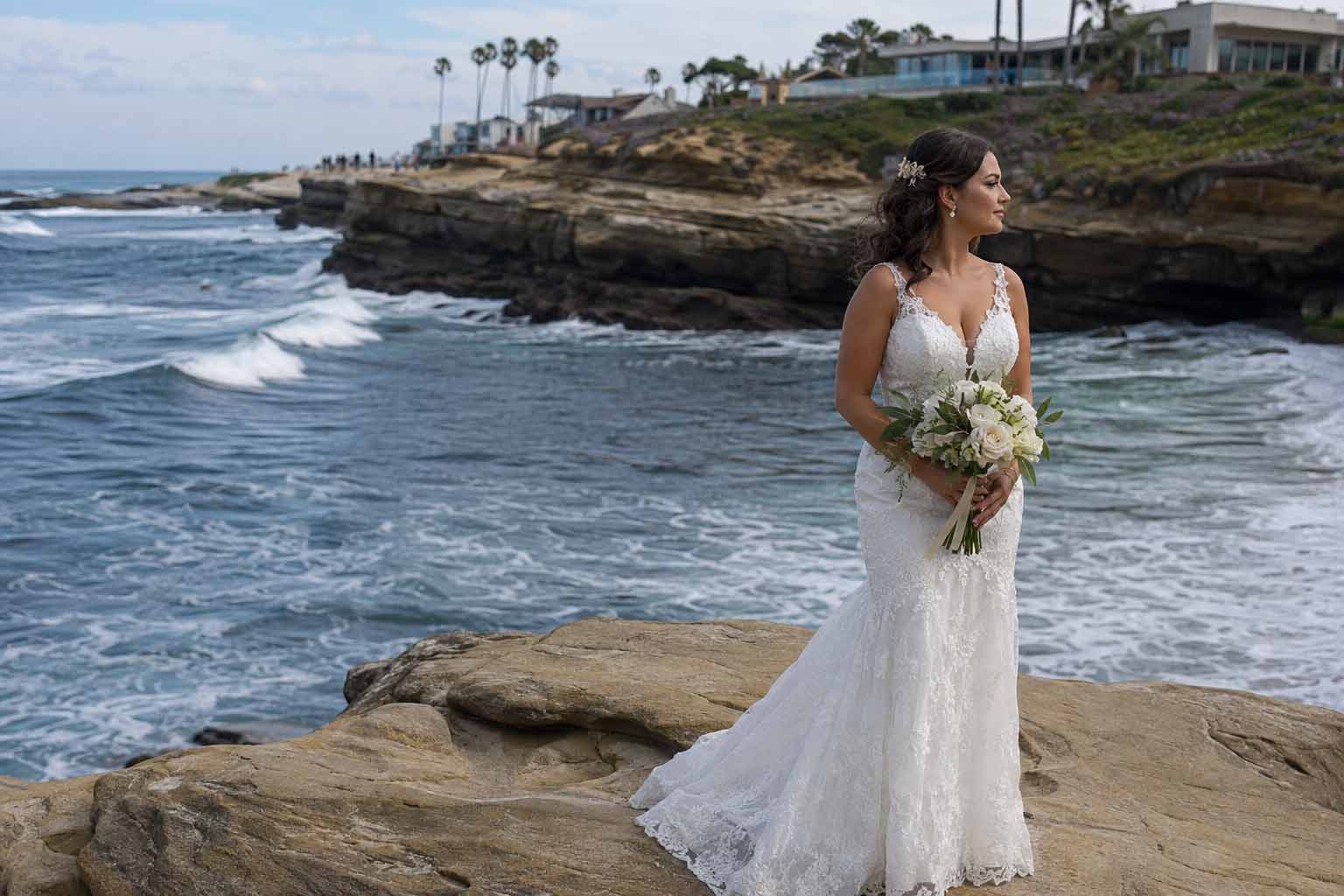
Lace or Satin for a San Diego Wedding?
Southern California weddings can take place in dramatically different settings, so venue should influence the decision without controlling it.
Coastal Weddings
For a coastal ceremony, consider more than visual style.
Think about:
- Wind
- Walking surfaces
- Train length
- Skirt weight
- Outdoor movement
- Temperature changes
- Photography in bright natural light
Both lace and satin can work beautifully near the coast.
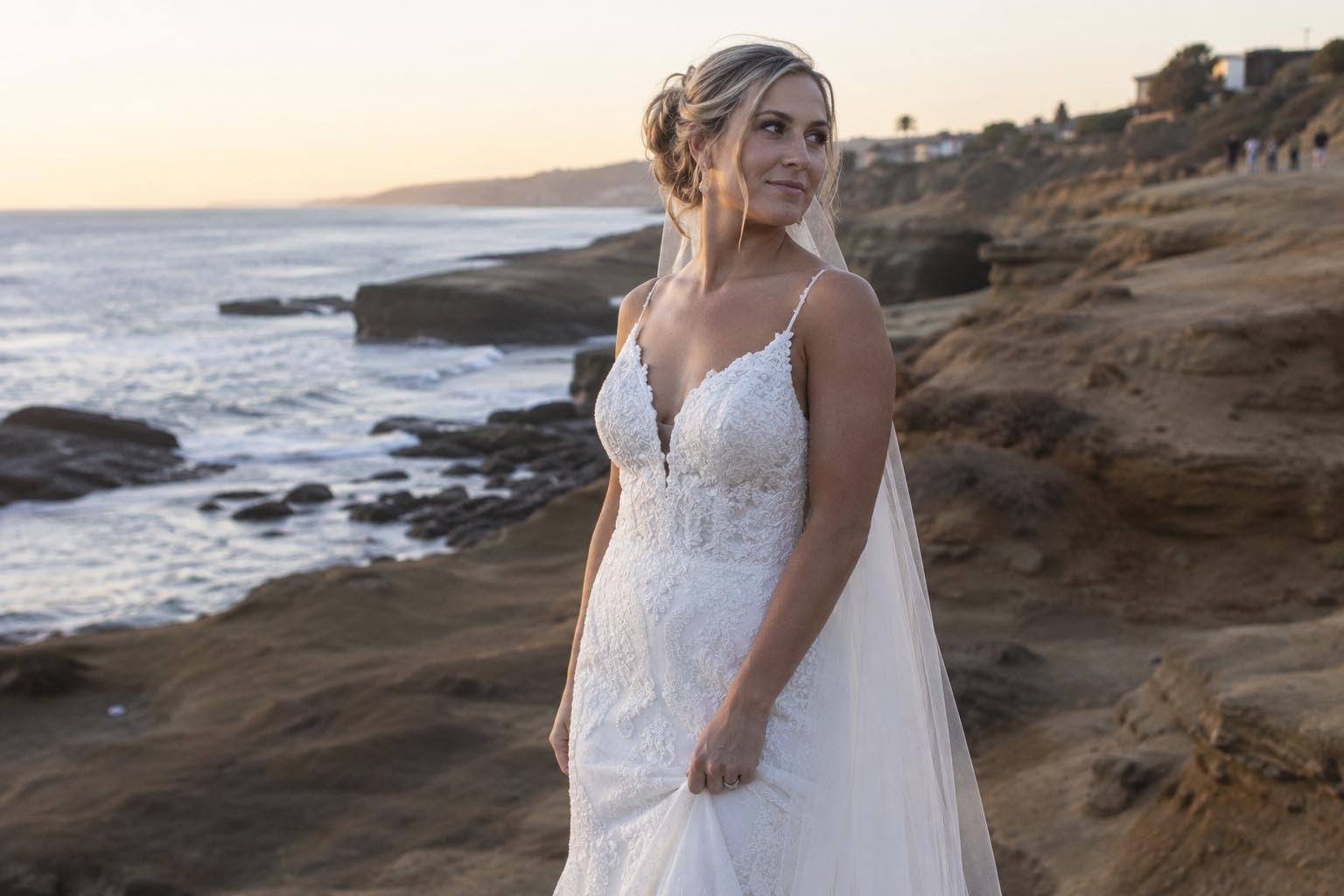
A textured lace gown may feel organic in the setting, while clean satin can create a striking contrast against the landscape.
Garden Weddings
Lace often relates naturally to garden surroundings because floral and botanical motifs visually echo the environment.
But a clean satin gown against greenery can be equally compelling because the contrast allows the silhouette to stand out.
Modern Downtown Venues
Satin can reinforce architectural lines and contemporary interiors, particularly when the gown features intentional draping or sculpted construction.
Graphic lace, structured corsetry, and dimensional floral treatments can create a sophisticated modern direction as well.
Estates, Churches, and Ballrooms
Either fabric can work.
The better question is how the neckline, train, skirt volume, and construction relate to the scale and atmosphere of the space.
The venue should inform your styling. It should not dictate your identity.
Is Lace Cooler Than Satin?
This is another area where oversimplified bridal advice can be misleading.
Lace is not automatically cooler for warm weather.
Imagine a lace gown with a fully structured corset, substantial lining, multiple tulle layers, embroidered appliqué, and beadwork. That dress may feel considerably warmer than a lightly constructed satin gown.
The reverse can also be true.
A substantial structured satin ball gown with multiple skirt layers may feel warmer than a lighter lace sheath.
For a San Diego wedding, evaluate:
- Fabric weight
- Lining
- Number of layers
- Bodice construction
- Sleeves
- Train
- Embellishment
- Indoor versus outdoor ceremony
- Expected movement throughout the day
Your bridal stylist should help you compare complete gowns rather than relying on simplified seasonal rules.
Alterations Can Change the Decision
Finding the gown is only the beginning.
Professional fitting determines how the gown ultimately supports, moves, photographs, and feels.
Lace and satin each create different alteration considerations.
Altering Lace
A lace motif may cross the exact seam that needs adjustment.
In some cases, an alteration specialist may carefully remove an appliqué, adjust the structural layer underneath, and reposition the lace so the pattern remains intentional.
Beading can add further complexity.
Sleeves, necklines, trains, and bodices may also require careful motif placement to preserve the original design language.
Altering Satin
Satin presents a different challenge.
Because the surface is clean and uninterrupted, seam tension, puckering, pulling, or asymmetry can become more visible.
A smooth fabric leaves little room for imprecise fit work.
This is one reason BTG considers alterations part of the bridal journey rather than an afterthought.
Learn more about how professional fitting affects support, movement, proportion, and the final gown through our guide to wedding dress alterations.
How to Decide Between Lace and Satin
Instead of asking what fabric is “better,” ask what you consistently respond to.
You May Prefer Lace If…
You may find yourself drawn toward lace when you value:
- Texture
- Floral or graphic detail
- Dimensional surface work
- Embroidery
- Visible craftsmanship
- Pattern
- Romantic or organic elements
Lace can also appeal to brides who enjoy discovering different details when seeing the dress from close range.
You May Prefer Satin If…
Satin may speak to you if you consistently respond to:
- Clean lines
- Draping
- Sculptural shapes
- Strong waist definition
- Smooth surfaces
- Architectural bodices
- Minimal detailing
Satin allows the silhouette itself to become the decoration.
Neither preference is more sophisticated or more bridal.
It is simply a different design language.
You Do Not Have to Choose Only One
One of the most useful discoveries during wedding dress shopping is that lace versus satin does not always need to be an either-or decision.
A gown can combine:
- Lace bodices with satin skirts
- Lace appliqué over satin
- Satin gowns with lace sleeves
- Lace detailing along trains
- Detachable lace elements
- Clean satin gowns paired with lace veils
This can be especially interesting when you love the clarity of satin but still want texture.
Instead of asking which element to eliminate, consider where each one belongs.
Brides with a specific vision may also want to explore custom wedding dress design and discuss how fabric, structure, proportion, and personalized details can work together.
Customization should always respect the gown’s construction. Not every modification is technically appropriate for every dress.
The Best Way to Compare Lace and Satin Is in Person
Digital research is an important part of modern bridal shopping.
The supplied The Knot Real Weddings Study 2026 found that roughly 36% of engaged couples were using AI for wedding planning by the end of 2025, while social media and wedding-planning resources continue to shape inspiration and research.
But a screen still cannot tell you how a wedding dress feels.
It cannot fully show you:
- Bodice support
- Fabric weight
- Lining
- Texture
- True sheen
- Train behavior
- Skirt resistance
- Neckline security
- How the dress responds when you move
That final decision needs physical proof.
When possible, try one strong lace direction and one strong satin direction during the same appointment.
Then stop comparing only in the mirror.
Walk.
Turn.
Sit.
Raise your arms.
Look at the back.
Notice the waist placement.
Watch how the train settles.
Take in the dress from across the room.
Most importantly, notice which gown allows you to think less about the dress itself and more about how you feel wearing it.
For additional preparation, read our wedding dress shopping guide before your appointment.
Frequently Asked Questions
Is lace or satin better for a wedding dress?
Neither fabric is universally better. Lace emphasizes texture and visible surface detail, while satin usually creates a smoother visual field that emphasizes silhouette, drape and construction. The best choice depends on the individual gown, your style, movement needs, venue, photographs and comfort.
Is a lace wedding dress more comfortable than satin?
Not necessarily. Comfort depends more on the complete construction than the surface material alone. Lining, corsetry, boning, embellishment, skirt layers, seam placement and total weight can make two gowns using the same fabric feel completely different.
Does satin photograph better than lace?
No. They photograph differently rather than one photographing universally better. Satin can create broad highlights that emphasize folds and silhouette. Lace creates texture, pattern and small areas of shadow. Lighting, gown color, camera angle and embellishment influence both.
Is satin too warm for a summer wedding?
Not automatically. Satin exists in different weights and fiber compositions, and the gown’s lining and number of layers strongly affect comfort. A lightweight satin gown may feel easier in warm conditions than a heavily layered lace gown. Evaluate the actual dress rather than relying on the fabric category.
Does lace cost more than satin?
There is no dependable rule. Price can be affected by textile quality, fiber, quantity of fabric, handwork, beadwork, lace application, construction complexity, customization and other design factors. Fabric name alone is not enough to predict the cost of a wedding gown.
Which wrinkles more, lace or satin?
It depends on the particular textile and gown. A smooth satin surface may make creases more visually apparent, while certain lace surfaces are less visually continuous but may require greater care around snagging. Fiber composition, fabric weight, finishing and storage all matter.
Can a wedding dress combine lace and satin?
Yes. A gown may use a lace bodice with a satin skirt, lace appliqué over satin, lace sleeves on a smooth gown, or detachable lace elements. The combination can balance clean construction with surface detail when the fabrics and proportions are designed cohesively.
How do I choose when I love both a lace and satin wedding dress?
Compare the complete experience, not only the mirror image. Walk, sit, turn and photograph both gowns. Compare bodice support, skirt movement, train behavior, venue compatibility and the way each dress reflects your personal style. The gown that remains convincing in motion is usually more informative than the one that wins a still comparison.
See Lace and Satin Wedding Dresses in Person
The difference between lace and satin becomes much clearer when the fabric is shaped into a real bodice, layered into a skirt, placed under natural light, and fitted to your proportions.
At Bridal & Tuxedo Galleria, our San Diego bridal experience brings together designer wedding dresses, private one-on-one styling, couture-informed construction knowledge, personalized fitting, customization, and professional in-house bridal alterations.
With more than 30 years of bridal experience, our focus is not on placing you into a predefined category.
It is on understanding how each gown supports you, moves with you, photographs, relates to your venue, and expresses the bridal style that feels genuinely yours.
Ready to compare lace, satin, and other designer wedding-dress fabrics in person?
Schedule Your Private Bridal Appointment
Explore different silhouettes, compare construction and movement, and work one-on-one with a bridal stylist who can help you understand what you are seeing and feeling in each gown.
Schedule a Private Bridal Appointment at Bridal & Tuxedo Galleria
San Diego, California
Designer Wedding Dresses | Private Bridal Styling | Custom Design | Professional In-House Bridal Alterations

Author bio :
Kayla brings more than 10 years of hands-on experience in bridal fashion and boutique styling, specializing in personalized bridal consultations and luxury client experiences. As the manager of the San Diego location of Bridal and Tuxedo Galleria, she is known for her keen eye for detail, deep understanding of couture wedding dress design, and ability to guide brides toward a gown that reflects their unique vision and wedding aesthetic. Her approach blends fashion expertise with genuine care, ensuring every bride feels confident, understood, and unforgettable on her wedding day
Call Now

Your Personalized Wedding Dress Shopping Experience in San Diego With over 30 years of styling expertise, our dedicated team is passionate about helping you find the perfect wedding dress and tuxedo.


Leave a Reply