
Retro Wedding Dresses for 2026–2027: Vintage Details to Try
Published: July 25, 2026
Expert review recommended: Navid Noor or an authorized Bridal & Tuxedo Galleria bridal stylist or in-house tailor
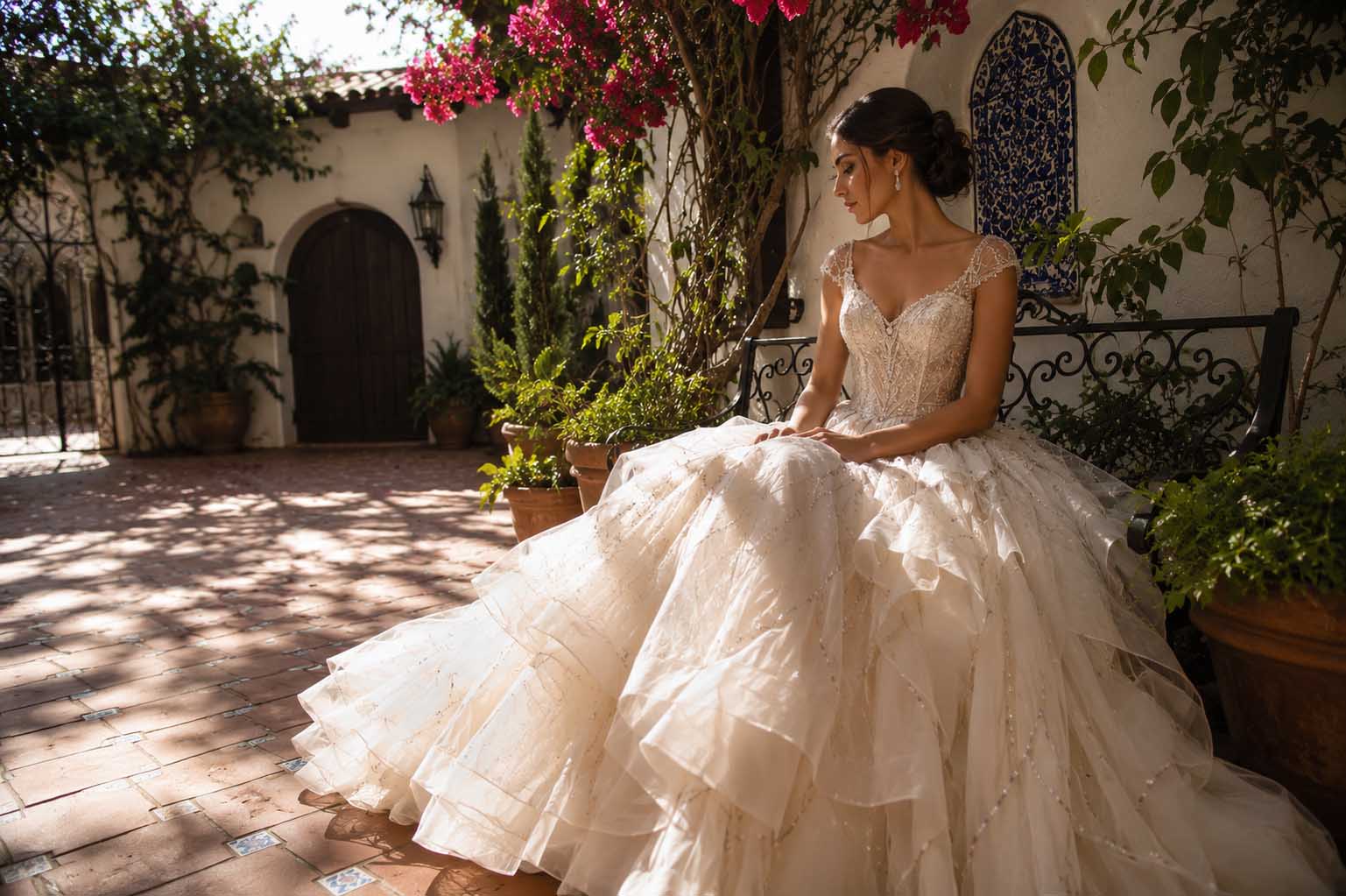
Retro Wedding Dresses are influencing 2026 and 2027 bridal fashion through expressive lace, sculpted corsetry, Basque waists, dramatic sleeves, full skirts, refined bows, and cathedral-length trains. Yet the most compelling new gowns are not literal reproductions of historical dresses. Designers are rebuilding recognizable vintage details with lighter construction, modern support, improved movement, and styling that feels personal rather than theatrical.
This guide explains which vintage-inspired details are worth trying, how different historical eras are being interpreted, and how to balance period references with contemporary comfort, proportion, and fit.
Why are retro wedding dresses trending for 2026–2027?
Brides and designers are revisiting expressive craftsmanship, romantic silhouettes, and recognizable historical details. Corsetry, lace, Basque waists, full skirts, sleeves, and dramatic trains are being updated with flexible support, lighter construction, customization, and contemporary styling that make the gowns easier to wear throughout a modern wedding.
What Are Retro Wedding Dresses?
Retro Wedding Dresses are gowns that use recognizable styling from an earlier fashion period, whether through silhouette, fabric, construction, neckline, sleeves, embellishment, or accessories. They may be newly designed, genuinely vintage, inherited, or closely reproduced from a historical garment.
This article focuses primarily on newly made retro and vintage-inspired gowns. These dresses can deliver the emotional character of an earlier era while offering modern sizing, stronger internal support, more reliable fabrics, and greater alteration flexibility.
| Category | Definition | Typical Advantages | Important Considerations |
| Authentic vintage wedding dress | A gown originally made during a previous fashion period | Historical authenticity, rarity, and distinctive workmanship | Textile condition, fragile seams, limited sizing, staining, and alteration restrictions |
| Heirloom wedding dress | A gown preserved and passed through a family or personal history | Emotional meaning and connection to family tradition | Structural condition, restoration needs, redesign feasibility, and preservation |
| Vintage-inspired wedding dress | A newly made gown influenced by an earlier fashion period | Contemporary sizing, support, fabrics, and comfort | The quality of the historical interpretation varies |
| Retro wedding dress | A new or older gown with clearly recognizable period styling | Strong visual identity and nostalgic character | The complete look should still feel personal rather than costume-like |
| Historically reproduced gown | A design closely based on period construction and styling | Greater historical accuracy and immersive design | Specialized construction, undergarments, accessories, and movement requirements |
The Victoria and Albert Museum’s wedding-dress collection demonstrates how varied bridal attire has been across five centuries. Wedding clothing has never followed one permanent definition of what a bride must wear.
Why Vintage Bridal Details Are Returning in 2026–2027
Brides are increasingly approaching their wedding wardrobe as an expression of identity rather than simply choosing the most familiar bridal silhouette. Visible craftsmanship, unusual proportions, archival references, and customizable details help a gown feel more individual in photographs and in person.
Recent runway reporting supports this movement. Vogue’s Spring 2026 bridal coverage identified draped Basque waists, distinctive lace, bows, unexpected bridal colors, and shaped skirts among the season’s notable directions. Fall 2026 collections continued the interest in lace, statement volume, embellished surfaces, outerwear, and multiple wedding looks. Spring 2027 collections have extended the conversation through lace, asymmetrical design, muted hues, and expressive necklines.
This return to historical detail also offers an alternative to years of extreme minimalism. A bride may still choose a clean, contemporary gown, but she now has greater freedom to add one expressive reference: a corseted waist, a high lace neckline, a sculptural bow, a cathedral veil, or a removable Victorian-inspired sleeve.
Multiple wedding events have expanded the possibilities further. A bride might wear a formal 1950s-inspired ball gown for the ceremony, change into a 1990s satin column for dinner, and choose a 1960s mini dress for the after-party. The looks can tell one connected story without relying on a single era.
The Vintage Eras Influencing Modern Wedding Dresses
Historical bridal fashion is rarely revived in a completely literal form. Designers frequently combine the waist of one period, the sleeve of another, and the fabric restraint of a third.
| Era | Recognizable Bridal Details | Modern 2026–2027 Interpretation | Best for Brides Who Love |
| Victorian and Edwardian | High necks, lace, fitted sleeves, corsetry, covered buttons | Sheer lace, lighter corsetry, illusion necklines, detachable sleeves | Romantic detail and regal coverage |
| 1920s | Beading, dropped waists, fluid movement, Art Deco geometry | Refined beadwork, cleaner drop waists, reception dresses | Movement and old-Hollywood glamour |
| 1930s | Bias-cut satin, draped necklines, long fluid silhouettes | Silk-like fabrics, sculptural draping, minimalist luxury | Restrained elegance and softness |
| 1940s | Defined shoulders, controlled waists, sleeves, tailored construction | Bridal jackets, structured sleeves, tailored bodices | Polished coverage and architectural form |
| 1950s | Defined waists, full skirts, tea-length hems, portrait necklines | Modern ball gowns, Basque waists, removable overskirts | Celebratory volume and feminine proportions |
| 1960s | Mod silhouettes, short dresses, clean lines, graphic simplicity | Mini reception dresses, crisp fabrics, simple accessories | Fashion-forward restraint |
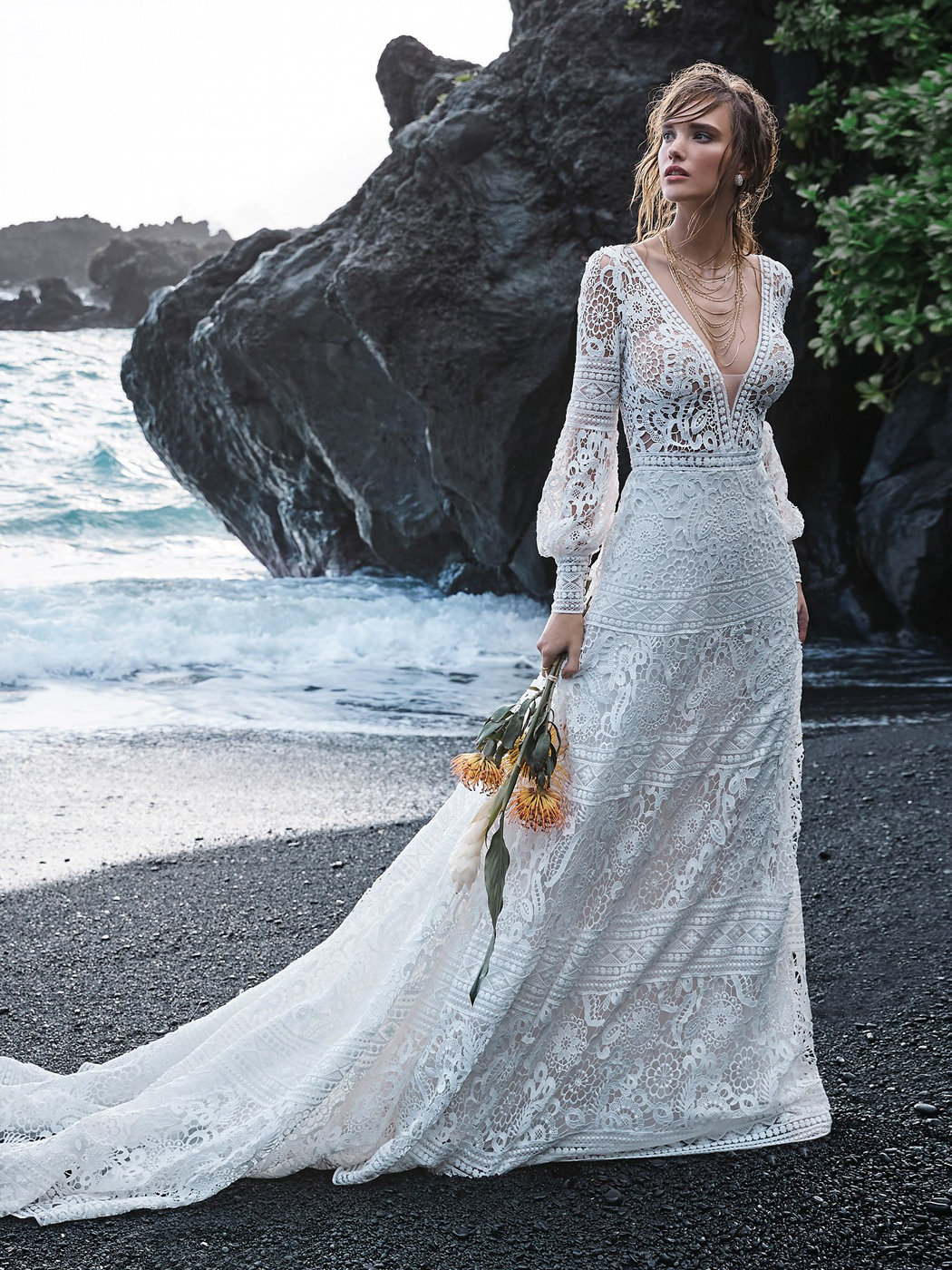
| 1970s | Flowing skirts, bell sleeves, soft lace, bohemian ease | Refined boho lace, fitted illusion sleeves, lighter trains | Outdoor celebrations and relaxed romance |
| 1980s | Puff sleeves, large bows, cathedral trains, expansive skirts | Controlled volume, removable sleeves, sculptural bows | Princess drama and expressive fashion |
| 1990s | Slip dresses, square necklines, clean satin, minimal embellishment | Corseted columns, bias-inspired skirts, modern satin gowns | Editorial simplicity |
The V&A notes that wedding garments were frequently altered and reworn during the 18th and 19th centuries, reminding modern brides that customization and transformation are not entirely new ideas.
Retro Wedding Dresses: Details Worth Trying in 2026–2027
Basque Waists and Sculpted Corset Bodices
A Basque waist extends below the natural waist in a V-shaped or softly curved point. The line recalls historical bodices and corseted formalwear, but contemporary interpretations can use flexible boning, shaped cups, support panels, and carefully positioned seams.
The depth of the point matters. A strong Basque shape can create a dramatic transition into a ball-gown skirt, while a softer version may provide historical character without dominating the silhouette. Bodice length, torso proportion, cup placement, and skirt attachment must be considered together.
During an appointment, compare a natural waist with both soft and deeply sculpted Basque shapes. Sit, turn, and bend slightly to determine whether the bodice remains supportive without pressing uncomfortably into the body.
Brides exploring waist construction can also review Bridal & Tuxedo Galleria’s guide to wedding-dress waistlines and its detailed drop-waist wedding-dress guide.
Full Ball-Gown and Princess Skirts
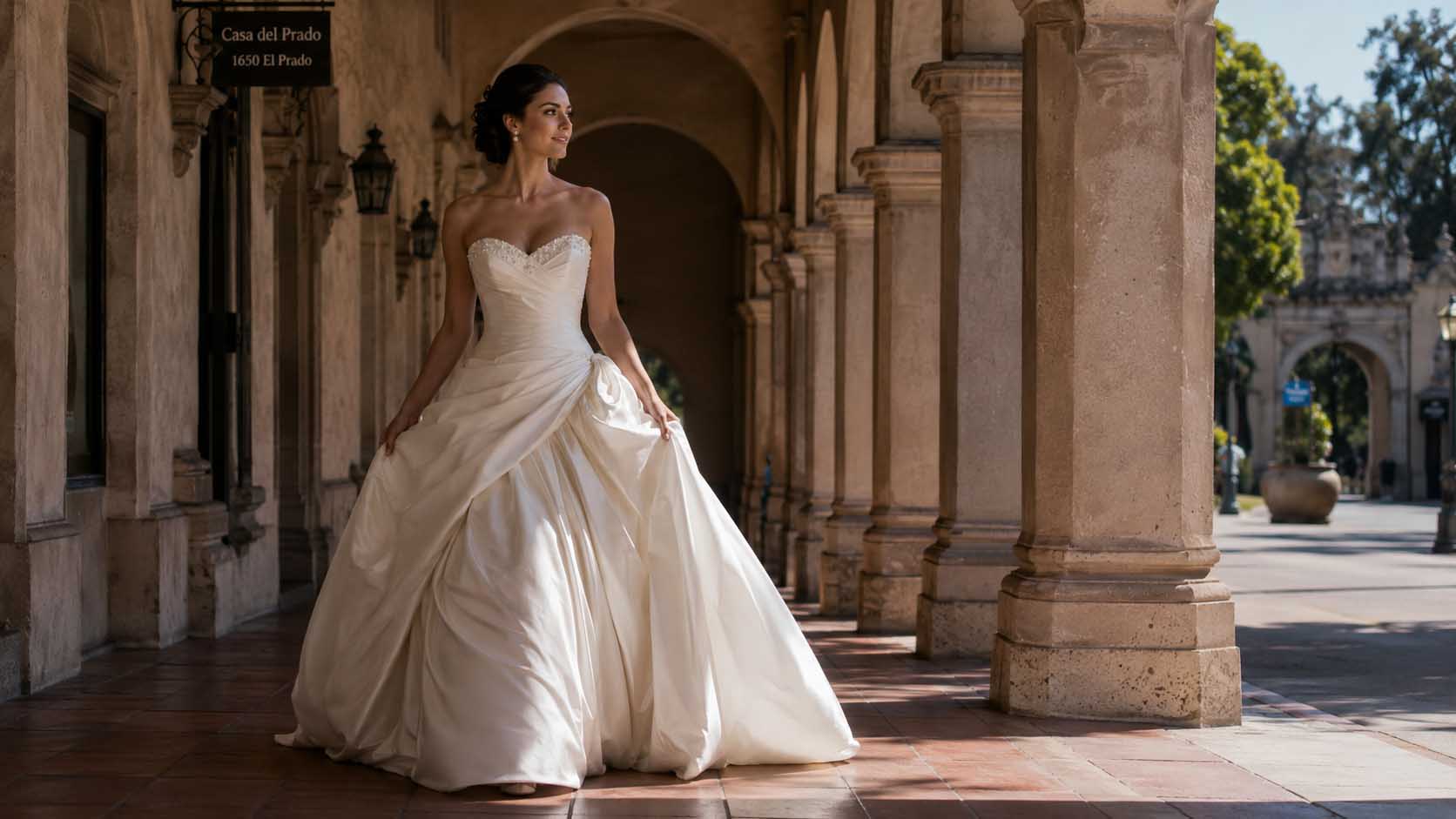
The full skirt remains one of the strongest connections between historical formalwear and modern bridal couture. Tulle, organza, satin, and Mikado produce very different types of volume.
Layered tulle can create softness and air, while Mikado and structured satin produce a more architectural outline. Organza can hold shape while feeling visually lighter. Petticoats, horsehair edging, pleats, gathers, and internal skirt layers determine where the volume begins and how it moves.
A well-constructed skirt does not simply become larger in every direction. Its fullness is deliberately distributed to support the bodice, waist, train, and bride’s proportions.
Try walking at a natural pace rather than taking small showroom steps. Notice whether the skirt follows your movement or requires you to kick it forward. Brides considering this silhouette can explore ball gown wedding dresses before their appointment.
Vintage Lace With Modern Placement
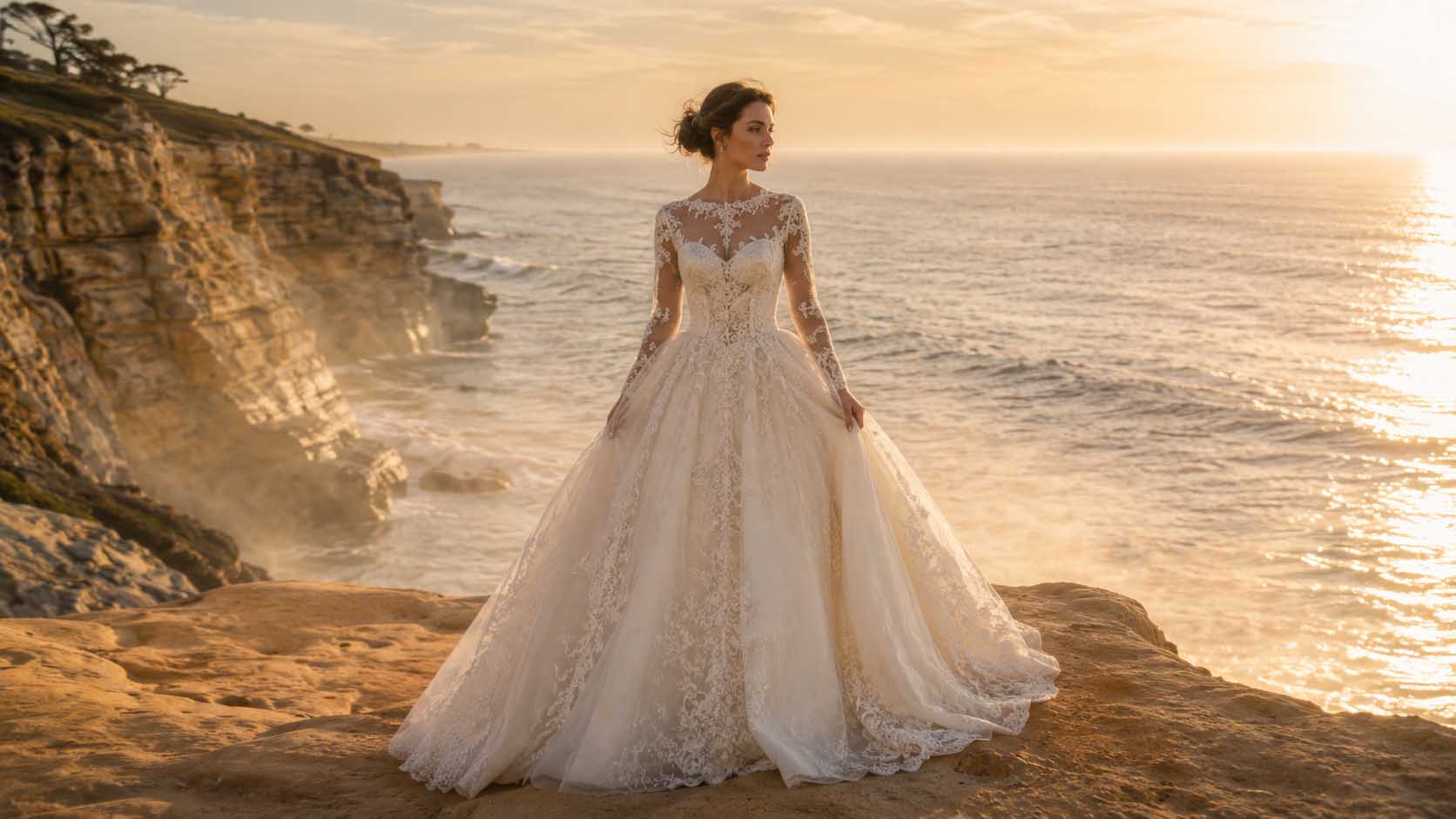
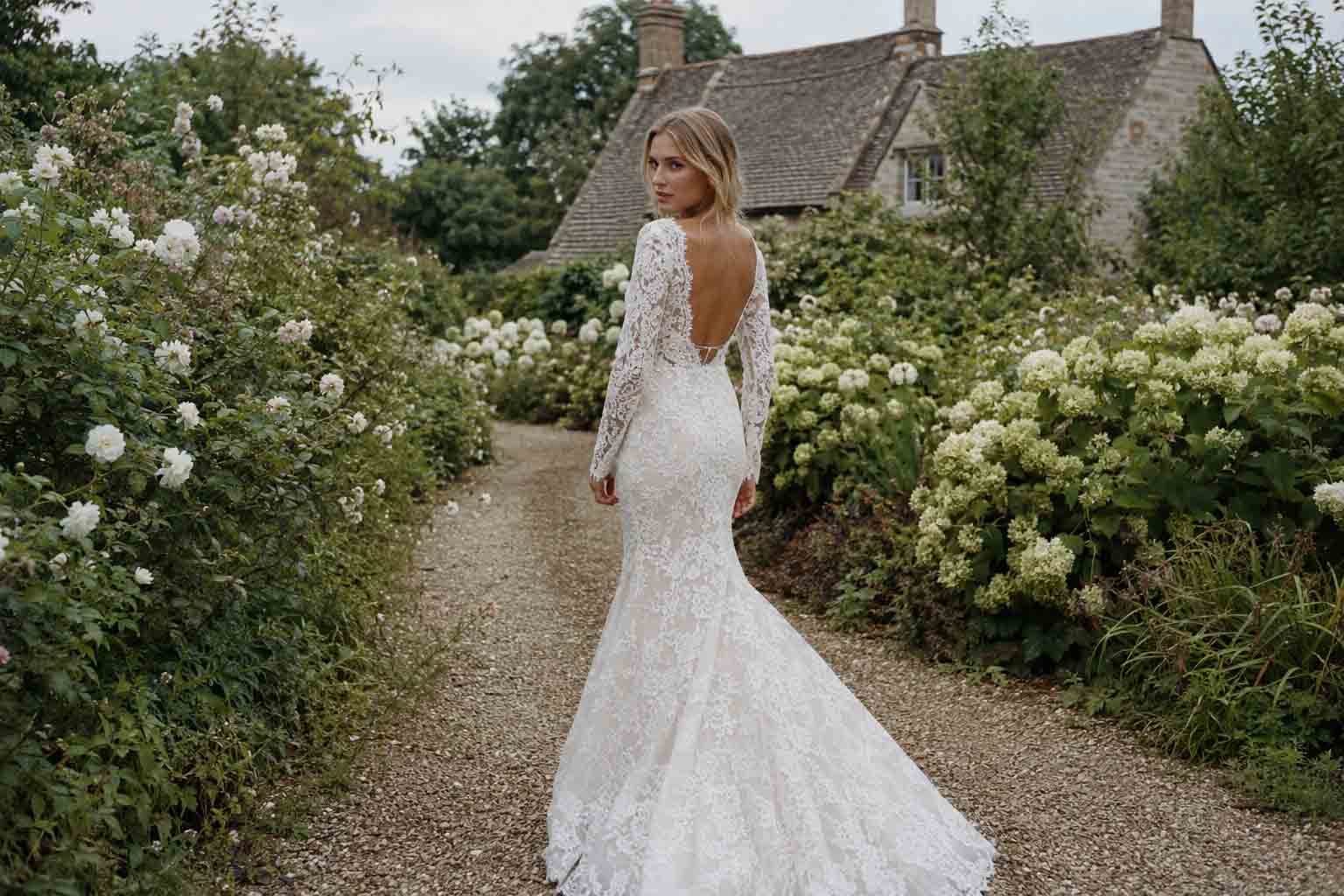
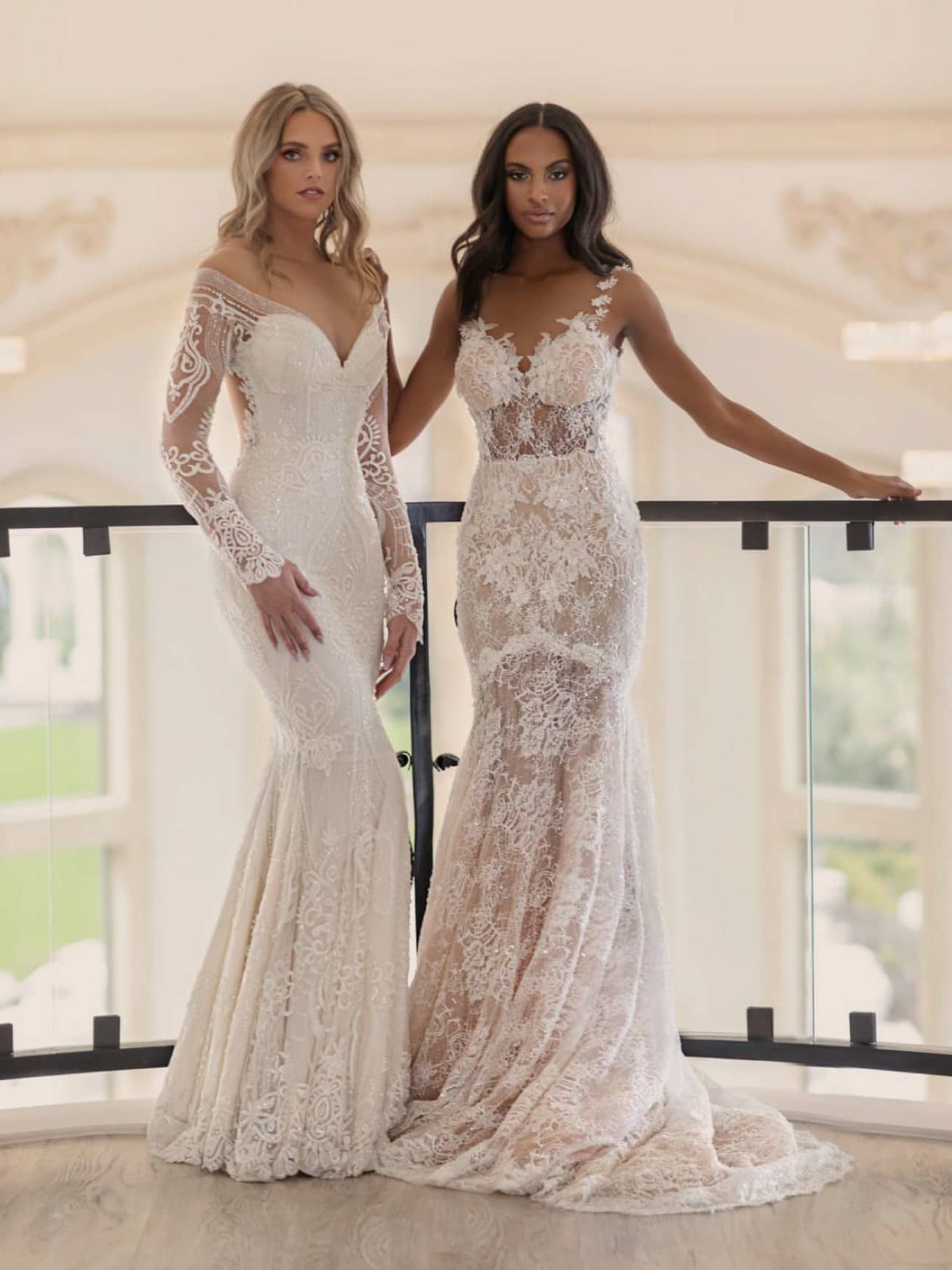
Lace can establish a historical mood more quickly than almost any other bridal material, but its scale and placement determine whether the result feels antique, romantic, botanical, dramatic, or contemporary.
Chantilly lace is typically delicate and lightweight. Guipure lace has a denser, more graphic quality. Embroidered tulle can create definition without covering the entire gown, while dimensional appliqués introduce texture and depth.
Modern designers often preserve open space around lace motifs rather than covering every surface. A lace bodice may transition into a cleaner skirt, or appliqués may become more concentrated along the train.
During a fitting, view the gown from several feet away. Close-up craftsmanship matters, but the overall lace pattern should remain coherent in full-length photographs.
For additional detail, review Bridal & Tuxedo Galleria’s lace A-line wedding-dress guide and bridal appliqué guide.
Vogue has identified lace as a major element across recent 2026 bridal collections, while the Fashion Institute of Technology’s analysis of Queen Victoria’s 1840 gown explains the lasting association between white lace and Western bridal fashion.
Victorian and Edwardian Sleeves
Fitted lace sleeves, bishop sleeves, puffed shoulders, high cuffs, illusion panels, and covered buttons can reference Victorian or Edwardian fashion without requiring a fully historical gown.
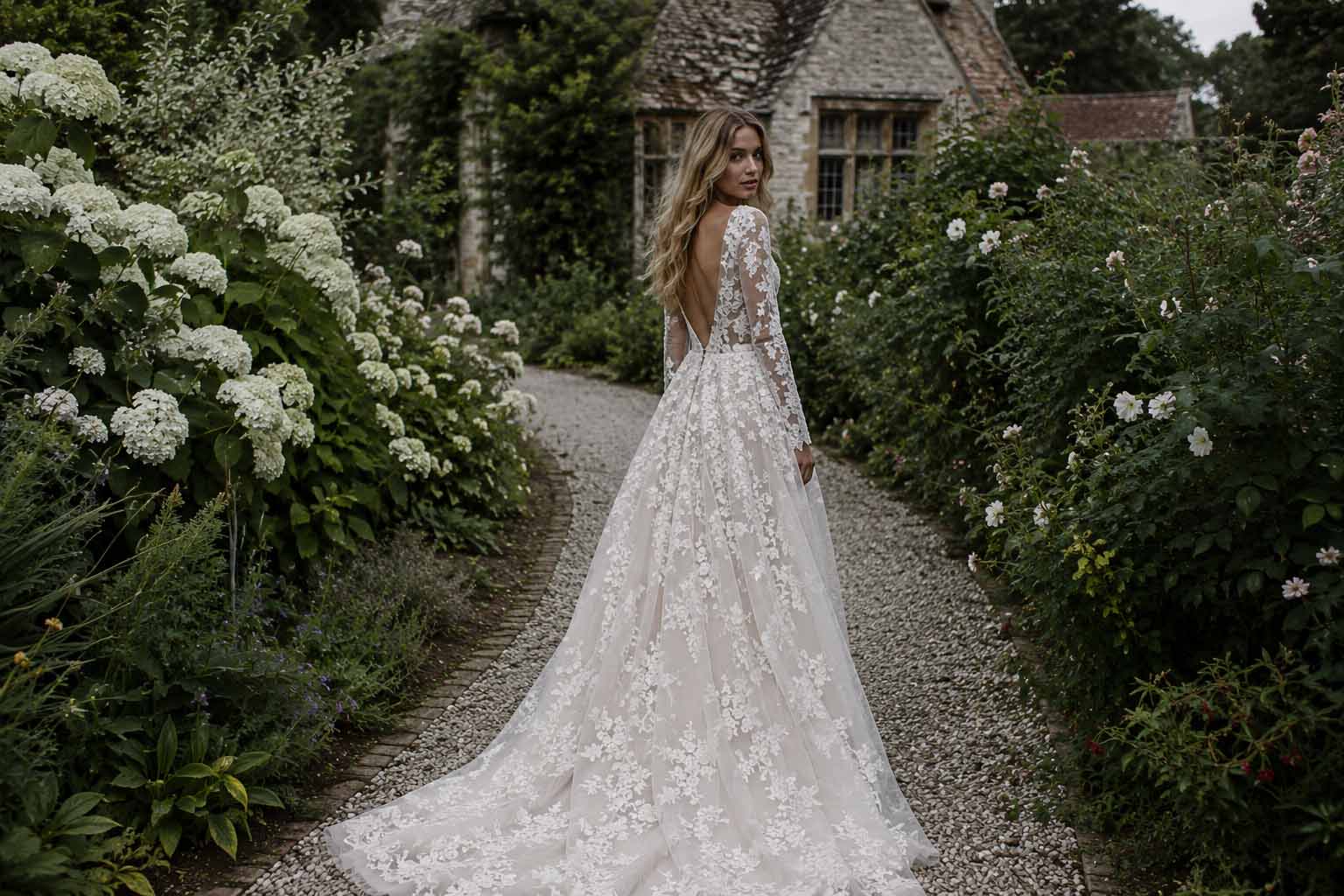
Modern sheer construction allows lace motifs to appear suspended over the arms. Detachable versions can provide ceremony coverage and a more open reception look.
Mobility is essential. Raise your arms, reach forward, hug someone, and sit with your hands in your lap. Beautiful sleeves should support the visual composition without preventing natural movement.
Dramatic 1980s-Inspired Sleeves and Bows
The expressive scale of 1980s bridal fashion is returning through refined puff sleeves, sculptural bows, prominent shoulders, and expansive trains. The modern difference is control.
A removable sleeve can create ceremony drama without committing the bride to the same volume all evening. A large bow may be positioned at the waist, shoulder, or back rather than combined with multiple competing features.
The Fashion Institute of Technology’s discussion of Princess Diana’s 1981 wedding dress illustrates how historical references, formal tradition, dramatic sleeves, and fairytale scale came together in one influential design.
Try removing one accessory before making a final decision. When the gown already includes a dramatic sleeve or bow, simpler jewelry and hair styling may allow the detail to feel more intentional.
Cathedral Trains and Regal Back Details
A cathedral train can transform a simple entrance into a ceremonial moment. Lace motifs, covered buttons, sculptural seams, and extended panels may also make the back of the gown as important as the front.
Practical planning should include the aisle width, flooring, outdoor surfaces, transportation, stairs, photography locations, and bustle construction.
The Metropolitan Museum of Art has documented historic bridal ensembles with dramatic cathedral-length trains, demonstrating how train construction can function as both textile art and ceremonial design.
Before choosing a long train, ask how it will be bustled and whether the bustle will preserve the skirt’s intended proportions. Bridal & Tuxedo Galleria’s guide to wedding-dress bustle types explains why fabric weight and internal construction matter as much as the bustle style’s name.
Portrait, Square, High, and Sweetheart Necklines
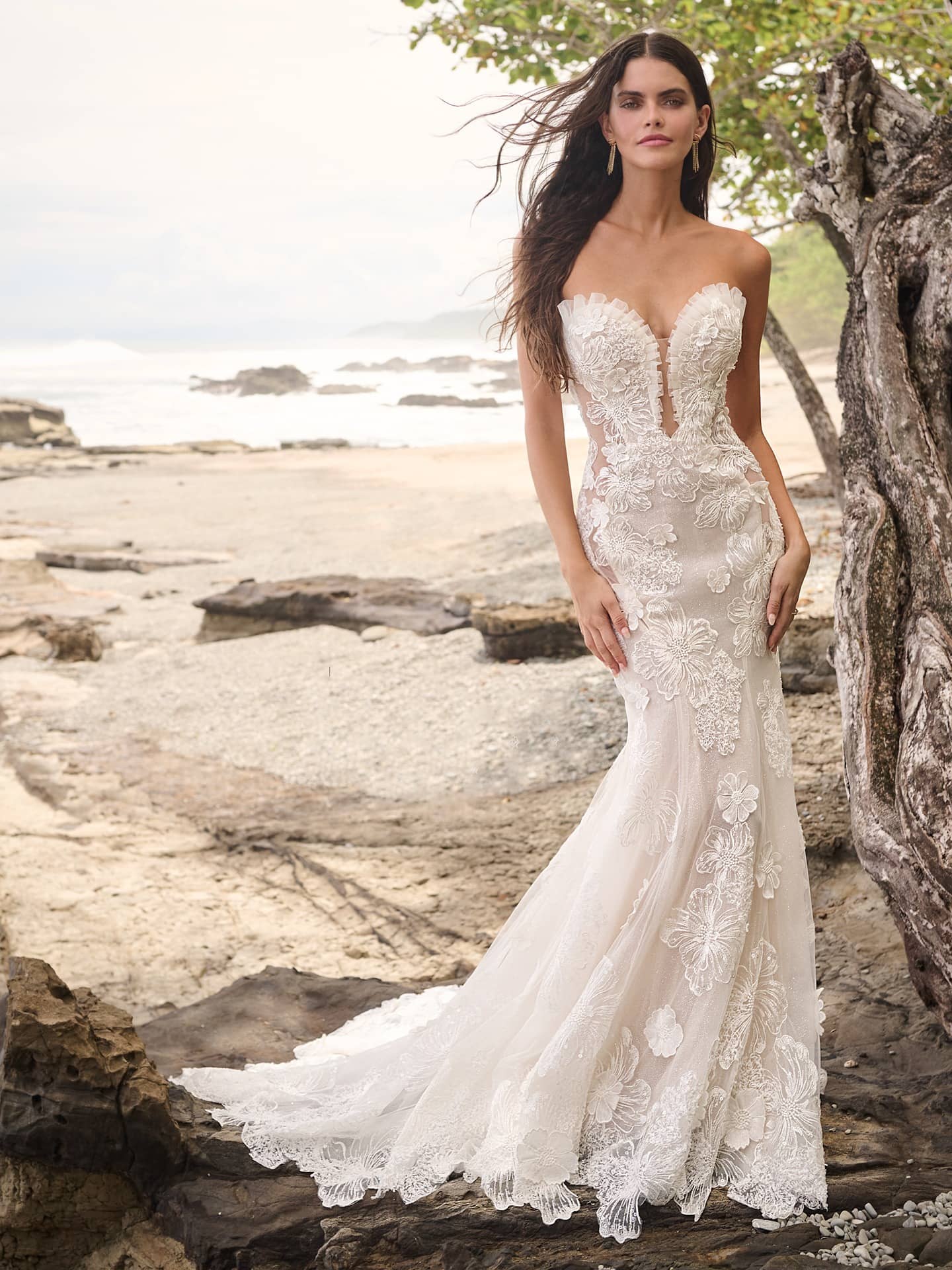
A neckline can reference an era without changing the entire gown. Portrait and sweetheart necklines create romantic curves, while square necklines can suggest Regency or 1990s restraint. High lace necklines introduce a more Victorian character.
Modern cups, illusion panels, straps, boning, and internal support can improve security while preserving the intended shape.
Compare neckline options while viewing the complete dress. A dramatic neckline may feel balanced with a controlled skirt but overly busy when combined with large sleeves, heavy lace, and statement jewelry.
Brides comparing these details can consult the boutique’s wedding-dress neckline guide.
Draped Satin and Old-Hollywood References
Bias-inspired lines, liquid satin, gathered waists, asymmetric draping, and cowl necklines recall the long silhouettes of the 1930s and the clean glamour associated with old Hollywood.
Softness does not mean the gown lacks structure. A fluid dress may still depend on internal support, carefully stabilized seams, lining, and controlled fabric grain.
Sit and walk in the gown while observing whether the draping returns to its intended position. Fabric that looks effortless may require highly precise patternmaking and tailoring.
Gloves, Veils, and Vintage-Inspired Headpieces
Accessories can establish a retro influence without altering the ceremony gown itself. Opera gloves may create formal drama, while short wrist gloves feel more playful. A lace mantilla, blusher veil, cathedral veil, Juliet cap, or pearl headpiece can reference a specific historical mood.
Choose one dominant accessory story. Gloves, a heavily embellished veil, statement earrings, and a jeweled headpiece may compete when worn together.
A modern hairstyle or restrained jewelry can prevent historically influenced accessories from appearing overly literal.
Soft Ivory, Champagne, and Muted Bridal Tones
Warm ivory, pale champagne, subtle blush, and muted undertones can add age, depth, or softness to a bridal look. These colors also change the appearance of lace and embroidery.
Spring 2026 and Spring 2027 bridal reporting has highlighted increased interest in not-quite-white gowns and softly muted colors.
Evaluate the color in natural and indoor light. Venue lighting, fabric sheen, photography style, lining color, and personal preference can all affect the final result. No single shade is universally preferable.
Bridal Jackets, Capes, and Removable Layers
A tailored jacket can reference the 1940s, while a lace cape or high-neck topper may introduce Victorian formality. Removable layers also provide flexibility for religious ceremonies, coastal evenings, winter estates, and air-conditioned ballrooms.
Check how the layer attaches and whether it changes the neckline, waist, or back of the gown. The dress should look intentional both with and without it.
Tea-Length and Mini Reception Dresses
A tea-length dress can bring a 1950s mood to a rehearsal dinner, civil ceremony, or reception. A clean mini dress may reference the 1960s while offering greater freedom for dancing.
This approach allows the ceremony gown to remain modern or formal while a second look carries the stronger retro identity.
Why Ball Gowns Are Central to the Retro Revival
The ball gown is one of the clearest bridges between historical formalwear and contemporary bridal design. Its fitted bodice, defined waist, full skirt, and extended train create ceremonial presence without requiring a historically accurate reproduction.
The silhouette also provides space for different references: a corseted Victorian bodice, a 1950s waist, an 1980s sleeve, or a modern minimalist skirt.
The sculptural potential of formal skirts has long interested couture designers. The Metropolitan Museum of Art describes Charles James as combining the roles of sculptor, architect, and engineer in his complex 1950s ball gowns—an approach that remains relevant to modern bridal construction.
| Traditional Reference | Modern Couture Update |
| Heavy corsetry | Flexible internal support and precise fitting |
| Dense petticoats | Engineered layering and lighter volume |
| Fixed sleeves | Detachable sleeves and convertible styling |
| Highly covered bodices | Customizable necklines and illusion options |
| Dense embroidery | Strategically placed appliqué and beadwork |
| Formal-only styling | Adaptable accessories and reception transformations |
The modern ball gown can feel regal without reproducing a royal costume. The distinction comes from fabric quality, disciplined proportions, internal engineering, and the bride’s ability to move naturally.
Princess Wedding Dresses Without the Costume Effect
A princess-inspired gown should create presence through proportion rather than literal character styling.
Choose one or two dominant references. A sculpted Basque-waist bodice with a smooth Mikado skirt may feel regal and modern. A lace corset, puff sleeves, cathedral veil, large bow, jeweled crown, and heavily embellished skirt worn together may create too many competing narratives.
A balanced princess look usually depends on:
- A clearly defined waist and intentional skirt shape
- Premium fabric with enough body to maintain its design
- Controlled embellishment
- A secure, contemporary fit through the bust and torso
- Accessories scaled to the gown
- Hair and makeup that feel connected to the bride’s normal style
- Enough movement for walking, sitting, turning, and dancing
- Detachable elements when a transformation is desired
- A silhouette appropriate to the venue’s architecture and formality
The bride should remain visually central. The dress may be dramatic, but it should not appear to be performing without her.
The Navid Noor Collection and Modern Vintage Grandeur
Navid Noor is the owner and head designer associated with Bridal & Tuxedo Galleria’s couture direction. The exclusive Lumière by Navid Noor collection interprets the visual language of high-end bridal design through sculpted construction, considered proportions, architectural lines, refined fabrics, embellishment, and customization.
Within this design language, the grandeur of historical ball gowns can be translated through a sculpted bodice, corset-informed support, intentional waist placement, balanced skirt volume, lace appliqué, fine beadwork, and a sweeping train.
These elements should not be understood as copies of a particular historic gown. Their strength lies in how recognizable ideas—ceremony, romance, structure, and scale—are reorganized around an individual bride.
The strongest Navid Noor ball-gown designs do not use volume for volume’s sake. The bodice, waist, skirt, and train should function as one composition, creating presence while still allowing the bride to stand, walk, sit, turn, and dance naturally.
Navid Noor Design Perspective — Editorial Paraphrase
A successful princess-inspired gown begins with proportion and engineering. The skirt volume, bodice structure, waist position, train, and bride’s movement should be treated as one complete silhouette. Historical drama becomes modern luxury when the bride feels supported rather than restricted.
Editorial verification note: Confirm this paraphrase, collection terminology, and referenced construction details with Navid Noor or an authorized Bridal & Tuxedo Galleria representative before publication.
Brides can learn more about the collection and customization process through the boutique’s guide to custom wedding dresses in San Diego.
Explore Vintage-Inspired Couture
Compare sculpted bodices, regal ball-gown silhouettes, lace placement, corset construction, and custom possibilities during a private bridal appointment in San Diego.
Retro Versus Modern: How to Find the Right Balance
| Design Decision | More Historically Expressive | More Modern and Restrained | Balanced Direction |
| Sleeves | Full puff or bishop sleeve | Strapless or minimal straps | Detachable structured sleeve |
| Lace | Full-coverage antique pattern | Small, clean appliqué | Lace concentrated on the bodice and train |
| Waist | Strong corseted Basque waist | Natural waist with minimal seaming | Soft Basque shape with flexible support |
| Skirt | Maximum volume and layering | Clean A-line or column | Structured ball gown with controlled fullness |
| Accessories | Gloves, veil, jewelry, and headpiece | One minimal accessory | One statement vintage reference |
| Color | Deep cream or colored bridal look | Bright ivory | Warm ivory or subtle undertone |
| Train | Cathedral or royal length | Sweep or chapel train | Dramatic ceremony train with a practical bustle |
The right balance depends on personality, venue, photography, movement, comfort, and the bride’s emotional response, not only the trend.
Which Retro Details Suit Different Wedding Settings?
San Diego Coastal Weddings
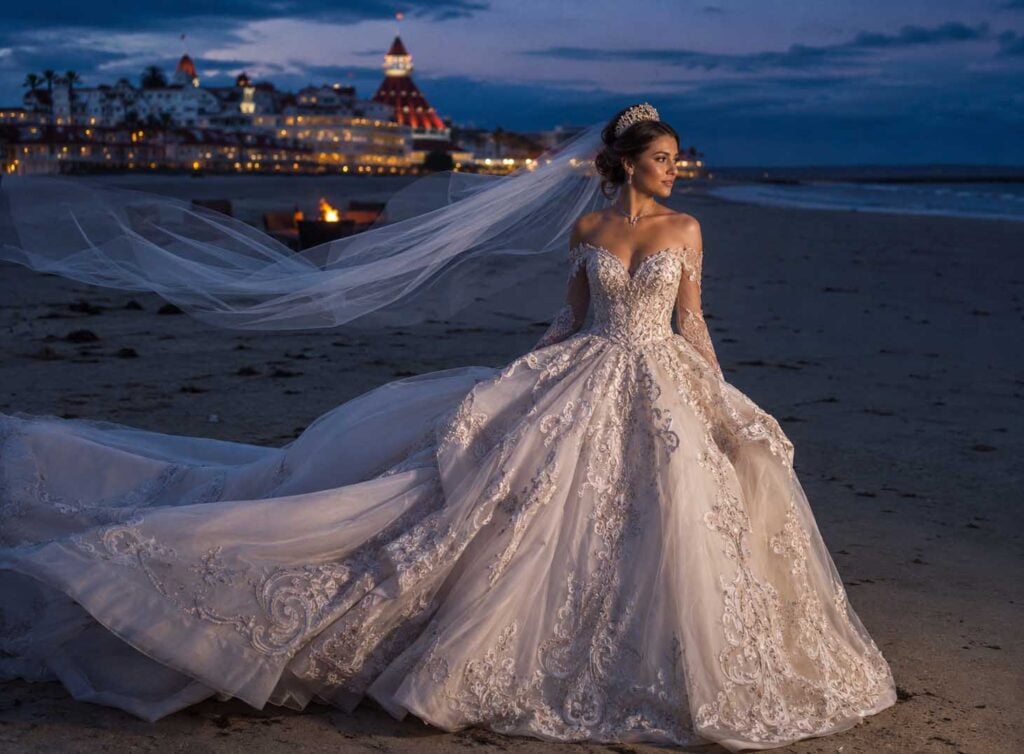
Coastal ceremonies in La Jolla, Coronado, or other waterfront settings may require lighter layers, breathable lining, secure veils, and manageable trains. Wind can lift lightweight sleeves and veils, while sand, stairs, and uneven surfaces can make dense skirts difficult to manage.
A retro-inspired lace A-line, draped satin gown, or lighter corseted silhouette may preserve the intended mood without excessive weight.
Luxury Ballroom Weddings
Structured Mikado, satin ball gowns, formal gloves, cathedral trains, and defined corsetry can feel especially appropriate in luxury ballrooms and Downtown San Diego hotels.
Indoor lighting may emphasize sheen and beadwork differently from daylight, so review photographs and video under several lighting conditions.
Estate and Vineyard Weddings
Romantic lace, warm ivory, fitted sleeves, textural skirts, and softer historical references work naturally in estate and vineyard environments.
Consider gravel, grass, temperature changes, transportation, and the walking distance between ceremony and reception spaces.
Garden Weddings
Floral appliqué, detachable sleeves, soft volume, and tea-length second looks complement garden settings without requiring literal botanical styling.
Train management is especially important on grass and garden pathways.
Historic or European-Inspired Venues
Basque waists, portrait necklines, cathedral veils, shaped skirts, and tailored jackets can respond beautifully to old-world architecture.
Use the venue as context rather than a costume brief. The gown should relate to the space without imitating its historical period in every detail.
Resort and Destination Weddings
Travel-friendly construction, removable layers, controlled volume, lighter corsetry, and a practical reception transformation can make a retro-inspired gown easier to transport.
Discuss steaming, garment storage, airline travel, and on-location alterations before finalizing the design.
Choosing Retro Wedding Dresses for Your Personal Style
The Romantic Bride
Try Victorian lace, 1970s softness, or a 1950s portrait neckline. Consider an A-line silhouette, embroidered tulle, fitted illusion sleeves, and a delicate blusher veil. Keep the look current with open lace placement or a clean skirt.
The Regal or Princess-Inspired Bride
Explore a Basque-waist ball gown, Mikado, satin, a sculpted sweetheart neckline, and a cathedral veil. Modernize the look through controlled embellishment and detachable sleeves.
The Minimalist Bride Who Wants One Vintage Detail
Choose a 1990s satin column or clean A-line with one historical element, such as a corset seam, square neckline, opera gloves, or a sculptural bow.
The Fashion-Forward Bride
Combine an asymmetrical bodice with a drop waist, removable skirt, unexpected headpiece, or muted bridal tone. Keep the silhouette coherent by limiting the number of competing details.
The Old-Hollywood Bride
Look for bias-inspired satin, a draped neckline, column or fit-and-flare silhouette, soft waves, and restrained jewelry. Modern internal support can provide security without disturbing the fluid exterior.
The Bohemian Bride
Explore 1970s lace, fitted or bell sleeves, lighter A-line skirts, textural fabrics, and a simple veil. Cleaner lace placement can prevent the design from feeling overly themed.
The Modest Bride
Consider high lace necklines, long fitted sleeves, illusion coverage, tailored jackets, and Edwardian-inspired details. Modernize the look with lighter fabrics and carefully matched illusion tulle.
The Bride Who Wants Two Distinct Looks
A formal ball gown can establish ceremony drama, while a tea-length dress, satin column, or 1960s-inspired mini provides a more relaxed reception look.
What Can Be Customized or Altered?
Many vintage-inspired details can be refined, but feasibility depends on the gown’s seams, fabric, lining, internal support, available material, timeline, and degree of reconstruction.
Possible changes include:
- Neckline depth and shape
- Cup size and bust support
- Boning and internal support
- Strap width or placement
- Sleeve addition or removal
- Detachable sleeve construction
- Illusion coverage
- Back height
- Waist placement
- Basque-waist depth
- Bodice length
- Skirt volume
- Petticoat construction
- Train length
- Lace or appliqué placement
- Lining color
- Bustle design
- Removable overskirts and reception transformations
| Requested Change | Often Possible? | Main Consideration |
| Add detachable straps | Often | Attachment points and bodice support |
| Adjust neckline depth | Sometimes | Cups, seams, lace, and internal construction |
| Add sleeves | Sometimes | Matching material, armhole shape, and support |
| Soften a Basque waist | Sometimes | Bodice pattern and skirt attachment |
| Reduce skirt volume | Often | Layer construction and silhouette balance |
| Add skirt volume | Often | Petticoat, underskirt, and fabric behavior |
| Shorten a train | Often | Lace motifs, hem design, and proportion |
| Add lace appliqué | Often | Material match, placement, and visual balance |
| Replace a zipper with a corset back | Case dependent | Pattern allowance and bodice engineering |
| Rebuild the entire bodice | Major modification | Cost, timeline, fabric, and structural feasibility |
Simple alterations refine fit without substantially changing the design. Structural alterations affect the gown’s support or pattern. Custom modifications add or replace significant components. Full custom design begins with a new concept and pattern.
No alteration should be promised before the gown is professionally assessed. Brides can explore wedding-dress alterations and in-house tailoring to understand the fitting process.
A Softer Next Step
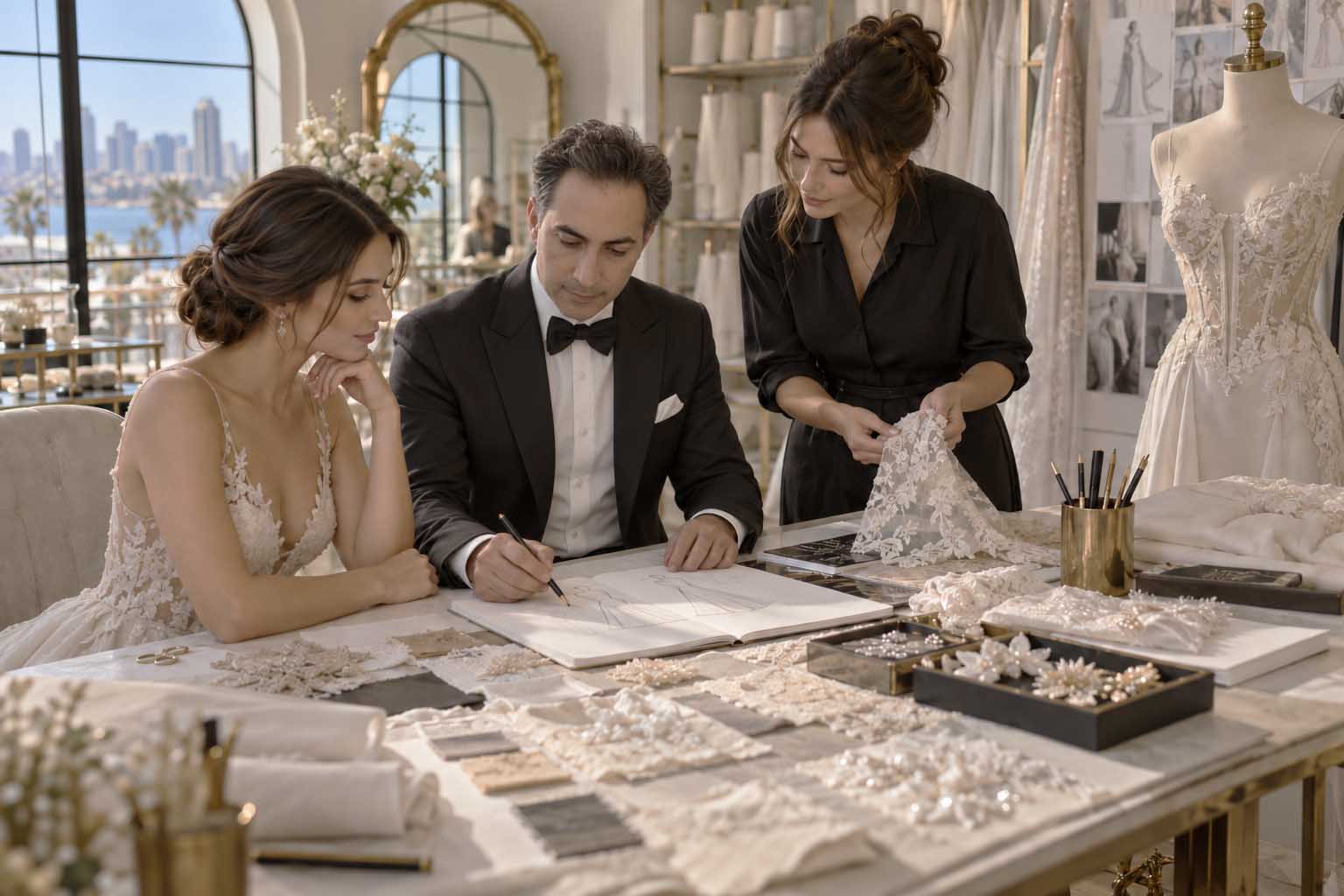
Bring photographs that communicate specific details—such as a waist shape, sleeve, lace scale, or train—rather than requesting an exact copy of another designer’s gown. A stylist can then help identify realistic designer, alteration, or custom options.
A Stylist’s Checklist for Trying Retro-Inspired Gowns
During your appointment, ask:
- Does the historical influence feel authentic to my personality?
- Am I visually central, or is the gown wearing me?
- Can I breathe comfortably?
- Does the bodice remain secure without constant adjustment?
- Is the waist positioned intentionally?
- Does the skirt volume begin at the right point?
- Can I sit naturally?
- Can I walk without kicking the skirt?
- Can I turn and climb stairs?
- Can I hug someone comfortably?
- Can I raise my arms?
- Can I dance?
- Does the train suit the venue?
- Can the train be bustled effectively?
- Does the dress photograph well from the front, side, and back?
- Do the accessories support rather than compete with the gown?
- Would removing one detail make the design stronger?
- Does the gown still feel like me after the initial surprise?
The Movement Test
Do not evaluate a gown only while standing on a pedestal. Test:
- Walking at a natural pace
- Sitting in a standard chair
- Bending slightly
- Hugging another person
- Raising both arms
- Turning in both directions
- Climbing several steps
- Performing basic dance movements
- Considering restroom access
- Imagining the gown after several hours of wear
Common Mistakes When Choosing a Retro-Inspired Gown
Avoid:
- Combining multiple historical eras without a clear direction
- Selecting a gown based only on edited social-media photographs
- Confusing visual scale with construction quality
- Ignoring internal bust and waist support
- Choosing a large skirt without testing movement
- Selecting heavy sleeves without checking arm mobility
- Over-accessorizing an already detailed neckline
- Assuming an authentic vintage gown can be altered like a new dress
- Ignoring climate, flooring, stairs, transportation, or aisle width
- Judging a sample before it is properly clipped
- Assuming sample size reflects the final tailored fit
- Choosing a trend instead of identifying a personal design language
- Waiting too long to discuss structural changes
- Failing to plan the bustle
- Using “princess” without defining the desired waist, skirt, fabric, neckline, and detailing
What to Expect at a Private Bridal Appointment in San Diego
Established in 1994, Bridal & Tuxedo Galleria has more than 30 years of experience serving brides in San Diego, Orange County, and throughout Southern California. The boutique offers designer gowns, private styling, custom design possibilities, and in-house alterations.
During a private appointment, a stylist can help you compare:
- Vintage-inspired and contemporary gowns
- Ball-gown and A-line volume
- Natural, Basque, and drop waists
- Strapless and sleeved bodices
- Lace and smooth fabrics
- Structured and fluid construction
- Ceremony drama and reception practicality
- Designer gowns and custom modifications
- Sample fit and final tailored fit
- Different Lumière by Navid Noor design directions
Bring reference images, your wedding date, venue information, and examples of the specific elements you value. The goal is not to reproduce another designer’s work. It is to understand the visual language you love and find an interpretation that belongs to you.
Current samples and gown availability can change, so confirm specific styles directly with the boutique before visiting.
Are Retro Wedding Dresses Right for You?
Consider these questions:
- Are you consistently drawn to the silhouette of a particular era?
- Do you prefer visible craftsmanship or clean simplicity?
- Would you rather wear one vintage detail or a fully expressive look?
- Do you want romantic softness, regal structure, old-Hollywood glamour, or playful retro styling?
- How important are sleeves, coverage, or corset support?
- Can your venue accommodate a dramatic skirt or train?
- Would detachable pieces make the gown more versatile?
- Are you comfortable while moving?
- Does the design feel personal rather than performative?
- Could alterations or custom design refine the concept?
The best gown connects historical inspiration with your own identity, comfort, movement, and wedding setting.
Frequently Asked Questions
1. What are Retro Wedding Dresses?
Retro Wedding Dresses use recognizable styling from a previous fashion period, including corsetry, lace, full skirts, dropped waists, sleeves, bows, satin draping, or distinctive accessories. They may be authentic older gowns or newly made designs. Most modern bridal versions combine historical references with contemporary sizing, internal support, lighter fabrics, and improved movement.
2. What is the difference between retro and vintage wedding dresses?
An authentic vintage wedding dress was actually made during an earlier period. A retro dress uses recognizable styling associated with that period but may be newly produced. A vintage-inspired gown interprets historical details more loosely, while an heirloom gown has personal or family history regardless of its precise fashion era.
3. Are retro wedding dresses trending for 2026 and 2027?
Yes. Current bridal collections and fashion reporting show renewed interest in lace, corsetry, Basque waists, full skirts, bows, muted tones, dramatic sleeves, outerwear, and multiple bridal looks. These details are generally being modernized rather than reproduced literally, giving brides historical character with contemporary fit and construction.
4. Which vintage wedding-dress eras are influencing modern bridal fashion?
Victorian lace and sleeves, 1920s beadwork and dropped waists, 1930s satin draping, 1950s full skirts, 1960s mini dresses, 1970s lace, 1980s volume, and 1990s minimalism are all visible in modern bridal design. Many current gowns combine details from several periods.
5. Are Basque-waist wedding dresses considered vintage-inspired?
Yes. The pointed or curved Basque waist has historical associations with corseted formalwear and earlier European fashion. Modern bridal versions often use lighter boning, shaped cups, flexible support, and controlled skirt construction to create the distinctive waistline without reproducing a historical understructure exactly.
6. How can I wear a princess wedding dress without looking costume-like?
Choose one or two dominant princess references and keep the rest of the look controlled. A sculpted bodice and full skirt may need only a simple veil. High-quality fabric, precise tailoring, modern hair and makeup, balanced accessories, and natural movement help the gown feel luxurious rather than theatrical.
7. Which fabrics create a vintage bridal look?
Chantilly lace, guipure lace, satin, silk-like charmeuse, Mikado, organza, embroidered tulle, moiré-inspired textures, and dimensional appliqués can all create vintage character. The effect depends on the silhouette, lining, lace scale, draping, color, and placement rather than the fabric name alone.
8. Can sleeves be added to a strapless retro wedding dress?
Sometimes. Detachable straps, off-the-shoulder drapes, illusion sleeves, and boleros may be possible, but the gown must have suitable attachment points and adequate bodice support. Matching lace or fabric can also be challenging. A bridal tailor should evaluate the gown before the change is promised.
9. Can an authentic vintage wedding dress be altered?
Potentially, but older textiles and seams may be fragile. Alterations should begin with a professional assessment of the fabric, lining, closures, seam allowance, lace, beadwork, and structural condition. In some cases, stabilization or restoration must occur before fit alterations are attempted.
10. Are ball gown wedding dresses comfortable?
They can be, provided the weight and volume are properly engineered. Comfort depends on bodice fit, waist support, skirt layers, petticoat construction, fabric weight, train length, and bustle design. Brides should walk, sit, turn, climb stairs, and dance in the gown before making a final decision.
11. What accessories work with a retro wedding dress?
Gloves, cathedral veils, blushers, mantilla veils, Juliet caps, pearl details, sculptural bows, and vintage-inspired earrings can all work. Select accessories according to the gown’s scale. One strong reference often creates a more refined result than combining several historically expressive pieces.
12. Can I combine vintage details with a modern wedding-dress silhouette?
Yes. A modern column can include a corseted bodice, a clean A-line can feature Victorian sleeves, and a minimalist ball gown can use a Basque waist. Combining one historical element with a contemporary silhouette is often the simplest way to create a balanced vintage-inspired look.
13. Does the Navid Noor Collection include vintage-inspired bridal details?
The Lumière by Navid Noor collection may use design elements associated with historical bridal grandeur, including sculpted bodices, shaped waists, lace, beadwork, full skirts, and dramatic trains. Not every gown should be described as retro-inspired. Current styles, construction details, and customization options must be confirmed directly with Bridal & Tuxedo Galleria.
14. Where can I try retro wedding dresses in San Diego?
Brides can compare vintage-inspired designer gowns, ball gowns, corseted silhouettes, lace dresses, and custom possibilities at Bridal & Tuxedo Galleria in San Diego. A private appointment provides time to evaluate the complete silhouette, movement, venue practicality, alterations, and Lumière by Navid Noor options.
15. How early should I schedule a bridal appointment for a 2027 wedding?
Begin shopping early enough to allow time for gown selection, ordering, delivery, alterations, and any structural or custom changes. Many brides start approximately eight to twelve months before the wedding, while a custom design or extensive modification may require more time. Confirm the appropriate timeline with the boutique based on the selected gown.
A Vintage Reference, Reimagined for You
The strongest Retro Wedding Dresses for 2026 and 2027 do not imitate history without interpretation. They take the intelligence and emotional impact of earlier bridal fashion, corsetry, shaped waists, expressive lace, full skirts, refined draping, sleeves, trains, and ceremonial proportions, and rebuild those elements for contemporary brides.
Modern construction, personal proportion, movement, and tailoring matter more than reproducing a decade literally. The same principle guides the connection between vintage ball-gown grandeur and the Lumière by Navid Noor collection: structure and romance become meaningful when they are designed around the individual bride.
Try several interpretations in person. Compare a clean Basque-waist gown with a lace version. Test controlled ball-gown volume against a softer A-line. Add and remove sleeves. Walk with the train. Evaluate how the gown feels after the first dramatic impression.
Explore Vintage-Inspired Couture in San Diego
Discover how sculpted bodices, regal ball-gown silhouettes, expressive lace, corsetry, and modern tailoring can bring your bridal vision to life.
Schedule a private bridal appointment at Bridal & Tuxedo Galleria to explore designer gowns, Lumière by Navid Noor, custom possibilities, and professional in-house alterations.

Author : Kayla Garett
Author bio :
Kayla brings more than 10 years of hands-on experience in bridal fashion and boutique styling, specializing in personalized bridal consultations and luxury client experiences. As the manager of the San Diego location of Bridal and Tuxedo Galleria, she is known for her keen eye for detail, deep understanding of couture wedding dress design, and ability to guide brides toward a gown that reflects their unique vision and wedding aesthetic. Her approach blends fashion expertise with genuine care, ensuring every bride feels confident, understood, and unforgettable on her wedding day
Call Now

Your Personalized Wedding Dress Shopping Experience in San Diego With over 30 years of styling expertise, our dedicated team is passionate about helping you find the perfect wedding dress and tuxedo.


Leave a Reply