
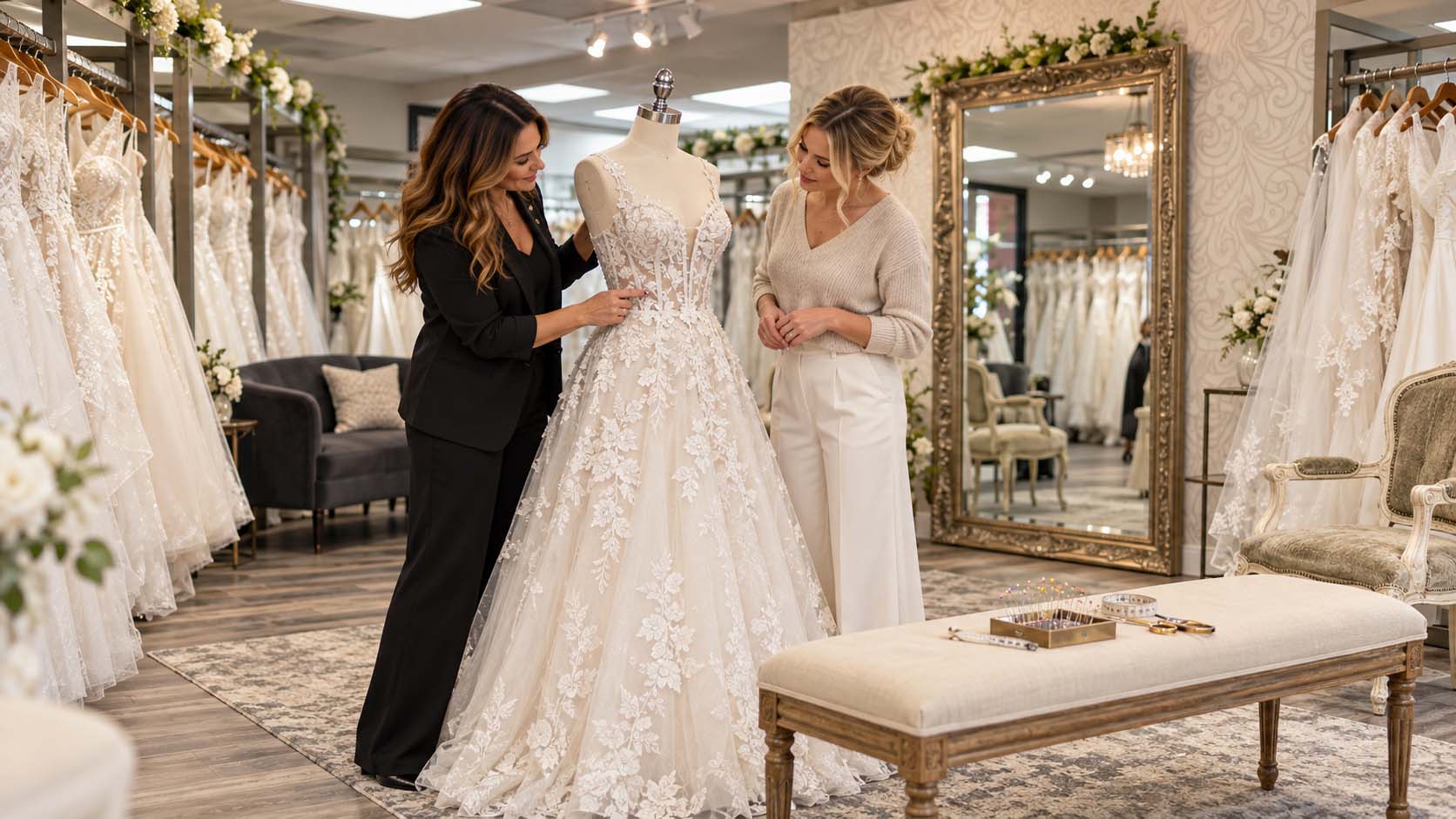
What Does a Stress-Free Bridal Appointment Look Like in San Diego?
You are not supposed to know everything before you walk into a bridal boutique. You may arrive with a carefully organized inspiration board, three unrelated screenshots, or no clear idea at all.
A stress-free bridal appointment in San Diego is not one in which every bride immediately recognizes her gown. It is one in which she is listened to, given enough guidance to understand the options, allowed to move at her own pace, and supported by people who understand both bridal fashion and gown construction.
That matters because wedding-dress shopping can feel exciting and vulnerable at the same time. You may love fashion but know very little about bridal sizing. You may be comfortable making decisions until several people are watching you make one in front of a mirror. You may simply worry that nothing will feel right.
None of that means you are doing the appointment incorrectly.
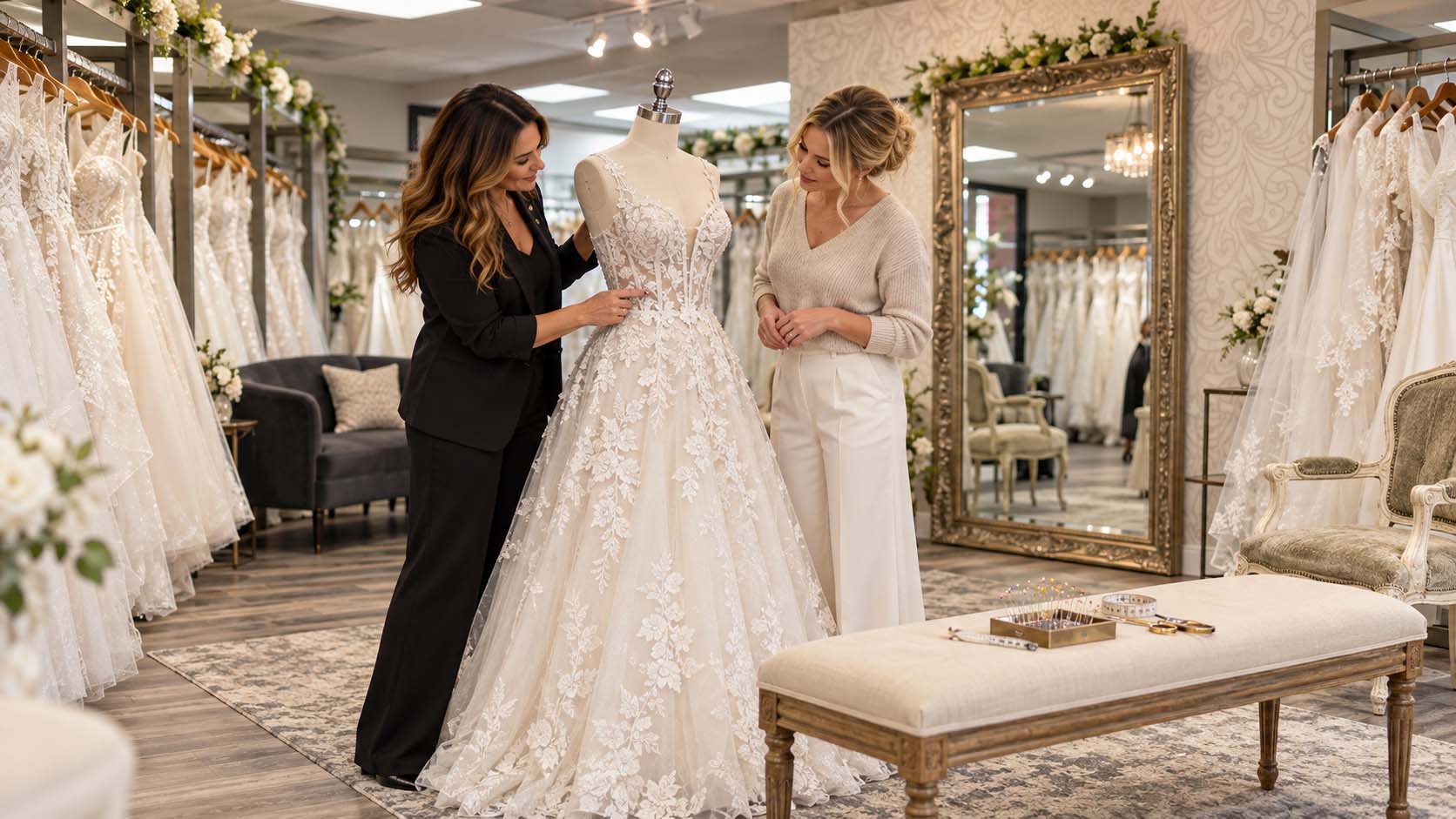
At Bridal & Tuxedo Galleria in San Diego, personalized styling turns a large, emotional decision into a series of manageable choices: silhouette, fabric, support, movement, setting, budget, and ultimately, how you feel in the gown.
What Makes a Bridal Appointment Stress-Free?
A stress-free bridal appointment combines simple preparation with a stylist who listens, curates relevant gowns, explains fit honestly, and respects the bride’s budget. Supportive guests and realistic expectations about sample sizing also help. Most importantly, the bride has room to ask questions, change direction, compare options, and leave without being pressured into a decision.
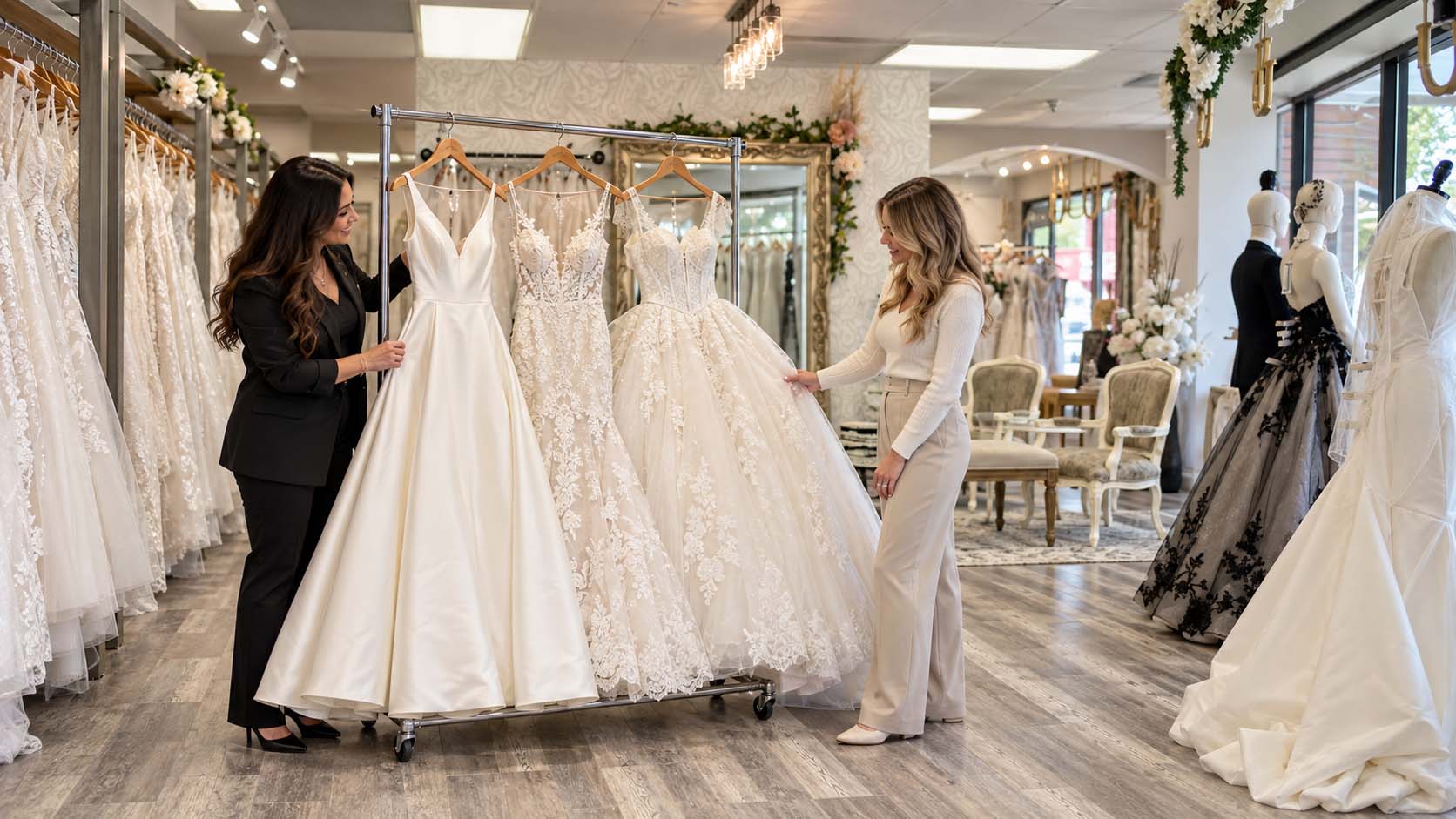
Why Wedding-Dress Shopping Can Feel More Stressful Than Brides Expect
A wedding dress carries more practical and emotional weight than an ordinary clothing purchase. It may be one of the most photographed garments you ever wear. It has a delivery timeline, a tailoring process, and a meaningful place in a day that already involves many decisions.
Add family expectations, social-media imagery, unfamiliar sizing, and the belief that you are supposed to have a dramatic emotional reaction, and a fitting room can become noisy before anyone has said a word.
Body vulnerability is often part of the experience, too. A stylist may need to help you into a gown, clip a sample, or discuss support and coverage. A sample may not close, even when the design could work beautifully in the correct size and after tailoring.
Bridal sizing can also differ from everyday clothing sizing. The number on the label is a garment reference, not an evaluation of your body.
Then there is decision fatigue. Hundreds of gowns can look appealing online, but they do not all serve the same bride, venue, climate, budget, or timeline. The goal of a good appointment is not to make you process every possible dress. It is to make the next choice clearer.
You also do not need to cry, gasp, or know instantly. Some brides have a powerful emotional response. Others notice something quieter: they stop adjusting the neckline, stand more naturally, or begin imagining the ceremony rather than analyzing the dress.
Both reactions are valid.
What a Stress-Free Bridal Appointment Actually Looks Like
The experience should feel guided, not controlled.
It begins with a welcome and a focused conversation rather than an immediate rush toward the racks. The stylist listens for what matters to you, then pulls a thoughtful first group of gowns. You have enough privacy to change and enough time to form your own opinion before the room fills with commentary.
As you try each dress, the stylist should explain what you are seeing. If the bodice is gaping because the sample is too large, that should be stated. If a neckline feels insecure because the sample is too small, the limitation should not be disguised.
If sleeves, straps, coverage, or a train might be adjusted, the conversation should include what is technically realistic, what depends on the designer, and what may affect cost or timing.
Budget should be treated as useful information, not a test of how much you are willing to spend. A well-run appointment keeps the gown selection within the range you have agreed upon unless you explicitly ask to see something outside it.
You should be able to reject a gown without defending the decision. You should also be free to change direction. Loving a clean satin ball gown after arriving with a folder of fitted lace dresses is not inconsistency; it is useful information discovered in person.
No pressure does not mean no guidance. It means you can think, compare, ask direct questions, understand ordering and alteration implications, and admit that you are unsure.
It also means the stylist helps separate your reaction from the reactions around you. A good bridal professional makes the room clearer, not louder.
The First Conversation Matters More Than the First Dress
The first 10 to 15 minutes should feel like a calm consultation. The questions asked during that time are not small talk. They help the stylist avoid irrelevant gowns and identify the few comparisons most likely to teach you something.
Expect the conversation to cover some combination of:
- Your wedding date and any travel deadline
- The venue and level of formality
- The season and time of day
- Whether the ceremony is indoors or outdoors
- Your comfortable gown budget
- Whether accessories or alterations are included in that budget
- Inspiration images and favorite designers
- Details you repeatedly save
- Silhouettes, necklines, fabrics, or coverage you want to explore
- Anything you strongly dislike
- Support, comfort, and movement priorities
- Cultural, religious, or family considerations
- Previous bridal appointments and what you learned from them
- How you hope to feel in the dress, even if you cannot yet describe how it should look
These details help translate a broad wish such as “romantic but not overly traditional” into useful design choices. The stylist might compare soft lace with dimensional appliqué or an A-line with a sculpted basque-waist ball gown.
If the ceremony is outdoors in Del Mar, fabric weight, wind, walking surfaces, and train management may matter. If the reception is in a formal San Diego ballroom, the conversation may shift toward structure, scale, stairs, and how the dress moves through the room.
The consultation also establishes boundaries. If you do not want a plunging neckline, do not enjoy strapless gowns, or need a particular level of coverage, say so.
An experienced stylist may offer one strategic surprise, but she should not repeatedly ignore a clear preference.
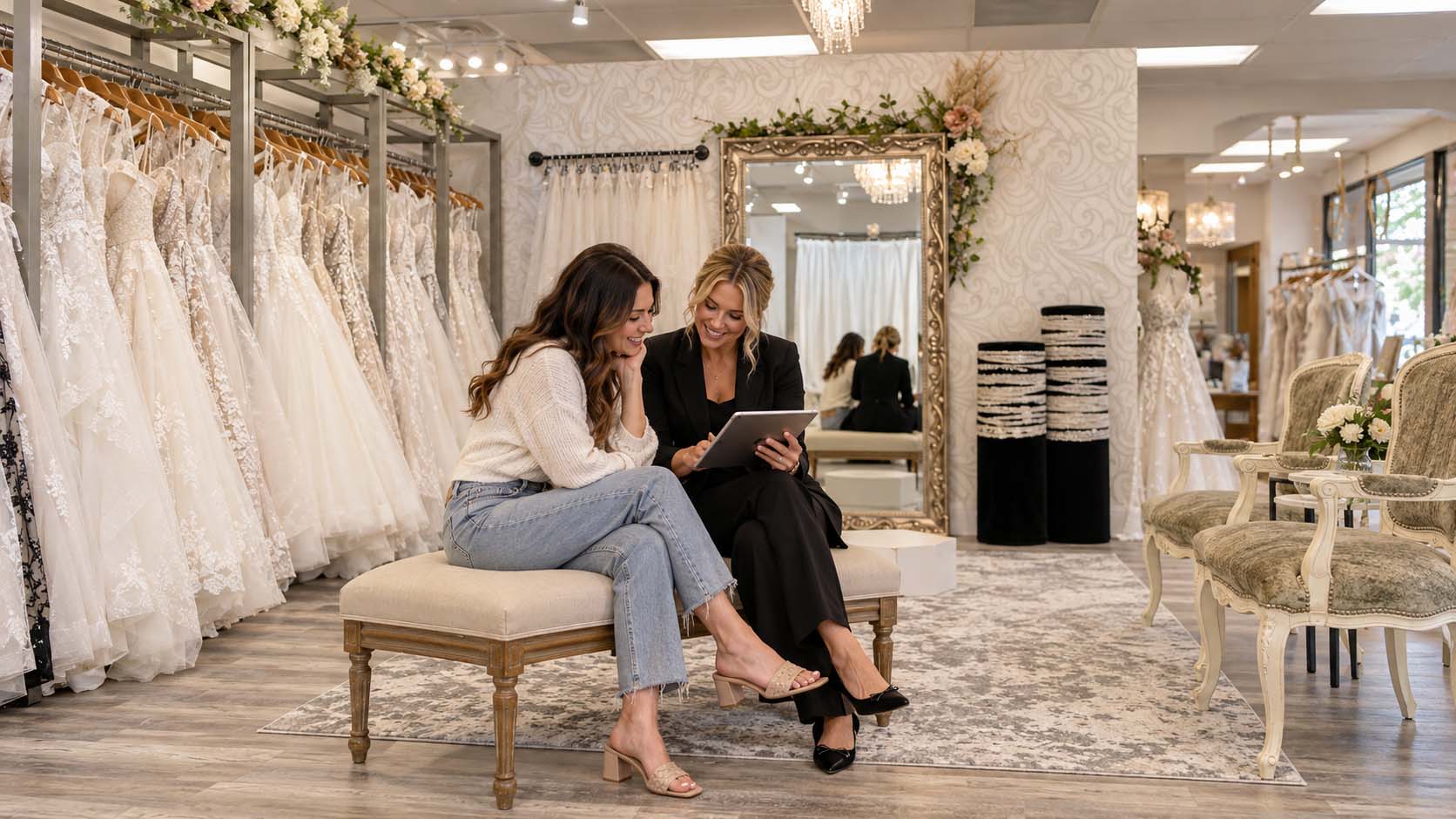
You Do Not Need to Know Your Wedding-Dress Style Yet
Silhouette vocabulary is helpful, but it is not an entrance requirement. You do not need to know whether you are an A-line, ball-gown, mermaid, fit-and-flare, sheath, basque-waist, or drop-waist bride before your first wedding-dress appointment.
If the terms feel unfamiliar, BTG’s wedding-dress silhouette guide provides a useful visual starting point.
Trying three strategically different gowns often creates more clarity than trying 20 nearly identical ones. One dress might show you that you like a defined waist but not a full skirt. Another may reveal that you enjoy clean Mikado more than soft crepe. A third may show that the neckline matters more to you than the silhouette.
The same principle applies to fabric. Satin and Mikado can create a clean, architectural effect, but their weight, sheen, and structure differ by gown.
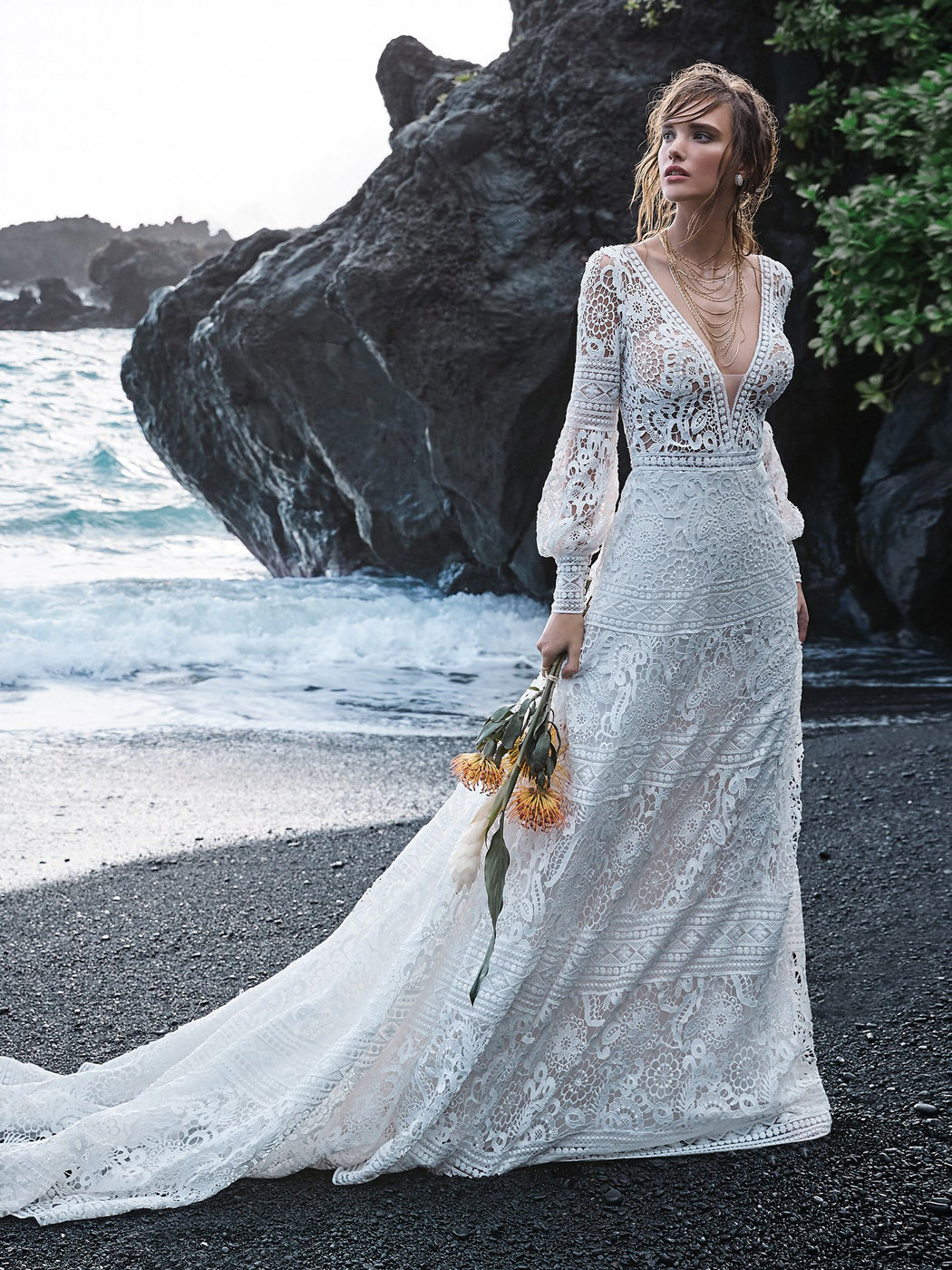
Lace can feel traditional, graphic, botanical, delicate, or modern depending on its scale, placement, lining, and construction. Crepe often produces a quieter continuous line, while layered tulle can create volume without the visual weight of a firm satin.
Trying on a dress is a form of research. You are allowed to dislike a popular detail. You are also allowed to respond to something you would never have saved online.
A Good Bridal Stylist Curates Instead of Overwhelming You
Random gown pulling asks, “What else would you like to try?”
Curated bridal styling asks, “What did this dress teach us, and what should we compare next?”
The difference is significant. A curator uses your venue, season, date, budget, preferred coverage, comfort needs, saved images, and reactions in the fitting room.
The first round might deliberately include a familiar option, a contrasting silhouette, and one informed surprise. The second round should become more precise.
For example, if you like the secure feeling of a corseted bodice but not the weight of its skirt, the next gown should preserve the support while changing the volume or fabric.
If you keep lifting an off-the-shoulder sleeve, the stylist should notice that the issue may be mobility rather than appearance.
If you love the drama of a train but will be walking across grass at an estate wedding, the conversation should include bustle options, train length, and how much fabric you are comfortable managing.
What a Skilled Bridal Stylist Notices
An experienced bridal stylist may notice details you have not yet put into words:
- You repeatedly touch or pull at a neckline.
- Your stride becomes shorter in a fitted skirt.
- You hold your shoulders differently in a gown with stronger support.
- You relax when the back or bust coverage changes.
- The waist seam is sitting above or below its intended position because of the sample fit.
- You become more animated in one silhouette even though your guests prefer another.
- A low back requires constant adjustment.
- You respond differently after seeing the complete look with a veil.
- The train is beautiful but impractical for your venue or movement priorities.
- A disliked detail could be altered, while another is fundamental to the gown’s structure.
These are not psychological judgments. They are practical observations that help reduce noise and direct the next comparison.
What the Bridal & Tuxedo Galleria Team Helps You Understand
A bridal appointment becomes more useful when the team can explain why one gown behaves differently from another.
At Bridal & Tuxedo Galleria, one-on-one styling can help a bride compare the parts of a dress that determine both appearance and wearability:
- Silhouette and proportion: Where the gown follows the body, where it releases, and how the bodice and skirt balance each other
- Neckline: How its width, depth, curve, and support relate to the bodice and straps
- Fabric: How satin, Mikado, crepe, lace, organza, chiffon, and tulle differ in weight, drape, texture, and movement
- Internal construction: Cups, lining, seams, boning, corsetry, and other elements that create support and shape
- Train and skirt: Physical weight, walking space, venue practicality, and bustle considerations
- Sleeves and detachable elements: Appearance, attachment points, mobility, and whether a proposed change is structurally realistic
- Veils and accessories: How the complete look affects scale, line, detail, and photography
- Customization and alterations: What may be changed, what must remain, and which questions require a gown-specific evaluation
This knowledge is especially useful when a sample is imperfect. Instead of asking you to simply imagine the finished result, a skilled team should identify which parts of the sample are reliable and which are being distorted by size or clipping.
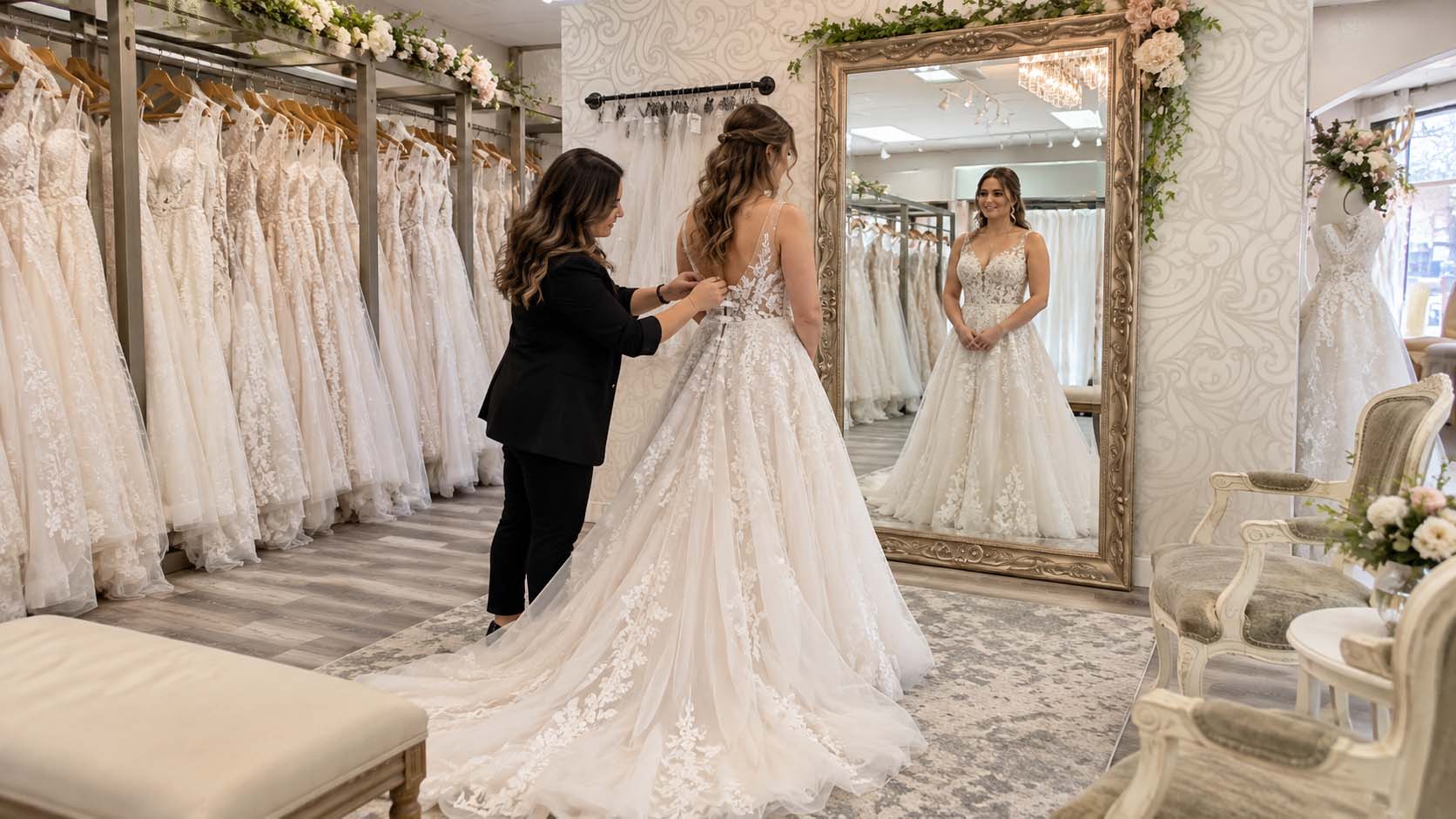
Through a Designer’s Eye: What Navid Noor Looks for in a Wedding Dress
Bridal & Tuxedo Galleria identifies Navid Noor as its owner and head designer. A designer’s evaluation goes beyond asking whether a gown is beautiful on the hanger. The dress must work as a complete composition on the bride who will wear it.
That means considering where the waistline actually sits, not simply whether the style is called basque or drop waist. A deep waist may lengthen one visual line while changing skirt balance or seated comfort.
A neckline must relate to the bride’s proportions, but it also needs adequate internal support. Visible boning may be a fashion detail; functional boning is part of the gown’s architecture. The two are not automatically the same.
Fabric has to be considered in motion. Mikado can hold a crisp, sculptural shape. Silk or satin may create long reflections and fluid drape. Crepe can reveal a precise continuous line, while layered tulle adds volume and movement.
Lace and appliqué must align with seams, neckline edges, waist placement, and the visual rhythm of the gown. A change that looks simple in a photograph may affect several connected parts of the construction.
A designer also watches the bride, not only the dress:
- Can she stand naturally?
- Does the bodice remain secure when she raises her arms?
- Does the skirt move with her or ask her to manage it constantly?
- Does the train suit the venue?
- Will the neckline, back, and embellishment photograph as intended from more than one angle?
- Is she wearing a current trend because it expresses her, or because she feels expected to choose it?
Customization requires the same complete view. Adding sleeves may change support and mobility. Lowering a back may weaken the structure a bride likes in the front. Repositioning lace can involve rebuilding the visual continuity of the bodice.
An experienced designer or alteration professional should explain those relationships before a bride bases her decision on a promised change.
The strongest designer-led advice does not prescribe an identity. It helps the bride distinguish fashion she admires from a gown she wants to inhabit for an entire wedding day.
Bridal Trends Should Inspire You, Not Pressure You
Current 2026–2027 bridal collections make room for very different instincts. Recent Bridal Fashion Week coverage highlights traditional ball gowns, expressive texture, lace detailing, sculptural shapes, and 1920s-influenced dropped silhouettes.
Spring 2027 reporting also points to clean satin gowns, modern basque waists, high-neck lace, separates, and removable vintage-inspired elements.
That does not mean every bride needs corsetry, a basque waist, a dramatic train, or a second look.
A trend is an option, not an instruction.
The practical value of trend knowledge is that a stylist can answer specific questions:
- Is the visible boning structural or decorative?
- Can a sleeve actually be made detachable?
- Would a drop waist create the proportion you like while allowing you to sit comfortably?
- Could an overskirt provide ceremony volume and a simpler reception shape?
- Does a sculptural satin gown suit a warm outdoor ceremony, or would its weight affect your comfort?
The test is not whether a detail is new. It is whether it supports your personal style, venue, movement, comfort, and complete visual balance.
A knowledgeable stylist translates trends into choices you can evaluate. She does not use them to make you feel behind.
When Online Inspiration Becomes Overwhelming
Pinterest, Instagram, TikTok, designer campaigns, and celebrity weddings are useful visual tools. They can help you identify repeated preferences and show a stylist what words such as “clean,” “romantic,” or “dramatic” mean to you.
They cannot show you everything.
A photograph may conceal the weight of a skirt, the stiffness of a bodice, or the way a train behaves after 10 minutes of walking. It cannot tell you whether a neckline feels secure, whether the sleeve restricts your arms, or whether the fabric feels comfortable against your skin.
Editorial images may use clips, careful posing, lighting, retouching, or a sample tailored to the model. A detail that looks effortless from the front may require substantial structure at the side or back.
Images also change proportion. A gown photographed on one body, from one angle, with one heel height is not a neutral template for how it will look on everyone else.
Bring a focused group of references rather than every image you have saved. Look for patterns: a recurring waist, neckline, fabric, or degree of detail. Then let the appointment test those ideas.
Trying on three useful comparisons can tell you more about your preferences than saving another 100 photographs.
What If the Sample Wedding Dress Does Not Fit?
A sample gown is the boutique’s try-on garment. It is not your ordered size, and it is not your finished, professionally altered dress.
If a sample is too large, a stylist may use clips to approximate the intended shape. If it is too small, the back may remain open or require an appropriate panel so you can evaluate more of the design.
Bridal sizes also vary by designer and may not correspond to the number on your everyday clothes.
What a Sample Can Often Help You Assess
- The overall design direction
- Fabric, color, texture, and embellishment
- Approximate silhouette and skirt volume
- Neckline style and visual balance
- Train length and fabric weight
- Your response to the gown’s general character
What an Imperfect Sample May Not Show Accurately
- Final bust support or cup placement
- Exact waist position
- Correct neckline security
- Smoothness through the torso, hip, or back
- True sleeve and strap placement
- Final hem and train balance
- How the ordered gown will look after professional alterations
Clipping is a visualization tool, not a substitute for correct fit. Ask what you can judge reliably in that particular sample.
If trying a gown close to your measurements is important, contact the boutique before your appointment because availability varies by style.
Most importantly, your body does not need to fit the sample. The selected gown ultimately needs to be fitted to you.
The Bridal Appointment Movement Test
Do not evaluate a wedding dress only while standing perfectly still in front of a mirror. With your stylist’s guidance and enough clear space, use this 10-part movement test:
- Stand naturally. Let your shoulders and arms settle. Notice whether the gown supports you without forcing your posture.
- Walk at a normal pace. Check stride length, skirt weight, friction, and whether you instinctively hold the dress up.
- Turn in both directions. Notice whether the skirt follows smoothly and how much space the train needs.
- Sit down. Assess bodice pressure, waist comfort, skirt management, and neckline stability.
- Raise your arms comfortably. This can reveal strap tension, sleeve restriction, and whether a strapless bodice shifts.
- Hug someone. A natural embrace tests arm mobility, neckline security, and delicate embellishment placement.
- Bend slightly, if appropriate. Notice whether the neckline stays secure and the bodice continues to support you.
- Imagine dancing. Take a few side steps or a gentle turn and consider weight, heat, train control, and sleeve mobility.
- View the side and back. Look beyond the front-facing mirror image. Check seam placement, back comfort, and the complete silhouette.
- Use your expected heel height. The exact wedding shoes are essential for alterations. During shopping, a similar height can help you judge proportion and movement.
The purpose is not to perform for the room. It is to learn whether the gown will let you participate in your wedding.
A dress may look secure while still requiring constant adjustment. A skirt may appear light but contain several heavy layers. A dramatic train may be manageable with a well-planned bustle, or it may be more gown than you want to handle.
If something feels wrong, ask whether the issue comes from the sample size, an alteration that can realistically be made, or a permanent feature of the design.
How Alteration Expertise Makes the Appointment Less Stressful
Many brides evaluate a sample as though nothing can change. Others assume almost anything can change.
Both assumptions can create unnecessary stress.
Depending on the gown’s construction, professional alterations or approved customization may refine:
- Cup placement and bust support
- Bodice and waist fit
- Strap length or placement
- Certain sleeve details
- Neckline shape or coverage
- Hem length
- Train balance and bustle
- Modesty panels or illusion coverage
- Appliqué placement
- Selected removable elements
But not every modification is structurally possible, visually advisable, economical, or permitted by the designer.
A neckline change may involve new cups, boning, seams, lining, and lace placement. Adding sleeves requires compatible fabric and stable attachment points. Shortening a lace hem can require lifting and reapplying the border. Changing a low back may affect the support that makes the bodice work.
This is why alteration knowledge is valuable during shopping, not only after purchase.
Bridal & Tuxedo Galleria offers professional in-house bridal alterations, allowing fit and modification questions to be discussed with awareness of gown construction.
That does not make every proposed change possible. It gives the bride a better opportunity to replace assumptions with a gown-specific evaluation before committing.
How Many People Should You Bring to a Bridal Appointment?
Bring the people whose presence makes it easier to hear yourself.
There is no universal ideal number. For some brides, that is one trusted person. For others, it is a small group that understands the budget, the wedding, and the difference between offering an observation and taking control of the decision.
Shopping alone can also be calm and productive.
Before the appointment, tell your guests what kind of help you want. You might ask them to wait until you have spoken first, focus on comfort and movement, or avoid comparing your body with a campaign image.
When several people give immediate, conflicting opinions, even a beautiful gown becomes hard to assess.
A skilled stylist can redirect the room with better questions:
- What does the bride like about this gown?
- Does she feel secure?
- Can she move?
- Does it suit the setting?
- How does her reaction change when she sees the complete look?
Confirm Bridal & Tuxedo Galleria’s current guest policy for your selected appointment type before visiting.
What Should You Bring to Your First Bridal Appointment?
Keep it simple:
- Your wedding date and venue information
- A comfortable gown budget
- A separate complete-look budget, if possible
- A focused set of inspiration photos
- Easy-to-change clothing
- Comfortable, clean undergarments
- Shoes with an approximate heel height, if useful
- A hair tie so you can see necklines and backs clearly
- Any essential coverage, support, mobility, or cultural requirements
- Questions about ordering, alterations, customization, and policies
- An open mind about at least one informed surprise
You do not need to buy special shapewear or a strapless bra before selecting a gown. Some dresses have substantial internal support; others need a different foundation solution.
Ask the boutique what is recommended for your appointment.
What You Do Not Need to Bring
You do not need:
- A fully developed bridal aesthetic
- Professionally styled hair and makeup
- Certainty about your silhouette
- A rehearsed emotional reaction
- 10 guests
- A promise to purchase that day
- A body that looks like the model in a designer campaign
Your starting point can be as simple as: “I want to feel comfortable, I need this level of coverage, and I do not yet know what shape I like.”
That is enough information to begin.
What If Your Family Loves a Dress You Do Not?
Listen to the specific reason, then return the decision to your own experience.
A family member may love the tradition, price, drama, or familiarity of a gown. That does not automatically mean it is the dress you want to wear.
Try replacing a vote with practical questions:
- What do you like or dislike?
- Can you move naturally?
- Do you feel secure?
- Does the dress match the wedding setting?
- Are you imagining your ceremony, or trying to convince yourself because the room reacted strongly?
An experienced stylist can acknowledge a guest’s intention without allowing it to overpower the bride. She may ask everyone to pause while you describe the gown first or let you return to the dressing room for a quiet comparison.
Your family can matter deeply and still not have the final decision.
What If You Do Not Find Your Dress at the First Appointment?
The appointment can still be successful.
You may leave knowing that you prefer a defined waist, a secure square neckline, lighter fabric, less lace, more coverage, or a different price range.
You may discover that the custom feature you imagined is unnecessary—or that it is central enough to justify a design consultation. You may simply need time to separate your own preferences from the energy of the day.
Do not keep trying gowns after your attention has collapsed. Write down your strongest options and why they worked. Ask about a follow-up appointment, availability, timing, and the boutique’s order policies.
Clarity is progress even when it does not end in an immediate purchase.
How Much Should You Tell Your Stylist About Your Budget?
Tell your stylist the amount you can comfortably spend on the gown and clarify whether that number includes tax, accessories, customization, and alterations.
Honest budget communication protects the appointment. It helps the stylist curate gowns you can genuinely consider and reduces the chance of forming an attachment to a dress that creates financial discomfort.
A professional should not treat the number as an invitation to push you to its highest edge.
Ask what is included in the quoted gown price. Special orders, designer changes, rush production, shipping, accessories, and alterations may be separate.
Bridal & Tuxedo Galleria states that alteration fees are separate from the gown price, so request a gown-specific discussion rather than assuming one universal tailoring cost.
How a Designer-Led Boutique Changes the Experience
A designer-led bridal boutique can connect style decisions with construction consequences.
That matters when you like most of a gown but question its neckline, sleeves, back, waist placement, or train.
A styling-only answer might describe how the change would look. A construction-aware answer considers support, seam placement, fabric behavior, proportion, movement, and the work required to make the alteration appear intentional.
Designer involvement also helps translate inspiration. Two saved gowns may share a mood while relying on incompatible architecture. One might have a soft draped bodice; the other may depend on rigid corsetry.
A designer can explain which parts of each reference can live together and which would fight the fabric or structure.
At Bridal & Tuxedo Galleria, Navid Noor’s role as owner and head designer supports the boutique’s couture and custom-design direction.
The practical value is not the title alone. It is access to a way of evaluating the entire bridal composition: silhouette, proportion, construction, movement, photography, venue, tailoring, and personal identity.
A Stress-Free Bridal Appointment at Bridal & Tuxedo Galleria in San Diego
Bridal & Tuxedo Galleria has served Southern California brides since 1994. Its San Diego showroom brings together personalized one-on-one styling, established designer collections, exclusive Navid Noor designs, custom wedding-dress possibilities, and professional in-house bridal alterations.
For a bride, the advantage is continuity.
The first appointment can include conversations about silhouette, fabric, neckline, support, venue, movement, customization, and fit rather than treating each stage as an unrelated transaction.
The team can help compare designer gowns, explain what a sample does and does not reveal, and identify when a question needs alteration or designer input.
BTG offers different appointment experiences, including standard one-on-one bridal guidance and a Princess Appointment for brides seeking additional privacy, time, and celebratory features.
Inclusions, fees, guest arrangements, appointment length, and Navid Noor’s availability should be confirmed for the selected date.
The goal is not to guarantee that every bride chooses a gown in one visit. It is to create a well-guided wedding-dress appointment in San Diego where the bride can make a more informed, comfortable decision.
Bridal Expertise Beyond San Diego: The Orange County Couture Design Studio
Bridal & Tuxedo Galleria provides the bridal boutique and gown-shopping experience discussed in this article at its San Diego showroom.
The brand also maintains an Orange County Couture Design Studio in Mission Viejo, connected with Navid Noor’s couture and custom-design work.
That relationship extends BTG’s designer-led identity in Southern California without changing the purpose of the San Diego appointment.
Bridal shopping and client consultations take place in San Diego, while the Orange County location functions as a design studio. Brides should contact the team to confirm the studio’s current access and service policies before planning a visit.
Frequently Asked Questions About Bridal Appointments in San Diego
1. How Do I Make My Wedding-Dress Appointment Less Stressful?
Prepare a few useful details rather than trying to know everything. Bring your wedding date, venue, comfortable budget, focused inspiration, and any support or coverage priorities. Choose guests who listen, tell your stylist what makes you nervous, and expect sample gowns to fit imperfectly. A good bridal appointment in San Diego should give you curated choices and room to think, not pressure you to decide immediately.
2. What Should I Expect at My First Bridal Appointment?
Expect a consultation followed by a curated try-on process. Your stylist may ask about your date, venue, budget, preferred styles, dislikes, comfort, coverage, and timeline before selecting gowns. As you try them on, compare silhouette, fabric, support, movement, and fit. You can arrive without knowing your style, and you do not need to purchase during the first visit.
3. What Should I Bring to a Wedding-Dress Appointment?
Bring your wedding date, venue details, realistic gown budget, several focused inspiration images, and questions about ordering or alterations. Comfortable undergarments, easy-to-change clothing, a hair tie, and shoes near your expected heel height can be useful. Confirm the boutique’s current preparation instructions before your visit because appointment types and policies can differ.
4. What Should I Wear to Try On Wedding Dresses?
Wear clean, comfortable undergarments and clothing that is easy to remove. Skin-tone underwear is often less visible under light or sheer fabrics, but you do not need to buy special shapewear or a strapless bra beforehand. Some gowns provide their own support. For final alteration fittings, bring the actual undergarments and wedding shoes you plan to wear.
5. How Many People Should I Bring Wedding-Dress Shopping?
Bring the smallest group that helps you think clearly. That may be one trusted person, a few supportive guests, or no guest at all. Choose people who respect your budget and wait for your opinion before giving theirs. Too many competing reactions can make useful comparison difficult. Always confirm the boutique’s current guest limit for your appointment type.
6. What If I Do Not Know What Style of Wedding Dress I Want?
You can begin without a defined style. Ask your stylist to select a few contrasting gowns—perhaps one related to your inspiration, one with a different skirt volume, and one informed surprise. Compare how each neckline, fabric, waistline, and structure feels. A small number of purposeful comparisons usually creates more clarity than trying many nearly identical dresses.
7. Do I Have to Buy a Wedding Dress at My First Appointment?
No. A first appointment can be valuable even if you do not purchase. You may identify your preferred silhouette, neckline, fabric, support, or budget direction. If you need more time, ask about a follow-up appointment and note the gowns you want to revisit. Before buying, understand the price, order timeline, alteration plan, and final-sale terms.
8. How Many Wedding Dresses Should I Try On?
There is no required number. Stop counting and focus on whether each gown adds useful information. If several dresses are repeating the same lesson, ask your stylist to refine the selection. Many brides gain clarity from a focused group of gowns, while others need another appointment. More dresses do not automatically create a better decision.
9. What If Wedding-Dress Samples Do Not Fit Me?
An imperfect sample fit is common because boutiques stock try-on gowns, not every style in every size. A stylist may use clips or an appropriate panel to help you visualize the design. Ask which elements you can evaluate accurately and which are distorted by the sample. Contact the boutique in advance if you need to confirm relevant sample availability.
10. Should I Tell My Bridal Stylist My Budget?
Yes. Share the amount you can comfortably spend and clarify whether it includes alterations, accessories, and taxes. A clear budget helps the stylist avoid presenting gowns that would make the decision financially uncomfortable. Also ask about separate charges for customization, rush service, shipping, and tailoring. Budget is a planning tool, not something to be embarrassed about.
11. How Far in Advance Should I Book a Wedding-Dress Appointment?
Book as soon as you know your wedding date and venue, especially if you want a weekend time. Bridal & Tuxedo Galleria’s published guidance suggests beginning the shopping process roughly nine to 12 months before the wedding. The right timing depends on the designer, gown, custom work, shipping, and alterations, so contact the boutique promptly if your timeline is shorter.
12. How Far in Advance Should I Buy My Wedding Dress?
Aim to select or order the gown early enough for production, delivery, and alterations. BTG currently advises ordering many gowns about six to nine months before the wedding, while beginning the search earlier can reduce time pressure. Custom work or complex changes may require more time. Confirm a written gown-specific timeline rather than relying on one general rule.
13. Can a Wedding Dress Be Customized After I Choose It?
Sometimes. Depending on the gown and designer, possible changes may include selected sleeves, straps, neckline refinements, lining, coverage, train details, or appliqué placement. Other changes may weaken the structure, require extensive reconstruction, or be prohibited by the designer. Confirm feasibility, cost, approval, and timing before purchasing a gown that depends on customization.
14. Can a Bridal Boutique Change the Neckline or Sleeves?
Certain necklines and sleeves can be changed, but the answer depends on construction. Cups, boning, seams, fabric, lace motifs, back height, and attachment points all affect what is possible. Ask for an alteration or designer evaluation of the specific gown. A visual idea should not be treated as a promise until the technical plan and cost are clear.
15. What Happens If My Family Does Not Like the Wedding Dress I Love?
Ask them to explain their concerns, then return to your own priorities. Consider how you feel, move, and see yourself in the gown, as well as whether it suits the setting and budget. A stylist can help slow down competing opinions and ask you to speak first. Your family’s feelings may matter, but the final dress must belong to you.
16. Is It Normal to Feel Nervous Before Wedding-Dress Shopping?
Yes. Bridal shopping can involve unfamiliar sizing, body vulnerability, family expectations, cost, and pressure to have a specific emotional reaction. Tell your stylist what concerns you before trying on gowns. You may also bring fewer guests, request a quiet moment, and focus on practical comparisons. Feeling nervous does not mean you will have a negative experience.
17. Can I Go Wedding-Dress Shopping Alone?
Yes. Shopping alone can make it easier to hear your own reaction and communicate directly with the stylist. You can take notes, ask about approved photos, or return with a trusted person for a second look if needed. Check the boutique’s photo and video policy before planning a remote call or sharing images from the appointment.
18. How Do I Know If a Wedding Dress Is Comfortable Enough for the Wedding Day?
Test it in motion. Stand naturally, walk, turn, sit, raise your arms, hug someone, and imagine dancing. Notice support, neckline security, sleeve mobility, skirt weight, stride length, and train management. Ask whether any discomfort comes from the incorrect sample size or from a permanent design feature. Comfort should be evaluated, not assumed.
19. What Questions Should I Ask My Bridal Stylist?
Ask what the sample fit is changing, how the gown will be ordered, what alterations are likely, and which customizations are realistic. Confirm the estimated arrival, final-sale terms, extra fees, and fitting schedule. Also ask how the dress moves, what support it provides, how its train will be managed, and whether the design suits your venue and timeline.
20. Where Can I Book a Private Bridal Appointment in San Diego?
Bridal & Tuxedo Galleria offers dedicated one-on-one bridal appointments at its San Diego showroom, along with a Princess Appointment for brides seeking additional privacy, time, and celebratory features. Review the current appointment descriptions and book online, or contact the boutique to confirm duration, fees, guest arrangements, inclusions, and Navid Noor’s availability for your date.
Your Bridal Appointment Should Leave You With More Clarity, Not More Pressure
You do not need to arrive knowing exactly which gown you want. Your body is not a problem to correct. Trends are sources of inspiration, not rules.
Supportive guests should help you hear your own response, and an experienced stylist should make complex choices easier to understand.
Photographs can begin the conversation, but construction, support, movement, and tailoring determine how a dress will live with you throughout the wedding day.
That is where the BTG team’s bridal knowledge, professional in-house alterations, and Navid Noor’s designer-led perspective can add meaningful guidance.
Bridal & Tuxedo Galleria offers this experience at its San Diego boutique and maintains an Orange County couture design presence in Mission Viejo for its wider Southern California design work.
Nervous About Your First Appointment?
You do not need to bring every answer. Start with your wedding date, the amount you are comfortable spending, a few ideas if you have them, and people who help you feel like yourself.
Your appointment can help turn the rest into clear, manageable choices.
Book Your Bridal Appointment in San Diego
Author bio :
Kayla brings more than 10 years of hands-on experience in bridal fashion and boutique styling, specializing in personalized bridal consultations and luxury client experiences. As the manager of the San Diego location of Bridal and Tuxedo Galleria, she is known for her keen eye for detail, deep understanding of couture wedding dress design, and ability to guide brides toward a gown that reflects their unique vision and wedding aesthetic. Her approach blends fashion expertise with genuine care, ensuring every bride feels confident, understood, and unforgettable on her wedding day
Call Now

Your Personalized Wedding Dress Shopping Experience in San Diego With over 30 years of styling expertise, our dedicated team is passionate about helping you find the perfect wedding dress and tuxedo.


Leave a Reply