
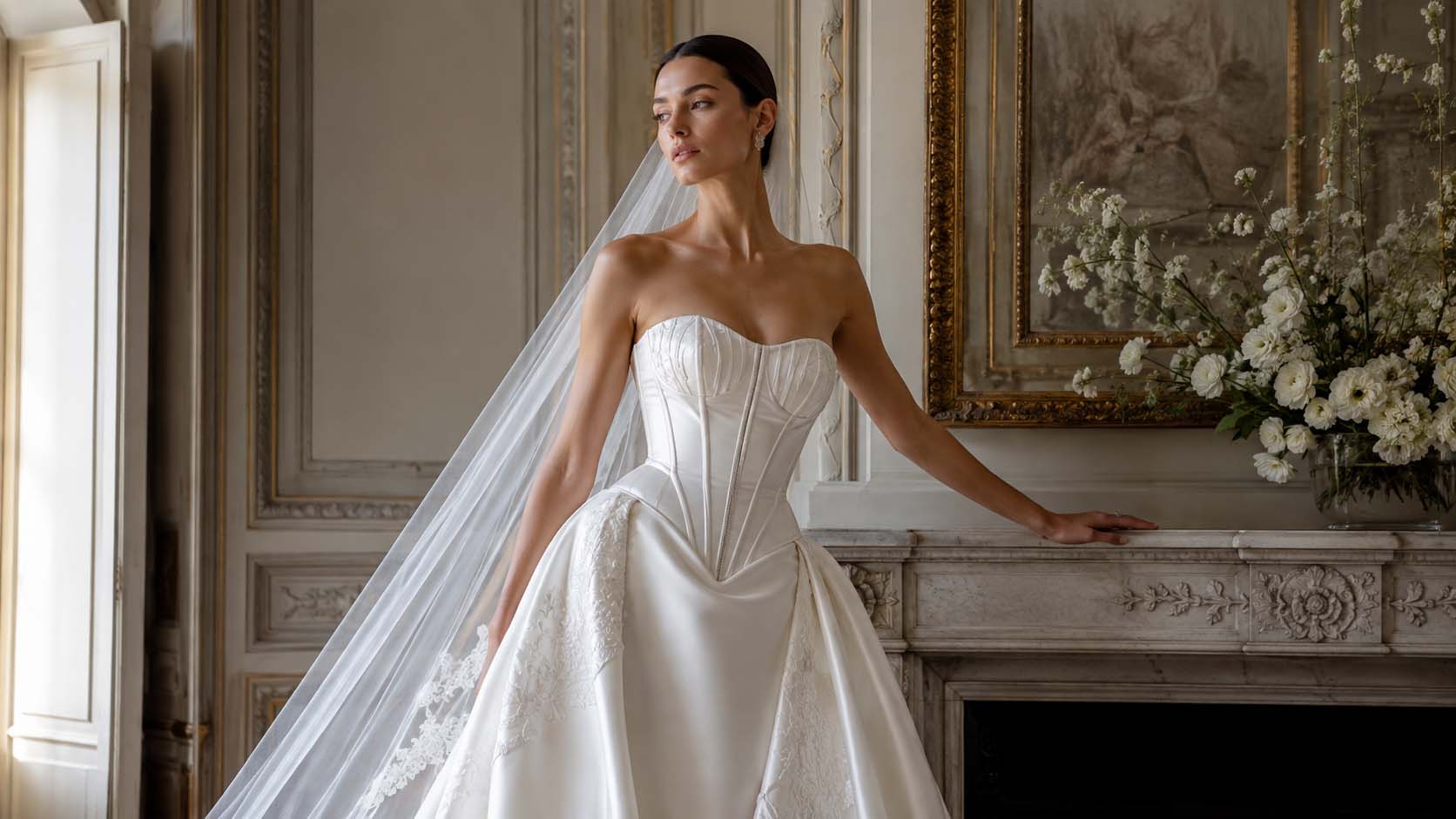
Corset vs. Structured Bodice: The Complete 2027 Wedding Dress Guide
When brides compare a corset vs. structured bodice wedding dress, the conversation often starts with appearance. One gown has exposed boning and sheer panels. Another has a smooth satin bodice with no visible construction at all. It is easy to assume these are two completely different categories.
Technically, they are not.
A corset is one type of structured bodice. A structured bodice is the broader category and can include internal cups, boning, interfacing, lining, support panels, shaped seams, or a waist stay without looking remotely corseted from the outside.
That distinction matters because the way a wedding dress looks does not always tell you how it feels or performs. A gown with visible boning may be primarily corset-inspired, while a sleek zipper-back Mikado dress may have significant internal engineering. Support, movement, comfort, and waist definition all depend on the actual construction of the individual gown.
For that reason, trying both styles in person is usually far more useful than deciding from inspiration photos alone.
Quick Answer: Corset vs. Structured Bodice
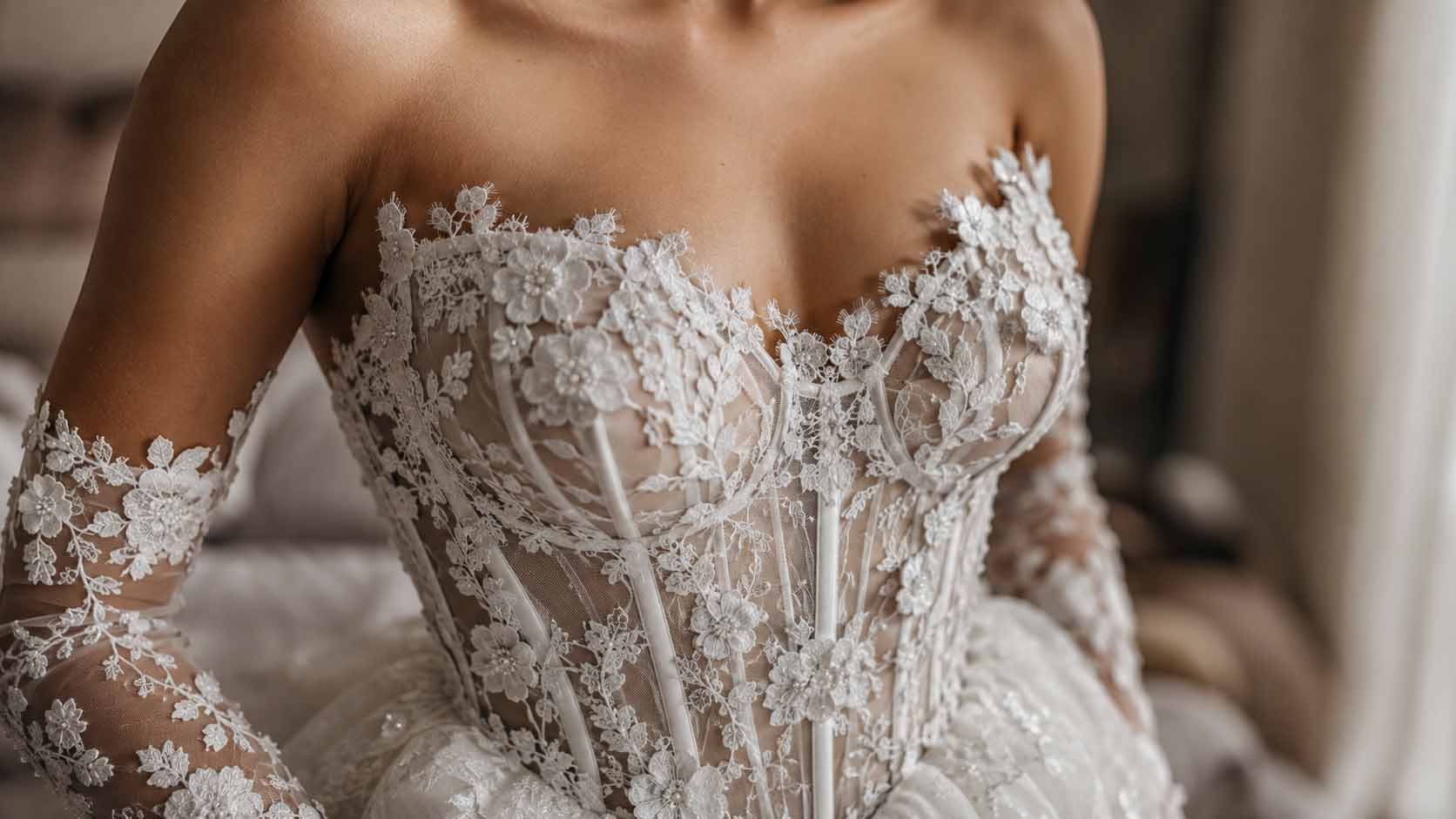
A corset bodice is a type of structured wedding-dress bodice that typically uses boning and carefully engineered support through the torso. A non-corset structured bodice can create stability through cups, seams, interfacing, lining, support panels, or hidden boning. Neither is automatically more comfortable or supportive. Fit and construction matter most.
What Is a Corset Bodice Wedding Dress?
A corset bodice uses engineered structure to shape and stabilize the upper portion of the gown. Depending on the design, that structure may be intentionally exposed or completely hidden beneath lace, satin, Mikado, or another fabric.
Modern bridal corsetry is considerably more nuanced than the traditional idea of a tightly laced historical corset. Contemporary wedding gowns may use flexible boning, shaped cups, supportive lining, internal waist anchoring, and carefully positioned seams to create definition without relying on extreme compression.
This is also where the difference between functional corsetry and a corset-inspired appearance becomes important.
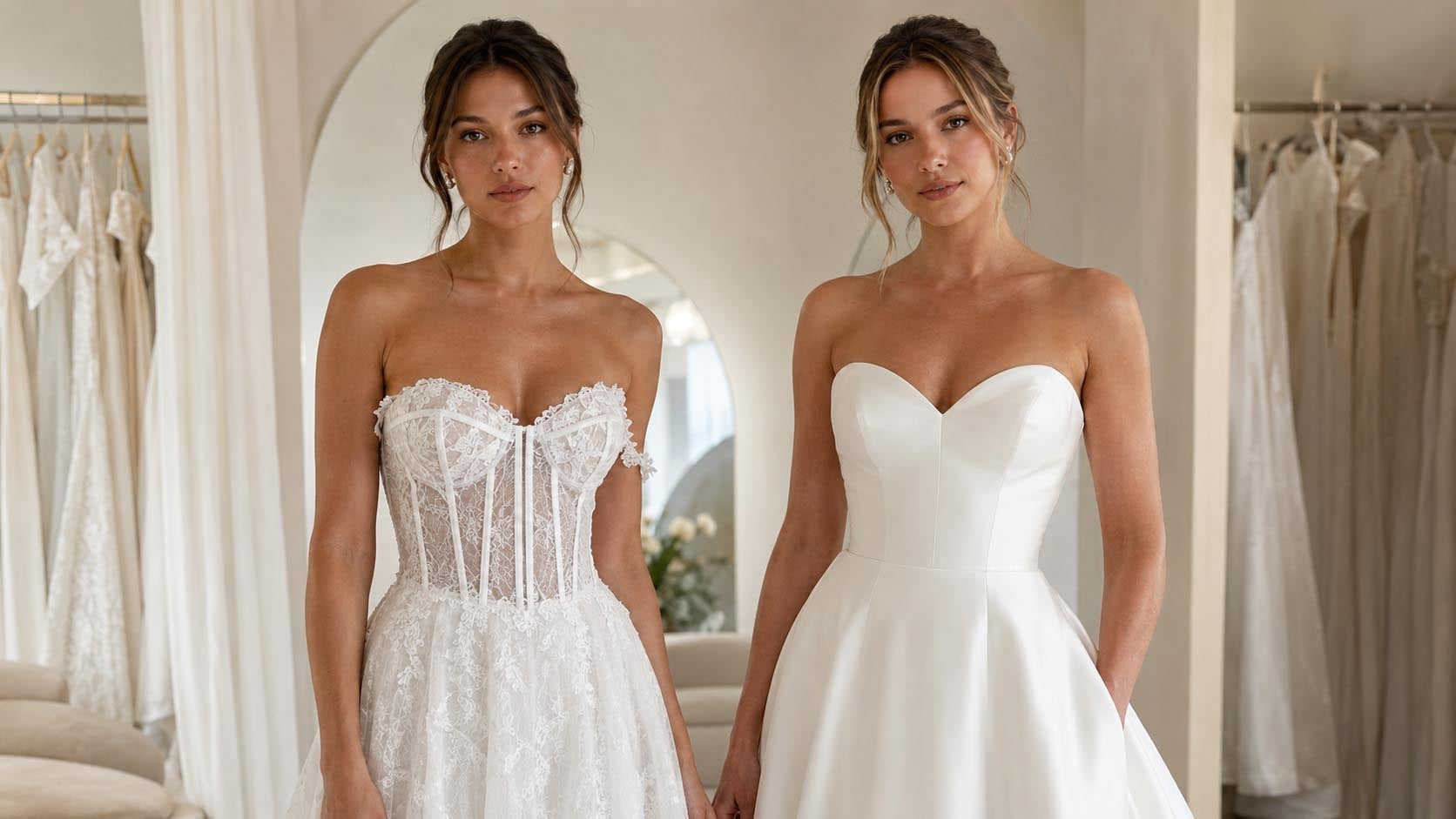
A gown may feature visible boning, sheer tulle panels, bustier-style cups, or lace-up detailing because the designer wants the visual language of corsetry. Those elements do not necessarily tell you exactly how the bodice functions internally.
Likewise, a lace-up closure does not automatically make a gown a true corset. Some lace-up gowns rely on other forms of internal support. A zipper-backed dress, on the other hand, may contain substantial boning, cups, and reinforcement beneath its outer fabric.
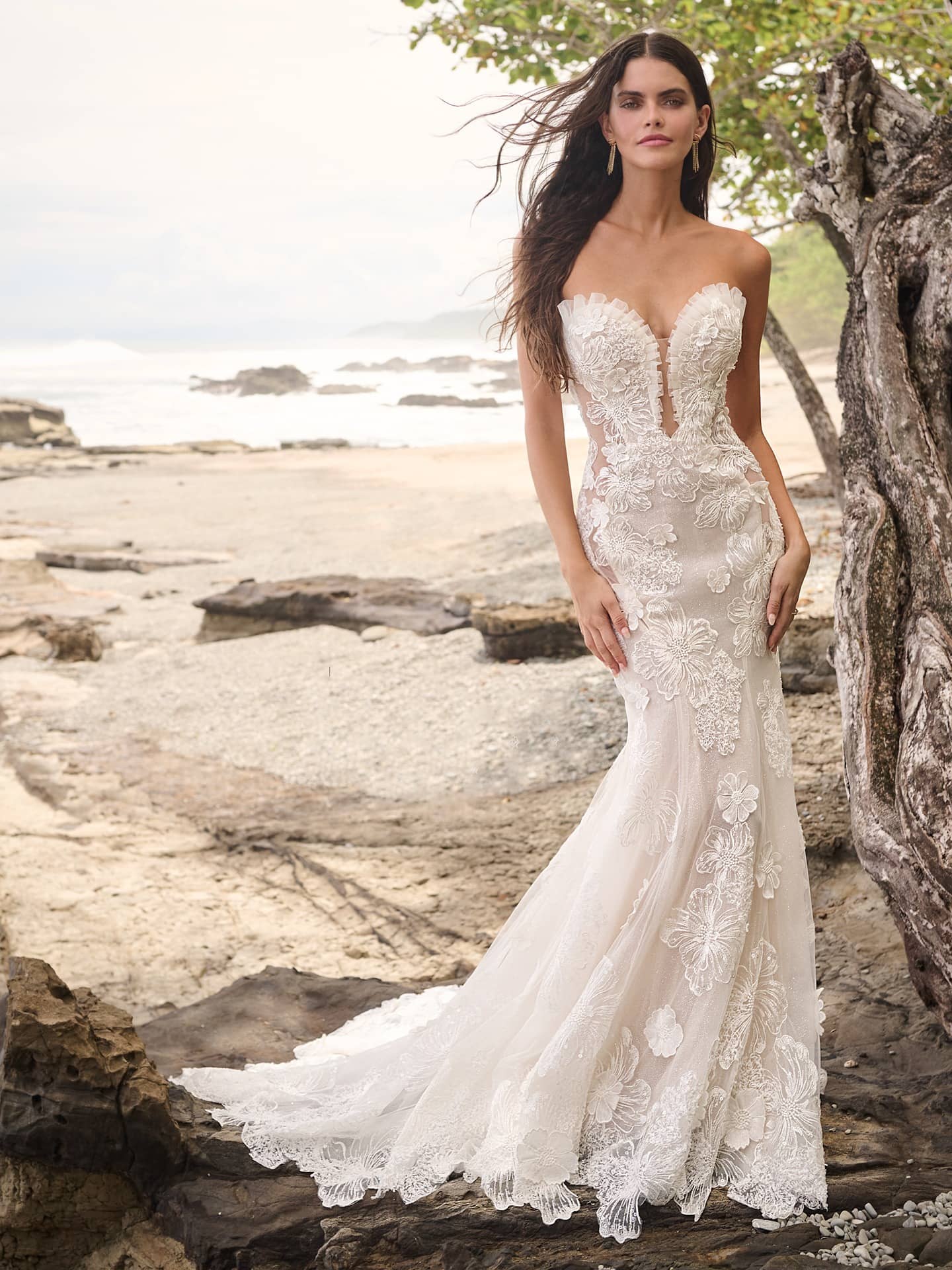
In many 2027 bridal collections, corsetry is becoming more visible. Boning is no longer something designers always try to conceal. It can become a decorative line, framing the bust, emphasizing a long-line bodice, or flowing into a curved Basque waist.
Long-line corsets are especially important in this conversation because they continue lower through the torso rather than ending at the natural waist. This can create a very architectural look, particularly when combined with a Basque or drop waist.
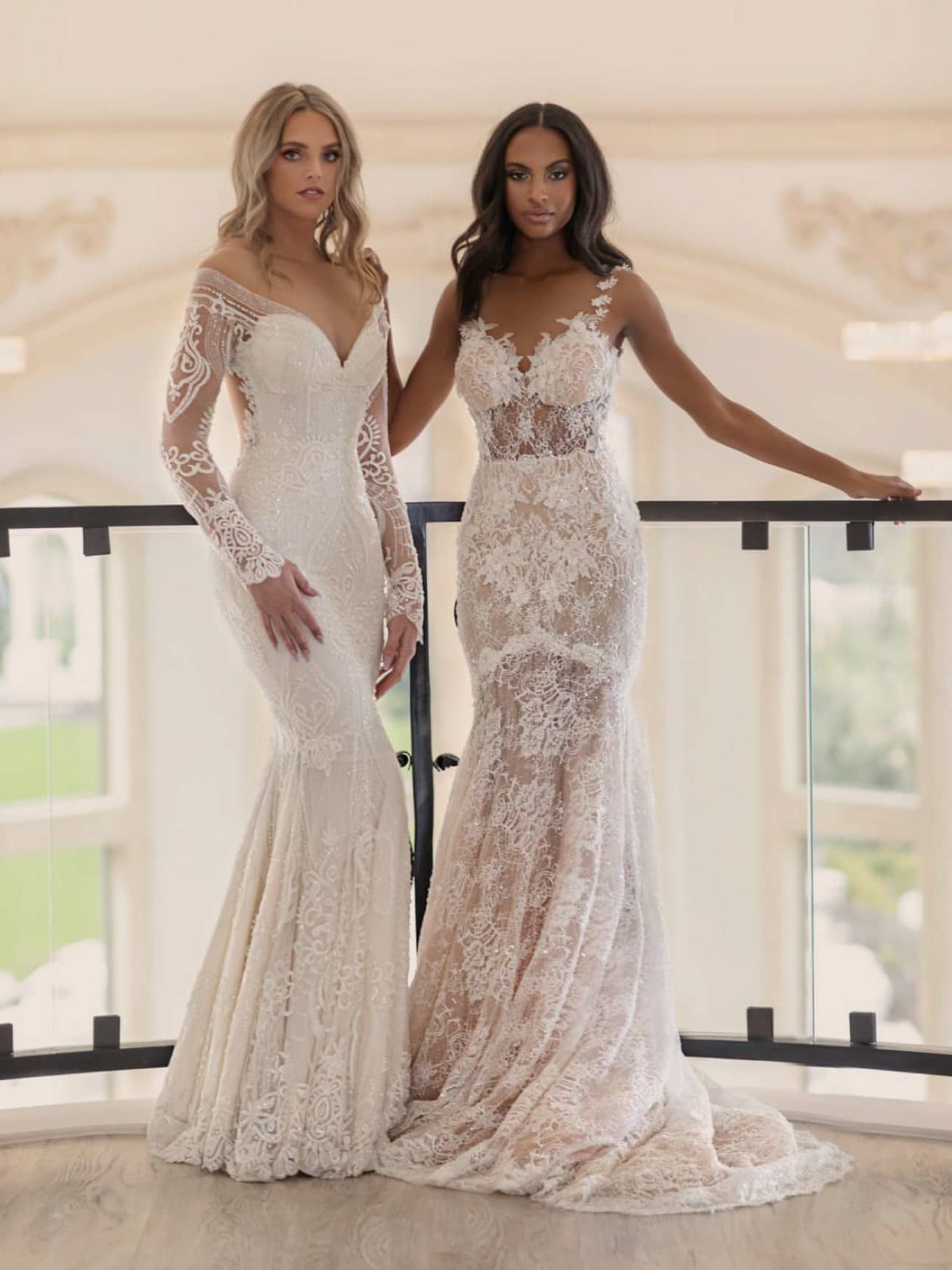
Sheer corsetry takes the idea even further. Illusion mesh or transparent tulle allows part of the gown’s internal architecture to become visible while lace, appliqué, embroidery, or beading adds softness over the structure.
The key point is simple: a corset should not be understood as merely a “tight bodice.” Good bridal corsetry is about engineering, placement, proportion, and support.
What Is a Structured Bodice Wedding Dress?
A structured bodice is any wedding-dress bodice intentionally designed to maintain shape and provide stability through construction.
Corsets belong within that category, but many structured gowns are not corsets.
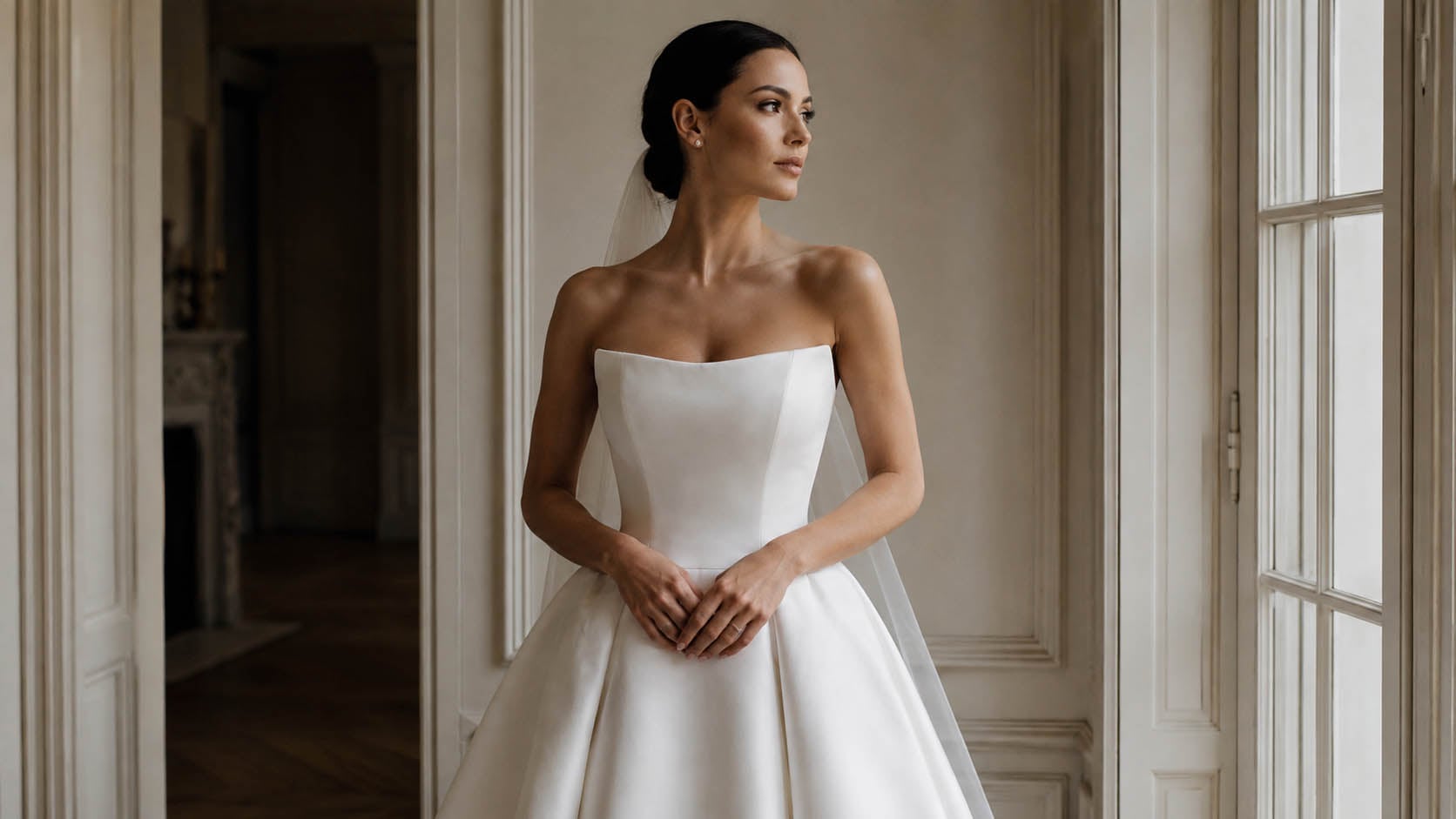
A clean strapless gown in satin or Mikado may appear almost effortless from the outside while relying on carefully shaped cups, internal boning, reinforced seams, interfacing, multiple lining layers, and sometimes a waist stay beneath the surface.
Princess seams can help shape the bodice vertically. Interfacing can stabilize fabric that would otherwise collapse. Internal support panels may control tension around the torso. A waist stay can help anchor the gown at the waist so the neckline is not expected to carry the entire weight of the dress.
This is particularly important with minimalist wedding dresses. When there is little lace or embellishment to distract the eye, construction becomes even more visible through the quality of the silhouette. A smooth satin gown can look remarkably simple while being technically sophisticated underneath.
That is why “structured” should not be interpreted as a visual style. It describes what is happening inside the garment.
Corset vs. Structured Bodice: What Is the Real Difference?
The simplest way to understand the comparison is that every corset bodice is structured, but not every structured bodice is a corset.
The difference lies in how that structure is created and how prominently the designer chooses to express it.
| Feature | Corset Bodice | Non-Corset Structured Bodice |
|---|---|---|
| Construction | Often uses clearly engineered corset support | May use cups, seams, lining, interfacing, panels, or hidden boning |
| Appearance | Can be visibly corseted or fully covered | Often smoother and more discreet |
| Closure | Lace-up, zipper, hooks, or combinations | Commonly zipper, buttons, hooks, or combinations |
| Boning | Frequently present | May be present but hidden |
| Adjustability | Some lace-up designs allow more adjustment | Usually more fixed once fitted |
| Aesthetic | Architectural, romantic, sensual, historical | Can be minimalist, classic, sculptural, or soft |
| Waistline | Often works well with long-line or Basque shapes | Can support natural, Basque, or drop waists |
| Sheer construction | Common in exposed corsetry | Possible, but usually less visually emphasized |
What the table cannot show is how different two gowns within the same category can feel.
Boning placement, cup position, back height, torso length, fabric weight, skirt construction, seam architecture, and alterations can completely change the experience of wearing the dress.
This is why asking, “Is a corset more supportive?” is usually less useful than asking, “How is this particular bodice supporting me?”
If you are beginning your search, save a few reference images and bring them to your bridal appointment at Bridal & Tuxedo Galleria. Instead of focusing only on the word “corset,” notice whether you are responding to the waistline, exposed boning, neckline, fabric, transparency, or overall structure.
Which Bodice Offers Better Support?
Support does not come from the word “corset” alone.
A beautifully constructed corset can feel remarkably secure, but a well-engineered non-corset bodice can offer just as much stability. Conversely, a poorly fitted corset may feel less supportive than a simpler structured gown that fits correctly.
Cup placement is one of the most important details. Built-in cups should align with the actual architecture of the gown and the bride wearing it. If the cups sit too high, too low, too narrow, or too wide, the neckline and overall bodice can shift with them.
Boning also matters, but more boning is not automatically better. The direction, length, and position of each piece influence how the bodice carries tension.
The waist can play a major role as well. Some gowns include an internal waist stay that helps anchor the dress around the waist rather than asking the neckline or straps to carry too much of the gown’s weight.
Back height, straps, seam placement, and skirt weight all participate in the same system.
A heavily structured ball gown has different engineering demands from a lightweight column dress. A very low back changes the available support architecture. A strapless gown needs to remain stable without depending on shoulder straps.
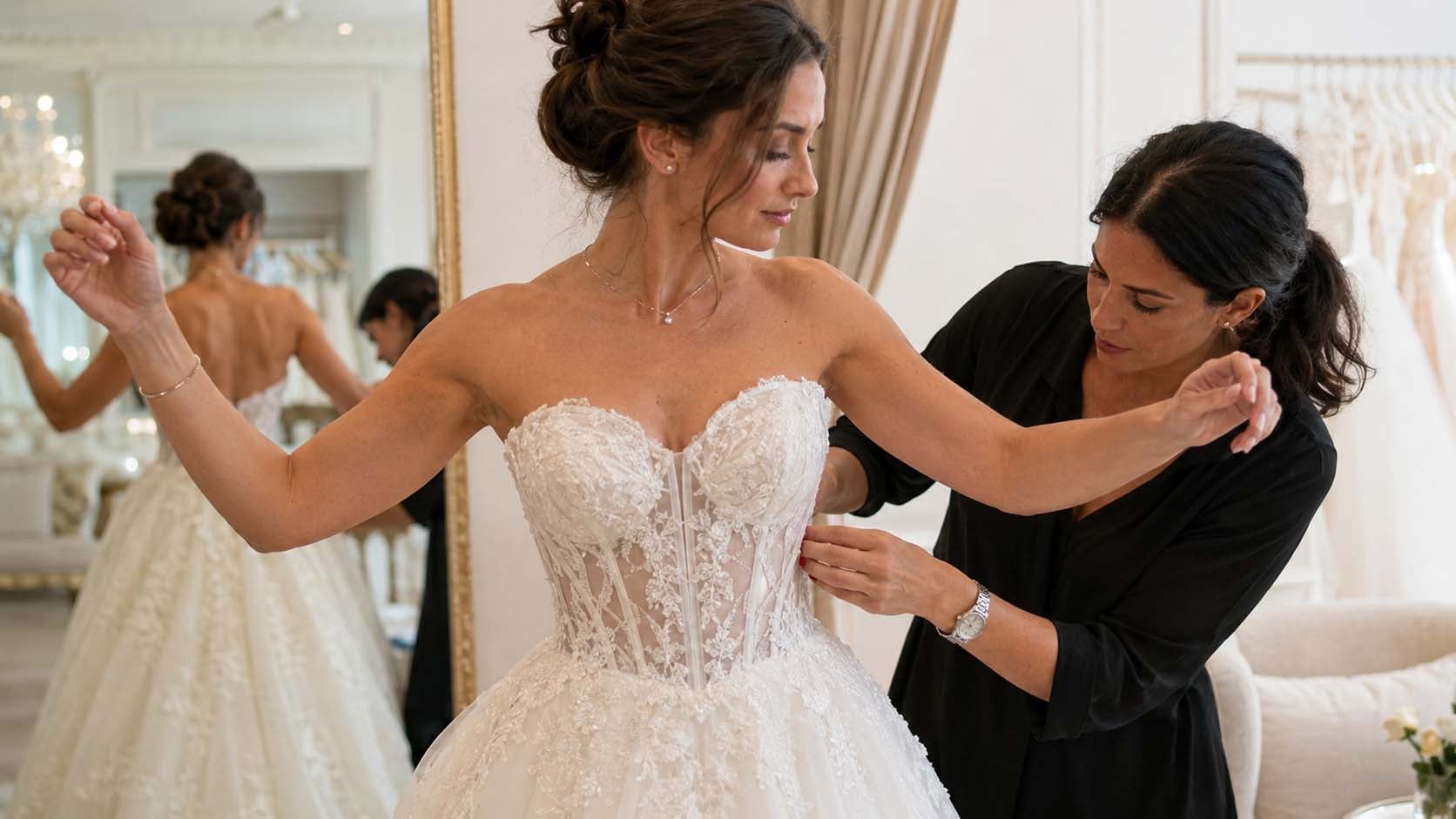
Professional alterations are therefore part of the support conversation, not simply the final cosmetic step. BTG’s wedding dress alterations guide explains why adjusting cups, seams, straps, or the waist can affect the way boning and internal construction behave.
Most importantly, tightness should never be mistaken for good support. A properly fitted gown should feel secure because the construction is doing its job.
Which Is More Comfortable for an All-Day Wedding?
There is no universal winner.
A corset can be extremely comfortable when it fits well and distributes tension appropriately. A non-corset structured bodice can also feel secure and easy to wear for many hours. Problems usually appear when the length, cup position, waist placement, boning, or overall fit does not correspond well with the bride.
This is why comfort should be evaluated in movement.
Standing in front of a mirror is only one part of wearing a wedding dress. You will sit during transportation and dinner, walk through the venue, hug guests, raise your arms, turn through your torso, and probably dance.
A long-line bodice that feels beautiful while standing may create pressure when seated. A soft bodice that feels comfortable for the first few minutes may begin slipping once you start moving.
During a fitting, walk naturally, sit fully, lift your arms, hug someone, rotate gently through your torso, and take a few dance-style steps once the stylist confirms that it is safe to do so.
If the train has already been altered and the bustle is ready, test that as well. A gown can feel very different once the train is secured for the reception.
You should also pay attention to signals from your body. Severe pressure, pain, numbness, pinching, restricted breathing, or significant difficulty moving are not simply signs that a gown is “supportive.” They are reasons to discuss the fit with your bridal stylist or alteration specialist.
How Bodice Construction Changes the Silhouette
The bodice does more than support the upper part of the gown. It also determines where the eye sees the transition between torso and skirt.
A natural waist creates a relatively familiar division between the bodice and skirt. A Basque waist extends below the natural waist in a curved or pointed shape, giving the gown a more elongated and often historically inspired architecture.
A drop waist continues the fitted portion of the gown lower before allowing the skirt to expand. Long-line bodices can create a similar sense of length through the torso.
These waistlines are becoming especially relevant as 2027 bridal fashion continues to explore more architectural shapes.
If you are drawn to an elongated bodice, BTG’s drop-waist wedding dress guide offers a deeper look at how those proportions work.
The skirt matters just as much.
An A-line creates a gradual transition from a fitted bodice into increasing volume. A ball gown produces a more dramatic contrast between the upper and lower portions of the dress. Mermaid and fit-and-flare designs continue shaping farther down the body before opening through the skirt.
Sheath and column gowns can still include considerable internal structure, but the overall silhouette remains more vertical.
There is no single waistline or skirt shape that works for everyone. Torso length, neckline, waist position, skirt volume, fabric, and personal preference all change the final composition.
For brides comparing dramatically different silhouettes, BTG’s mermaid vs. ball gown wedding dress guide is a useful next step.
Why Corsetry Is So Important in 2027 Bridal Fashion
Corsetry is one of the strongest visual themes emerging from the Spring and Summer 2027 bridal collections, but the trend is broader than exposed boning alone.
The Knot’s 2027 bridal-fashion coverage points to long-line corsetry, curved Basque waists, drop-waist hybrids, sculptural strapless necklines, draped bodices, Mikado, dimensional appliqués, and continued interest in minimalist 1990s references. Inside Weddings has similarly highlighted exposed structure, Basque waists, three-dimensional florals, modern simplicity, and convertible bridal elements.
What makes the movement interesting is the way designers are using construction as part of the visual story.
For several seasons, brides have seen corset-inspired bodices with sheer panels and visible cups. In 2027, that idea is evolving. The corset is becoming longer, more architectural, and more closely connected to the waistline.
Basque waists are especially important because they combine historical references with contemporary styling. Instead of appearing costume-like, they are being interpreted through clean fabrics, modern necklines, and streamlined skirts.
Visible boning is also being used more deliberately. Rather than simply exposing what would normally be hidden, designers are treating boning channels as graphic lines that frame the body and guide the eye through the bodice.
At the other end of the spectrum, minimalist gowns remain relevant. Clean Mikado and satin dresses may contain significant hidden internal construction while presenting an almost uninterrupted exterior.
That contrast is part of what makes the 2027 bridal market so interesting. A bride can choose visible architecture or completely concealed engineering and still participate in the broader movement toward stronger, more intentional bodice design.
Another important direction is adaptability. Detachable sleeves, removable overskirts, toppers, and other convertible pieces allow one structured foundation gown to evolve between ceremony and reception.
These trends should be viewed as design directions rather than instructions. A gown does not need exposed boning or a Basque waist to feel modern.
Fabric Changes the Way Structure Looks
The same bodice architecture can feel completely different depending on the material placed over it.
Mikado naturally supports sculptural shapes because the fabric has enough body to hold deliberate folds, curves, and seams. It works particularly well when the design goal is clean architectural luxury.
Satin can move in several directions. A heavier satin can create a polished, sculptural surface, while a more fluid satin softens the overall effect.
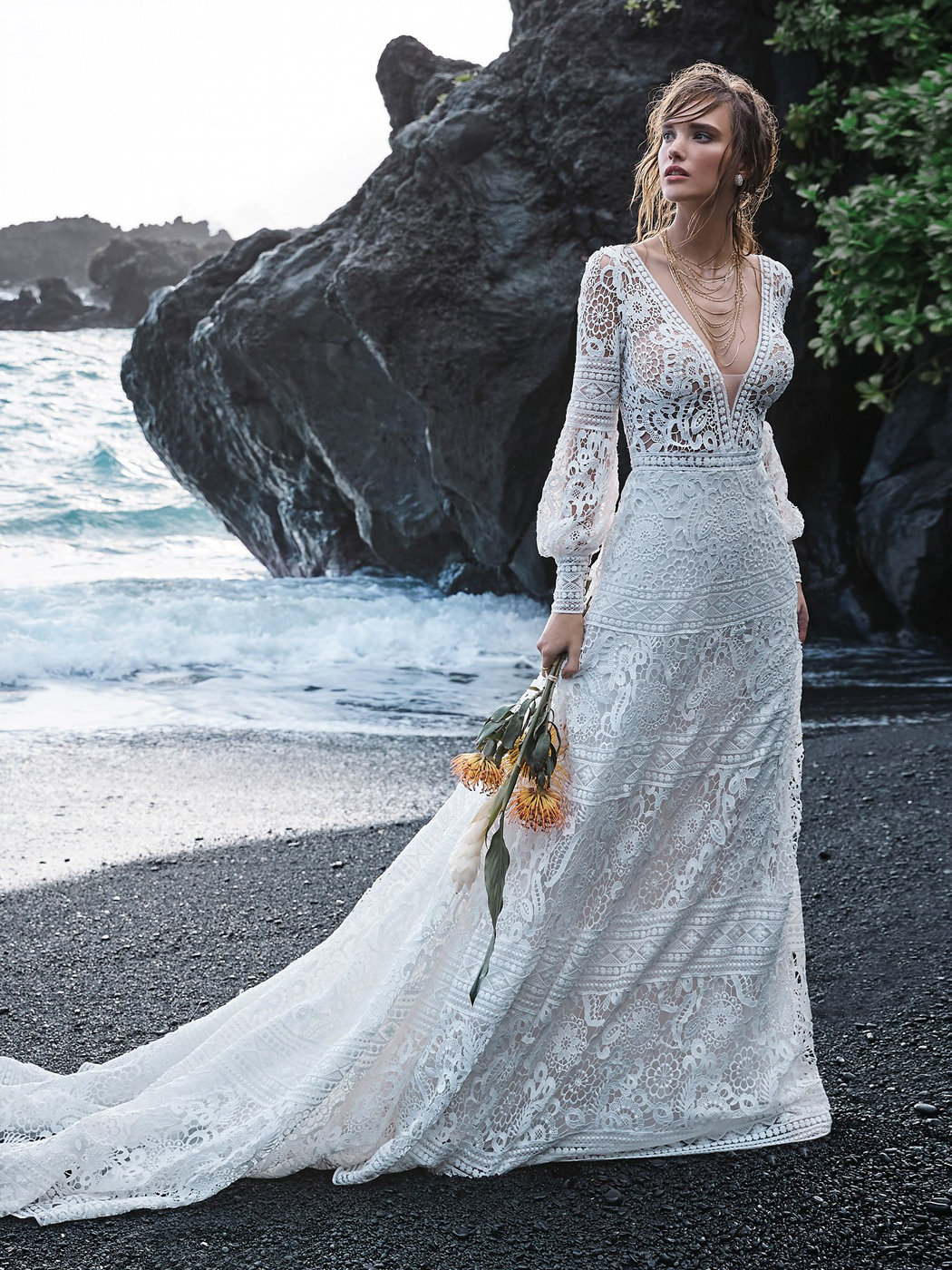
Lace allows structure to become more romantic. It can completely cover the corset foundation or be strategically placed over illusion mesh so parts of the construction remain visible.
Tulle and organza introduce lightness. They can soften the relationship between a strong bodice and a larger skirt or create transparent layers around more structured elements.
Draping offers another interesting contrast. A bodice can be highly engineered underneath while appearing soft and fluid on the surface.
Beading, pearls, dimensional flowers, and appliqué can add visual richness, but luxury bridal design is not defined by decoration alone. Pattern balance, internal finishing, material quality, seam precision, lace placement, and tailoring often matter just as much.
A simple Mikado gown with extraordinary construction can feel every bit as luxurious as a heavily embellished corset dress.
The Lumière by Navid Noor Approach to Structure
For Bridal & Tuxedo Galleria, bodice construction is closely connected to proportion and personalization.
Navid Noor is the owner and head designer of Bridal & Tuxedo Galleria and the designer behind the Lumière by Navid Noor collection. BTG’s official materials describe his bridal experience as extending more than 15 years, with an emphasis on couture-informed design, proportion, construction, and wearability.
Within this design philosophy, the exterior of the gown and its internal foundation are not treated as separate ideas.
A beautiful neckline needs the correct support beneath it. A Basque waist needs to sit in the right position. Lace placement needs to respond to the seams and structure underneath. A dramatic train should feel visually connected to the proportions of the entire gown.
BTG’s own design and construction content notes that certain Lumière gowns may incorporate details such as waist stays, flexible boning, and strategically positioned support panels. That should not be interpreted as a claim that every gown uses exactly the same foundation. Construction varies from design to design.
For brides who want more control over these details, custom wedding dress design in San Diego can create possibilities that are difficult to achieve through standard alterations alone.
A custom consultation may involve discussing the neckline, waist placement, bodice shape, sleeves, lace placement, train, detachable elements, or the relationship between ceremony and reception styling.
This is one of the practical advantages of couture-inspired customization. Instead of asking whether an existing gown can be forced into a completely different shape, the structure can be considered earlier in the design process.
So, Which Bodice Should You Choose?
Start with the visual language you love, then evaluate how it actually feels.
If you are drawn to exposed boning, sheer panels, long-line bodices, sculpted cups, or Basque waists, a corset-inspired design may naturally fit your vision.
If you love smooth satin, architectural Mikado, clean draping, or minimalist gowns where the internal construction disappears completely, a non-corset structured bodice may feel more aligned with your style.
Your preferred closure can also matter. Some brides appreciate the adjustability of certain lace-up designs, while others prefer the cleaner appearance of a zipper, covered buttons, or hook-and-eye closure.
Think about your wedding day as well.
A long ceremony, active reception, outdoor setting, warm season, transportation between venues, or extensive dancing can all influence what feels comfortable.
Customization is another consideration. If your ideal gown combines a particular neckline with a different waistline, detachable sleeves, an overskirt, or personalized lace placement, discussing those goals early may be more useful than choosing a dress based on one feature alone.
There is no reason to decide between “corset” and “structured” before you try the gowns.
The fitting room usually gives you a better answer.
Choosing Bodice Construction for a San Diego Wedding
San Diego weddings range from coastal ceremonies and outdoor gardens to historic estates, luxury resorts, and formal hotel ballrooms.
That variety makes practical fitting especially important.
For an outdoor ceremony, fabric weight and layering deserve attention. A heavily constructed satin bodice will create a different experience from a sheer corset with lightweight tulle, particularly during a warm afternoon.
Coastal celebrations introduce wind, which can affect veils, detachable sleeves, overskirts, and lightweight fabrics more than the bodice itself. A stable upper structure can create a useful foundation when other parts of the bridal look are designed to move.
Indoor ballroom weddings offer a different environment. Heavier Mikado, substantial satin, structured ball gowns, and elaborate corsetry may feel completely appropriate in an air-conditioned interior.
Transportation is often overlooked. If you are considering a long-line corset, Basque waist, or drop waist, make sure you actually sit in the gown before making a final decision.
Your wedding dress also needs to work after the ceremony. Consider how it feels through dinner, photographs, greetings, and dancing rather than judging it only from the front of the fitting-room mirror.
San Diego conditions vary significantly by season, venue, and time of day, so there is no single bodice construction that is “best” for a local wedding.
What to Ask During Your Bridal Appointment
A good bridal appointment should help you understand how the gown is built, not simply whether you like the photograph it creates.
Ask your stylist whether the boning is functional, decorative, or both. Find out whether the gown includes built-in cups, a waist stay, or other internal support. If the dress feels very secure, ask where that support is actually coming from.
You can also ask whether the neckline or waistline can realistically be changed, whether the cups or boning can be repositioned, and whether altering the seams would affect the internal foundation.
If you are considering detachable sleeves or an overskirt, ask how those pieces connect to the bodice and how secure they remain during movement.
Most importantly, ask what alterations are normally required for that particular construction.
A bridal gown is a complete system. The skirt, bodice, neckline, cups, boning, straps, closure, and waistline all influence one another.
Try Both Before You Decide
The most useful conclusion to the corset vs. structured bodice discussion is also the simplest: labels do not reveal enough.
A lace-up gown is not automatically a true corset. A zipper-back gown is not automatically lightly structured. Visible boning does not guarantee more support. A minimalist satin bodice may contain some of the most carefully engineered construction you try.
Photographs cannot show you pressure, stability, movement, or how a long-line bodice feels when you sit.
Your final decision should come from the complete experience of the gown.
Look at the waistline. Notice the neckline. Pay attention to how the cups sit. Walk. Sit. Raise your arms. Think about your venue, your reception, and how you want to feel after several hours in the dress.
The right bodice is the one where construction, proportion, aesthetic, comfort, and movement work together.
Frequently Asked Questions
Is a corset bodice the same as a structured bodice?
A corset is a type of structured bodice, but not every structured bodice is a corset. Structured gowns can use cups, boning, lining, interfacing, reinforced seams, support panels, or a waist stay without having visible or traditional corset construction.
Is a corset wedding dress more supportive?
Not necessarily. Support depends on the construction and fit of the individual gown. Cup placement, boning position, waist anchoring, back height, seams, straps, skirt weight, and alterations can all affect how secure a bodice feels. A correctly fitted structured bodice may feel more supportive than a poorly fitted corset.
Are corset wedding dresses comfortable all day?
They can be. Comfort depends on fit, torso length, boning placement, waist position, fabric, and the bride’s movement throughout the day. It is important to sit, walk, raise your arms, turn, and take a few dance-style steps before deciding.
Can a strapless structured wedding dress stay up?
Yes. A strapless gown can remain stable through properly fitted cups, internal boning, reinforced lining, support panels, waist anchoring, and overall bodice construction. Straps are not the only source of support in a wedding dress.
Do all corset wedding dresses have lace-up backs?
No. Corseted gowns can use lace-up closures, zippers, hook-and-eye systems, or combinations of these. A lace-up closure alone also does not confirm that the gown has functional corset construction.
Can a corset bodice be altered?
Many can, but the possibilities depend on the individual dress. Moving seams can affect boning, cups, lace motifs, illusion panels, and the balance of the entire bodice. A bridal alteration specialist should inspect the gown before confirming major structural changes.
What should I wear under a corset wedding dress?
Many corset and structured wedding dresses already include cups or internal support and may not require a traditional bra. The answer depends on the gown, so it is best to ask your stylist before purchasing undergarments and bring your final choices to your fittings.
Are corset wedding dresses trending for 2027?
Yes. Long-line corsetry, exposed boning, Basque waists, sculpted strapless bodices, sheer panels, and corset-inspired construction are prominent in Spring and Summer 2027 bridal fashion. At the same time, minimalist gowns with hidden structure remain an important direction.
What is the difference between a Basque waist and a corset?
A Basque waist describes where and how the waistline is shaped, usually extending below the natural waist in a curved or pointed form. A corset describes bodice construction. A gown can have both a Basque waist and a corset, but the two terms do not mean the same thing.
Where can I try corset and structured wedding dresses in San Diego?
Brides can compare different bodice constructions at Bridal & Tuxedo Galleria in San Diego. A one-on-one appointment allows you to compare corset-inspired gowns, structured designer dresses, different waistlines, fabrics, and customization possibilities while evaluating each gown in movement.
Find the Bodice That Works With Your Wedding, Not Just the Photograph
Corsetry is shaping some of the most exciting wedding dresses heading into 2027, but visible structure is only one direction.
A beautifully engineered bodice may reveal its construction through exposed boning and a dramatic Basque waist, or it may hide every technical detail beneath a perfectly smooth layer of Mikado.
What matters most is how the gown works as a complete design.
At Bridal & Tuxedo Galleria, brides can explore designer wedding dresses, the Lumière by Navid Noor collection, custom bridal design, and professional alterations while comparing how different bodices actually feel in person.
If you are deciding between a corset wedding dress and a more discreet structured bodice, the best next step is to experience both.
Book Your Private Bridal Appointment
Explore different structures, waistlines, fabrics, and silhouettes with one-on-one guidance at Bridal & Tuxedo Galleria in San Diego.
Interested in a more personalized neckline, bodice, waistline, train, or detachable detail? Explore custom wedding dress design in San Diego.

Author bio :
Kayla brings more than 10 years of hands-on experience in bridal fashion and boutique styling, specializing in personalized bridal consultations and luxury client experiences. As the manager of the San Diego location of Bridal and Tuxedo Galleria, she is known for her keen eye for detail, deep understanding of couture wedding dress design, and ability to guide brides toward a gown that reflects their unique vision and wedding aesthetic. Her approach blends fashion expertise with genuine care, ensuring every bride feels confident, understood, and unforgettable on her wedding day
Call Now

Your Personalized Wedding Dress Shopping Experience in San Diego With over 30 years of styling expertise, our dedicated team is passionate about helping you find the perfect wedding dress and tuxedo.


Leave a Reply